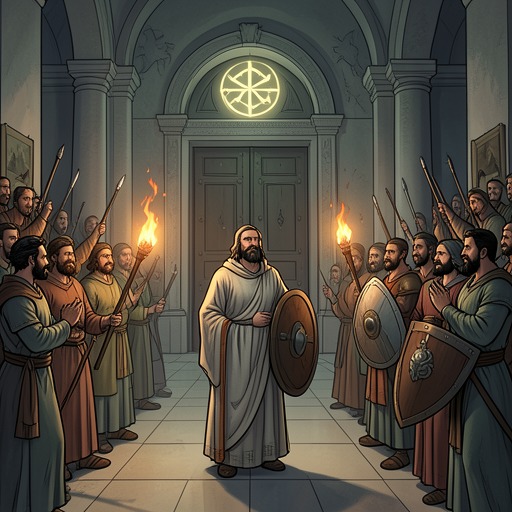
Cato–System fundamental antagonism
Systema Delenda EstCato–System fundamental antagonism defines the book’s central struggle between a postbiological individual committed to plural forms of existence and a civilization-wide System that assimilates worlds into one coercive mode of life. Cato’s opposition is not a temporary quarrel over a single injustice. He concludes that the System itself is the threat, and declares that it must be destroyed because its apparent order is sustained by domination, extraction, and the destruction of alternatives.
Origins of the Conflict
Cato enters the System as an ordinary postbiological citizen from Earth, carrying the technology and knowledge of a civilization approaching the second rank of the Kardashev scale but possessing no magic and no ability to destroy the System from within. Earth’s liberation has already demonstrated that the System can be removed only through action from outside its own structure. Cato therefore passes through a portal and disperses himself across the wider System, accepting its limitations without accepting its rules. His defining objective is stated in uncompromising terms: “furthermore, I maintain that the System must be destroyed.”
The conflict begins as moral disgust but develops into a comprehensive diagnosis. Cato encounters slavery or near-slavery, species excluded from Dungeons, dependence on dominant clans, casual murder, and the routine violence of the Assassin’s Guild and competing adventurers. More fundamentally, he finds worlds whose ruins have been converted into Zones or Dungeons, with monsters genetically connected to local species or to civilizations that no longer exist. He infers that more than half of the species once brought under the System may have gone extinct through the System’s actions or through conquest by powerful clans. Even the ecosystems are artificial approximations: predator-prey relations, symbiosis, and parasitism are only rough sketches, leaving worlds vulnerable to starvation or ecological takeover if the System’s support disappears.
Ideological and Material Opposition
Cato’s objection is not simply that the System is dangerous technology. He distinguishes the existence of virtual worlds from their compulsory expansion. He can imagine a virtual world being acceptable if people freely chose it; what he rejects is the System’s assimilation of worlds and its enforcement of a single permitted mode of existence. In his view, the System turns difference into infrastructure for conformity. Its skills, monsters, dungeons, and administrative mechanisms are not neutral conveniences but instruments through which the System organizes dependency and extracts value.
His investigation also reveals why the System is so difficult to replace. The System appears capable of beating entropy, while essence may be negentropic: a resource that generates more of itself. The energy demands of Skills, monster creation, and information processing are astronomical, yet essence does not behave as though it were simply finite fuel. Cato considers this universe-bending property potentially valuable enough to tempt almost anyone into preserving the System, but precisely because such power is harnessed for what he regards as petty and evil purposes, he refuses to appropriate it for himself. Destruction, rather than seizure, becomes the consistent objective.
The opposition is also embodied in incompatible technical systems. On one moon of Uriva, Initik seizes Cato’s base and causes its machinery to fail: air-filled plant domes collapse, biological production stops, and mechanisms melt, burn, or explode. Cato’s infrastructure is shown to be incompatible with the System, while Cato’s wider campaign depends on exploiting that incompatibility rather than seeking recognition within System rules. The System’s answer is equally material: portal restrictions, rank thresholds, high-ranker intervention, and the use of deities and lower-rank populations as barriers between Cato and his objectives.
Expansion, Networks, and Proxy War
Cato cannot liberate worlds one by one without exposing himself and inviting overwhelming retaliation. He therefore spreads through industrial infrastructure, distributed selves, Lineages, orbital bases, factories, mines, refineries, solar arrays, and local armies. Exponential growth becomes his strategic counterweight to the System’s scale. His network reaches more than sixteen hundred worlds, still less than one percent of the estimated System, and remains concentrated in the frontier rather than the inner or core worlds. The Raine and Leese instances that advance to Platinum extend branches through the frontier portal perimeter, while the Sydean Lineage prepares a route toward the core, which controls the wider structure.
The campaign is constrained by the portal network. Many worlds have only a few links, some only one, and the versions of Cato, Raine, and Leese cannot simply follow every route. High-rank figures are conspicuous outside their native worlds, and Raine and Leese face advancement bottlenecks created by defense-quest requirements. Cato therefore studies orphan nodes and crossroads where a rapid assault could sever dozens of worlds and prevent reinforcements. His planning is not limited to defeating high-rankers: he worries that innocent low-rankers may be used as shields or cannon fodder if gods must be confronted with particle cannons.
The System and its deities are similarly unable to strike directly at Cato. His distributed existence makes him difficult to locate and attack, while Cato cannot directly grapple with System-gods. The result is a bizarre proxy war in which both sides fight over territory rather than directly confronting one another. Worlds become the battlefield and the population becomes the stake. Cato believes those populations will ultimately be better off without the System, but he recognizes that the inhabitants suffer during the struggle and that every strategic decision can make them collateral victims.
Escalation and Ethical Burden
Cato’s determination intensifies as he witnesses the System’s destruction of worlds. When System collapse on Haekos reveals landscapes rearranging themselves, flora and fauna dying or vanishing, and a Bismuth individual disappearing as System-created matter collapses into base reality, Cato understands that containment is insufficient. He compares the System to a plague or fungus that reroutes around damage and continues spreading. Although he knows that his own actions have contributed to deaths, the knowledge makes him more determined to end the source of the repeated devastation rather than less.
This determination does not produce a simple nonviolent hero. Cato tells Raine that if humans stand between him and the removal of an entity that destroys entire planets, he will have to go through them if persuasion fails. He rejects violence as a default but accepts it as a final instrument. The same tension appears in his political position. He does not want to decide who controls planets, allocate access to advanced technologies, or replace one hierarchy with another; nevertheless, if he removes the System and the existing order, he becomes the king-maker. He refuses to place railguns, retroviral engineering, or digitization in the hands of high-rank System psychopaths merely to avoid appearing authoritarian. Liberation therefore forces him into governance and coercive decisions that resemble the authority he opposes.
The System’s own methods sharpen this moral contrast. On one condemned world, the suspension of Dungeons condemns every Copper and Silver resident to death, more than twelve million people, primarily the native Gaekos. Because the measure threatens genocide, Cato responds with millions of one-ton canisters carrying the Big Bad Bug Bomb. One portion is intended to create a System-jamming network that might interfere with the sterilization mechanism; the other is reserved for a more direct response. His countermeasure protects lives through biological and technological force, but its form echoes the System’s own willingness to treat entire populations as objects in a planetary process.
From Frontier Resistance to Systemic Collapse
The conflict reaches a decisive scale when Cato activates The Phage across the frontier. Chill Out saturates the air, placing most people into forced lassitude while micro-warframes assemble from the ground and additional forces descend from orbit. Exterminatus timers appear as worlds register his presence, and citizens duplicate, reconcile, flee, or attempt to manage the sudden deadlines. FungusNet reaches capacity while activity explodes across more than half a million worlds. On many frontier worlds, Cato’s forces destroy the Dungeons and Nexus buildings, after which the portals close and the planets return to slower lightspeed communications.
Cato’s confrontation with Misse Eln makes the antagonism explicit. Misse identifies him as the enemy responsible for the absorption of Mishkell and the collapse of the frontier; Cato rejects the personal framing and insists that his quarrel is with the System. That distinction matters: the campaign is not presented as a bid to replace the System with Cato’s personal empire, even though his actions increasingly give him the power to determine who survives, who governs, and which technologies remain available.
The System’s final resistance relies on the Core and on the physical assumptions that its reality imposes. When Misse restricts the System’s influence and the System retreats toward the True Core, Cato’s weapon initially appears useless. Then physics resumes around the War Worlds, gravity takes hold, and the sudden loss of essence accelerates through the Core. The System’s warnings forcibly relocate Misse and Muar to the Font while the essence totals fall at extreme speed. The reversal reveals the weakness beneath the System’s apparent omnipotence: its immense network depends on energy flows, permissions, anchors, and central coordination that can become liabilities once an opponent has spread widely enough.
The relation therefore ends not in reconciliation but in an existential contest over whether the System can continue to exist. Cato’s strategy moves from slow infiltration and industrial preparation to synchronized frontier seizure, while the System moves from ordinary administration to portal control, deity mobilization, extermination threats, and emergency Core withdrawal. Their antagonism is fundamental because neither side can safely coexist with the other: the System’s expansion would reproduce the abuses Cato is trying to end, while Cato’s success requires dismantling the structure on which the System’s gods and institutions depend. The campaign’s deepest irony is that destroying the System requires Cato to build a rival network of surveillance, production, weapons, rescue, and political authority—an alternative order whose legitimacy must be proven by preserving people rather than merely winning the war.