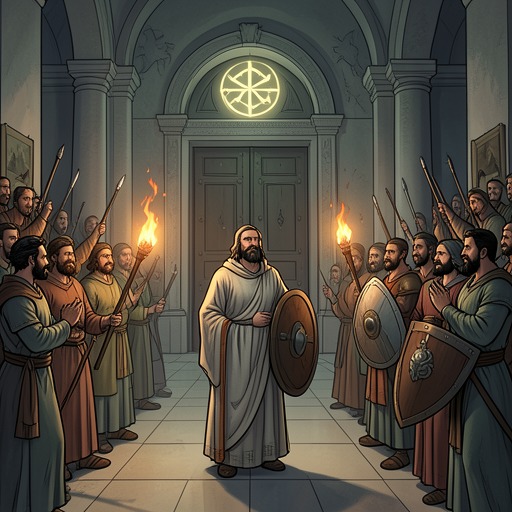
Cato’s Arrival on Sydea
Systema Delenda EstCato’s Arrival on Sydea is the decisive threshold at which Cato’s private opposition to the System becomes an active political and military project. He enters a world he regards as synthetic, restrictive, and destructive, intending not merely to survive within it but to expose its machinery, recruit local allies, and ultimately remove its power over inhabited worlds.
Causes and Background
Cato arrives as an ordinary postbiological citizen of a civilization technologically advanced enough to approach the second rank of the Kardashev scale, but without magic or any native ability to destroy the System from within. His opposition begins with a settled conviction that the System must be destroyed. Earth’s liberation has shown that resistance is possible, yet Sydea presents a different problem: Cato must operate under System limitations while refusing to accept the System’s rules as the measure of reality or legitimacy.
The arrival therefore carries a strategic burden beyond simple travel. Cato’s movement through the portal is tied to the crisis created by the large number of outworlders on Sydea, particularly four Bismuth-rank figures whom local forces cannot handle. He needs Sydean assistance to pass whatever checkpoint has been established, but excessive activity could alarm the authorities and cause the portal to be closed, leaving him stranded. His first task is consequently one of controlled visibility: he must become influential without appearing so dangerous that Sydea’s institutions destroy their own connection to the wider System.
What Happens
Cato establishes himself through distributed bodies, warframes, factories, scouts, and orbital infrastructure rather than through a single conventional human presence. Fabrication is easy for him because machines behave consistently, whereas negotiation with people remains difficult even after extensive experience. When Onswa explains the corporeal needs of his people, Cato responds by setting factories to produce facilities for bringing resources to the surface. Bioprinted walls, floors, and furniture can be made with little adjustment to System restrictions, making material relief an immediate and practical form of diplomacy.
His ideological confrontation with Sydea’s high-rankers is equally important. Cato rejects the claim that the System is unreal; he insists that it is entirely real, but synthetic and hostile. In his account, the System prevents genuine civilizations from flourishing, takes over existing societies, twists them into parodies, and confines life to one narrow avenue. His own body feels unnatural because it has been designed to resist System takeover, and the local plants’ aversion to him becomes an unintended sign of that resistance. The encounter makes clear that Cato is not offering a familiar religion or a rival supernatural doctrine. He is presenting an external technological and civilizational alternative to a power the Sydeans can see and experience every day.
Cato also makes the System’s coercive structure legible to those caught inside it. When accused of ruining Sydea through violence, quests, outworlders, and punitive essence prices, he redirects responsibility to the System: it is the System that brings outsiders in, assigns the quest, extorts essence, and tries to kill the inhabitants. His description of their predicament as a game they cannot win culminates in his declared intention to overturn the board. The arrival thus becomes an act of political reframing: Sydea’s people are not merely failing within a fair system, but are being compelled to participate in an unwinnable structure.
Strategic Expansion
The immediate Sydean intervention grows into a method for planetary and interplanetary expansion. Cato multiplies himself across worlds and builds industrial capacity locally because portals cannot move large forces reliably. Factories, mines, refineries, atmospheric extraction, frozen-volatiles processing, and vast solar-panel fields create a decentralized war economy. Weapons and warframes occupy only a fraction of each world’s production, but exponential growth makes even that fraction immense after years of accumulation.
This distributed structure gives the arrival on Sydea consequences far beyond the initial meeting. When Initik later seizes Uriva’s moons, three of Cato’s bases are found there: a hollowed cavern filled with machinery, air-filled domes containing plants, biological production systems generating Cato-beasts, and orbital weapons aimed toward the planet. The System’s seizure renders the facilities inert, with machinery melting, burning, or exploding, confirming that Cato’s technology is incompatible with System control. Yet the destruction of those bases does not end his campaign, because he has spread through other worlds by unknown means.
Resistance and Moral Stakes
Cato’s strategy is presented as defensive in purpose but coercive in execution. He wants to preserve as many people and things as possible, yet he admits that other humans may stand between him and the System. If persuasion and the threat of severing enough of the System fail, he will fight those who place weapons in his path. The distinction between liberator and conqueror therefore remains unstable from the moment he reaches Sydea.
That instability becomes concrete when the System condemns more than twelve million Copper- and Silver-rank inhabitants of a world, most of them Gaekos, to death through exterminatus. Cato answers with millions of one-ton canisters containing the Big Bad Bug Bomb. One half is intended to create a System-jamming network that might disrupt the sterilization mechanism; the other half is reserved for a different response. His attempt to save a population uses biological force on a planetary scale, creating an ethical parallel between his countermeasures and the System’s own destructive interventions.
Cato’s political responsibility expands with his military reach. He does not want to decide who governs planets or who receives access to advanced tools, but he recognizes that removing the System and the existing hierarchy leaves him responsible for constructing a replacement. He becomes, in his own practical assessment, a king-maker, unable to hand railguns, retroviral engineering, or digitization technology to high-rank actors who might abuse them. He offers independent gods a route out of the System, while warning that base reality demands different kinds of effort and contains no promise of effortless superiority.
Consequences and Significance
The arrival’s long-term consequence is the transformation of Cato from an infiltrator seeking passage into the center of a civilization-scale counter-system. His growth is initially slow, but exponential expansion eventually carries his influence across hundreds of worlds and then across the frontier. When the frontier offensive begins, Cato activates The Phage to place most inhabitants into forced lassitude while micro-warframes assemble from the ground and additional forces descend from the sky. The attack demonstrates the full evolution of the method first tested on Sydea: distributed technology, biological disruption, rapid occupation, and the preservation or evacuation of populations under extreme time pressure.
The event also remains connected to the System’s own hierarchy. System elders consider countermeasures such as imposing minimum portal thresholds on Cato’s Copper creatures and seeking intelligence from World Deity Eis, patron of other Ahrusk beings. Their response confirms that Cato’s arrival has changed the strategic scale of the conflict: he is no longer a local nuisance but a threat requiring access to the System’s deepest powers.
Cato’s later confrontation with Misse Eln condenses the political meaning of his Sydean arrival. Misse attributes the collapse of the frontier and the absorption of Mishkell to Cato’s actions, while Cato insists that his quarrel is with the System rather than with every individual power-holder. Even so, the collapse of the frontier and the dangerous physics of the War Worlds show how resistance to one ruling structure can destabilize the entire order around it. Cato’s arrival is therefore both liberationist beginning and systemic tipping point: the first step in a campaign intended to preserve people from the System, and the opening move in a chain of interventions capable of remaking worlds through force, technology, and political choice.