Cato’s Expansion Across the System Worlds
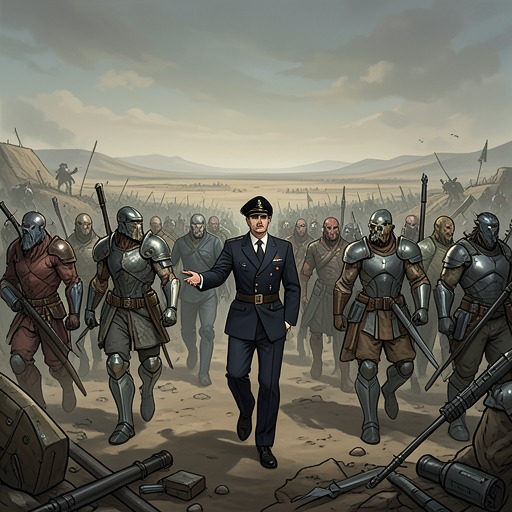
Systema Delenda EstCato’s Expansion Across the System Worlds is the strategic process by which Cato turns a single counter-invasion into a distributed presence across the System. Its decisive principle is not the rapid movement of armies through portals, which the System’s technological restrictions make difficult, but the creation of local industry, communication, biological agents, and war-making capacity on every world reached. What begins as patient construction in remote industrial spaces eventually becomes a network large enough to spread Cato’s influence to hundreds of worlds and help drive the frontier toward collapse.
Strategic Premise and Early Constraints
Cato’s expansion develops under two opposing conditions. The System has already been disrupted and destroyed on Earth, but it remains active elsewhere, and its imposed physics renders most technology more complex than gears nonfunctional. Even the warframe’s System interface is based on a blank brain integrated into the crown of its cranium, while the rest of the frame is protected from the System’s intrusion. Cato therefore has to fight inside a reality that suppresses conventional electronics, armor, and firearms while still using the System’s own portals and quest infrastructure to move through the worlds.
The campaign’s earliest material base is correspondingly improvised. On a moon, Cato shelters in a crater while drones mine silicates, carbides, volatiles, and metals from the regolith. A rudimentary solar array supplies electricity, and a hacked-together manufactory processes the gathered materials; bio-fusion is insufficiently scalable and cannot efficiently charge batteries without infrastructure he does not yet possess. This is the campaign’s characteristic rhythm: expansion begins slowly, with local resources and deliberately limited production, but every new foothold creates the conditions for another.
Biological Infrastructure and Communication
Because the System forbids advanced technology, Cato explores the boundary of what can count as organic. His own body is grown from engineered genetics in an industrial orbital womb, with cells that fuse deuterium and organs that operate more like machinery than natural anatomy. The same logic allows the campaign to substitute living systems for prohibited devices. Cato uses radio lizards and later develops plant-based communication, allowing him to maintain contact with Raine and Leese without openly exposing his network to the System.
The biological factories on the moon embody this technological strategy. They draw electricity into chemical foundries that produce acids and proteins from carbon, hydrogen, nitrogen, and phosphorus; solar energy supports computronium, which calculates the chemical and topographical requirements of tailored organisms; and micro-laboratories grow tissue samples under simulated environments before collecting the resulting data. Cato is not merely manufacturing weapons. He is manufacturing the biological tools that make distributed coordination possible under System restrictions.
The care packages sent to the Sydean Lineage demonstrate the practical and ethical dimensions of this work. Cato launches capelets along with plants and supplements, intending both to extend his communication network and to help the Lineage biology integrate with them. The capelets are designed to use direct nerve induction rather than microwaves, and their damaged tissue can regrow over time, although they require water and sugar and remain less effective when badly damaged. Cato admits that custom creatures are difficult to build, but regards the effort as an obligation to the people depending on them. His expansion therefore treats communication and survival as linked infrastructure rather than separate military conveniences.
From Footholds to a Distributed Campaign
The Sydean Lineage functions as a major propagation mechanism. Once Raine and Leese reach Platinum, they can launch heavier payloads farther, reducing the time required to establish additional footholds. Cato is already spread across twenty worlds when he decides that his immediate objective is to extend as far and as fast as possible, while preparing an invasion force for every planet in case a local crisis demands intervention. The communication network remains imperfect: the radio plants eventually reach their limits, and even simple text messages strain the available bandwidth. Cato considers replacing them with a large tree or another organism capable of handling greater power and communication capacity, relying on biological growth to solve the problem over time.
The campaign also has to account for worlds that cannot be reached by the same method. Two worlds lack moons, preventing Cato from using his usual orbital presence and forcing him to postpone their occupation while he searches for an alternative invasion plan. He refuses to abandon them merely because they are inconvenient, in part because he rejects the idea that variant selves are expendable backups. Each variant is a complete person, and that conviction places a moral limit on the otherwise relentless logic of expansion.
The campaign’s distributed structure becomes especially important on Uriva. After the System-god there proves more active than expected and Initik removes Raine and Leese from the immediate theater, Cato’s versions on different worlds must work with partial information and limited bandwidth. Cato-Ikent recognizes that rescuing the sisters from Uriva must be the responsibility of the local Cato, which possesses their gestalts and the industrial base needed to act. The expansion is thus not a single centrally directed army but a collection of related instances, factories, Lineages, and communication systems that must preserve common objectives despite isolation.
Industrialization and Systemic Escalation
The decisive change comes when exponential growth finally becomes visible at planetary scale. After years of work by many Lineages, Cato has spread to hundreds of worlds, and each has undergone full-tilt industrialization. Factories, mines, and refineries draw material from local environments; gas-giant atmospheres are siphoned, frozen volatiles are cracked on icy asteroids, and vast areas of solar panels provide energy. Each world builds its own armies and warframes because portals cannot move meaningful forces between worlds, turning local self-sufficiency from a limitation into the foundation of Cato’s strategy.
Only a fraction of each production base is devoted directly to weapons and warframes, while a larger portion is designed to be rapidly retooled between civilian and military purposes. After the warning from Koh-rel, that conversion begins across the network. The proportions may appear small, but years of accumulation make them enormous in absolute terms. Cato’s power no longer depends on one hidden base or one decisive weapon; it resides in the synchronized potential of hundreds of industrial systems.
This growth changes the meaning of the conflict for the System. Earlier, Cato could be dismissed as a dangerous actor on a border world. Later, his presence becomes a system-wide strategic fact. He recognizes that orbital infrastructure can handle anyone below Bismuth, while even Bismuth opponents can be removed when collateral damage is acceptable, though inhabited areas and Bismuth dungeons remain difficult problems. His expansion therefore combines deterrence, preparation, and the threat of selective bombardment, while leaving unresolved the question of how to attack dungeons whose basement-universe nature makes them effectively immune to orbital fire.
Opposition, Feedback, and Consequences
Cato’s spread provokes counter-mobilization. Muar receives a Crusade quest described as the divine equivalent of a Grand Quest, one whose scope may continue expanding until Alum or beyond. Because Uriva has been severed from the System and Muar has personally witnessed what Cato can do, he concludes that he has the necessary investment to pursue the Crusade. He leaves Uriva through the Nexus, intending to warn and prepare worlds deeper toward the core, teach them to recognize signs of Cato’s presence and mortal agents, and ensure that they can defend themselves even if they cannot stop his expansion.
The campaign also exposes the System’s behavioral power. Cato observes that quests are not merely suggestions: their goals are written into System reality, and following them becomes the path of least resistance. Rewards make completion feel good, including the euphoric rush Cato experiences when the System grants essence after a kill and promotes him to High Copper. He sees this pleasure as one of the mechanisms that creates murderous high-rank psychopaths. The Crusade functions as an even larger attractor, drawing people away from their worlds and toward a common campaign against him. Cato recognizes that this response is partly his responsibility, since the System is defending itself against the pressure his expansion creates, even though the defense remains horrific.
By the time Misse Eln consolidates power, absorbs Mishkell, and presides over the collapse of the frontier, Cato’s expansion has become one of the central causes of the System’s political transformation. Misse tells Cato that these actions would not have been necessary if he were not the enemy; Cato answers that his quarrel is with the System rather than with her personally. The exchange reveals the campaign’s political ambiguity: Cato presents himself as an enemy of a corrupt structure, while the defenders of that structure experience the expansion as an existential assault regardless of his stated target.
The final escalation reaches the War Worlds, where Misse restricts the System’s influence and causes its essence drain to stop. As the System pulls back toward the True Core, ordinary physics resumes: a hundred suns that had been held apart are suddenly close enough for gravity to take hold. Soon afterward, the core region becomes an unreadable white fury while essence totals fall rapidly. Cato’s campaign has therefore moved beyond territorial acquisition. Its distributed industrial pressure, political reaction, and eventual confrontation with the System help produce a cascade in which the architecture of System reality itself begins to fail.