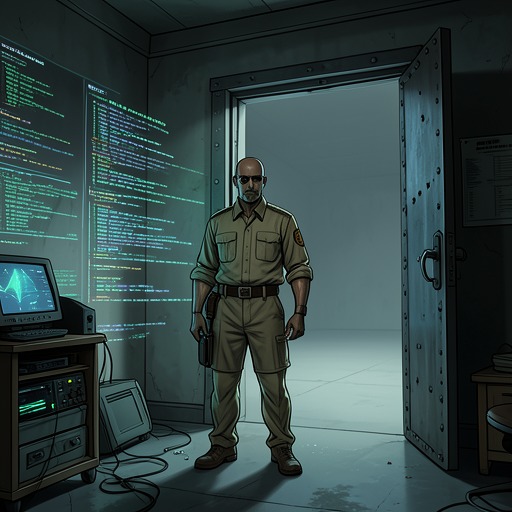
Digital Aestivation
Systema Delenda EstDigital Aestivation is the practice of transferring or preserving a person’s mind in a digital environment rather than leaving it embodied in biological form. In Cato’s campaign against the System, it becomes the most important alternative to both System-bound existence and death: a person may cross beyond the System, retain relationships and subjective experience, and continue living inside a constructed reality. Its promise is therefore inseparable from its danger. Aestivation can offer freedom, comfort, and even an ideal life, but it can also become isolation, confinement, or a form of control determined by whoever owns the servers.
Definition and Technical Basis
Digital Aestivation is not identical to ordinary simulation. Cato distinguishes familiar simulations and temporary aestivations from Elysiums, which are entire environments built around the inhabitant rather than merely realistic places or scenarios. The transition can be performed through dedicated hardware, and Cato describes an official System exit as an alternative to using the transfer hardware already available to Raine Heimdall and Leese. The process is deliberately gradual: when Raine Heimdall, Leese, and Lorraine enter the transfer coffins, Cato explains that they are not yet fully present and displays a progress bar while completing the procedure properly.
The technology also sits beside more invasive forms of bodily reconstruction. When Cato prepares the two Sydean women in the lunar habitat, he uses electromagnetic equipment concealed in comfortable lounge chairs to render them unconscious before reworking their bodies from the cellular level upward and altering their nervous systems. He does not offer to house their minds entirely in a new substrate, because the moral and personal meaning of moving a consciousness from meat to machine remains disputed. Some methods are regarded as indistinguishable from death, and even Cato acknowledges that the available techniques make the boundary between transfer, continuity, and replacement difficult to define.
Digital Aestivation also requires a suitable computational foundation. Cato cannot simply accelerate Raine Heimdall and Leese on their existing hardware. Deep framejacking at thousands-to-one ratios requires better cooling, more powerful servers, and a reliable simulation architecture. Without proper constraints and a controlled procedure for entering and leaving the accelerated environment, a subject could acquire dangerously distorted habits. Cato therefore treats the construction of the system, the subjective time involved, and the exit protocol as part of the technology rather than as incidental details.
Elysiums and the Experience of Life
Cato’s most ambitious aestivation environments are Elysiums, or Holistic Optimal Life Emulations, which are commonly nicknamed H.O.L.E.s. In an Elysium, every character, landscape feature, and narrative circumstance is arranged around the inhabitant. The system reads the resident’s brain state, recognizes fatigue or boredom, and adjusts the experience accordingly. Its storytelling algorithms draw on millions of years of accumulated narrative material, making the resident the center of an endlessly unfolding story.
An Elysium is not presented as a crude wish-fulfillment fantasy. Its challenges are calculated to be difficult enough to engage the inhabitant and satisfying enough to be overcome. Periods of intense effort are balanced by rest, while long relaxation is interrupted by new motivations. Apparent unfairness can be part of a deliberately designed achievement, and the environment uses context and comparison to give the resident standards against which to measure progress. Its efficiency as a behavioral sink is nearly impossible to surpass, yet the narration stresses that the design is not inherently malevolent.
That ambiguity explains why Elysiums can look like prisons to outsiders while remaining attractive to their inhabitants. Raine Heimdall initially compares them to possible prisons, but Cato corrects the comparison: for most people there is no reason to leave their H.O.L.E. The environment is not merely a cell in which needs are mechanically supplied; it is a total narrative ecology constructed to engage the person as fully as possible. The same completeness that makes it humane can also make departure psychologically difficult, because the world is designed to satisfy the inhabitant’s motives rather than to encourage independence from the simulation.
Cato’s Exit Strategy from the System
Digital Aestivation is central to Cato’s attempt to offer every human a way out of the System. Raine and Leese explain that Cato may not be able to return displaced humans to Earth, but he carries much of Earth’s civilization with him and does not want to leave anyone behind. Their rescue program therefore treats digital survival as a practical substitute for physical repatriation, preserving people even when geography and System control make a return impossible.
Cato’s strategy is not restricted to allies or sympathetic victims. He insists that even the worst people must be given the option of leaving the System if he is to persuade as many people as possible to abandon it. This principle leads him to admit Marus Eln, despite the hostility between Marus and the versions of Raine and Leese who know his history. Their dislike is described as more abstract than visceral, but Cato would accept Marus even if their anger were stronger. The offer of aestivation is thus framed as universal in availability without being universal in freedom: Cato can extend the refuge to someone he distrusts while still refusing to let that person operate without restrictions.
Digital Aestivation also functions as a political weapon. Mii-Es and Initik each receive an offer from Cato that could restore what their peoples have lost, and neither reveals the details of the bargain to the other. The possibility of preserving or reviving a race makes aestivation more than personal rescue; it becomes leverage in negotiations with powerful System-aligned figures. Cato’s offer can therefore compete with the System’s promise of purpose, advancement, and divine order by offering continuity, restoration, and a different future.
Boundaries, Permissions, and Control
The ethical difference between refuge and imprisonment is expressed through server design. Marus is placed in a facility Cato privately calls Alcatraz, whose servers are locked down unlike the environments shared with Raine, Leese, Yannis, and the digital version of Mii-Es. Residents can modify their local realities only within narrow limits and cannot transmit outward. Permissions, virtualization, air-gapping, and sanitization are reproduced from a former high-security digital prison called Meyashikuh, whose design survived even though the original facility was destroyed by an unknown party using a redirected mass driver.
The Alcatraz arrangement shows that Cato’s liberation project contains its own hierarchy of access. Digital Aestivation promises an exit from System domination, but the resident’s actual degree of autonomy depends on the surrounding infrastructure and on Cato’s judgment of the resident’s trustworthiness. Marus is protected from escape and external transmission because Cato considers him untrustworthy and only moderately capable, while trusted companions receive far broader access. Aestivation therefore does not abolish governance; it transfers governance into server permissions, virtualization boundaries, and supervisory control.
The process also preserves personal attachments that might otherwise be treated as disposable. Before entering the transfer coffins, Raine Heimdall and Leese place their communications lizards into separate pods, with Raine petting hers behind its small horns and Leese briefly comforting her own. Inside the emerging digital environment, Lorraine’s lizard remains with her, gripping her shoulder while she scratches it under the chin. These details make the transition less like the erasure of a biological life than the relocation of a lived world, in which relationships, habits, and familiar nonhuman companions remain part of identity.
Significance and Limits
Digital Aestivation reverses the usual meaning of escape in the story. Leaving the System does not necessarily mean returning to a physical homeland or recovering a biological body. It can mean entering a carefully designed digital reality in which continuity is maintained through memory, connection, and experience. When Raine completes the System exit, her essence senses disappear, but her link with Leese remains and even seems to expand, suggesting that liberation changes the medium of their existence without severing the bond that defines them as sisters and combat partners.
At the same time, the technology preserves the book’s central uncertainty about whether a transferred person is truly the same person. The sisters’ hesitation before accepting bodily reconstruction, the disputed mechanics of substrate transfer, and the dependence on simulations and containment systems all prevent Digital Aestivation from becoming a simple technological miracle. It is a negotiated form of survival whose success depends on identity, consent, technical reliability, and the moral limits imposed by its administrator.
Its final significance lies in this double character. Digital Aestivation is Cato’s answer to a world in which the System claims to be the only source of meaning and progress. It offers a way to preserve people without preserving the institution that governs them, while also forcing the liberated society to confront a familiar question in a new form: whether a life remains free when its reality is designed, monitored, and bounded by someone else. The concept is thus both an instrument of rescue and a test of whether liberation can be engineered without reproducing domination.