Dungeon Anchor Rule
Systema Delenda EstThe Dungeon Anchor Rule is the principle that major System dungeons physically anchor the System to the worlds in which they appear. A dungeon is consequently both a killing ground and an infrastructure node: its monsters, quests, rewards, and simulated environments conceal a deeper function in the maintenance of System reality. Cato’s destruction of a dungeon anchor on Sydea demonstrates the rule’s decisive importance, turning an apparently localized delve into an act of planetary sabotage.
Definition and Function
The rule emerges from Cato’s understanding of the dungeons scattered across Sydea. The planetary map listed more than fifty known dungeons, alongside cities, conflict zones, mines, quarries, and farming areas, although it covered only a fraction of the planet. Cato recognized that these were not isolated recreational or military spaces. Like other major System creations, they served to anchor the System to the world itself. His experience during the Earth campaign had shown that destroying such anchors disrupted System operations in the surrounding area for a period of time.
That disruption made dungeon anchors strategically valuable. Cato needed interruptions in the System’s coverage because Sydea’s zones were small and their boundaries narrow. Without a local disturbance, crossing from one zone to another would expose his position immediately. Destroying an anchor could therefore create operational concealment as well as weaken the System’s local control. The rule converts the System’s own geography into a vulnerability: the more extensively the System relies on dungeons, the more physical points it provides for an attacker to target.
The rule also clarifies why dungeon architecture is so difficult to treat as ordinary geography. Dungeon entrances are physical, but their deeper levels appear to occupy a basement universe or pocket dimension. Their labyrinthine passages connect spaces that simulate distinct biomes, while the dungeon’s anchor exists as a physical crystal embedded at the bottom of that deeper reality. Cato suspected that this dimensional disjunction was the principal mechanism by which dungeons tied the System to Sydea, although he acknowledged that other experts had proposed competing explanations.
Operation in Cato’s Sydean Expedition
Cato entered a dungeon located in a lake at the end of a deep canyon, rated for upper Silver and lower Gold ranks. That rating represented a major increase over the immature dungeons known from Earth, which had been removed before they could develop even low Silver-level challenges. Cato was not seeking personal advancement or a conventional reward. He entered specifically to remove the anchor, accepting the danger that a live System quest might reveal his exact location to anyone monitoring it.
The dungeon’s creatures and environments functioned as obstacles around the real objective. A large elemental appeared as a mobile blizzard, but its speed was insufficient to threaten the warframe, and Cato crushed its central core. In flooded canal tunnels, eel-like creatures attacked with electricity; the warframe’s superconducting construction and insulation made that assault nearly irrelevant. On the final floor, acoustic mapping located both a huge serpent in a deep pool and the dungeon’s actual core.
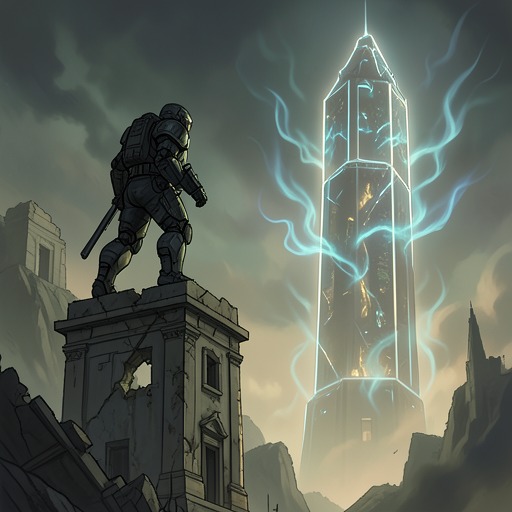
The anchor was not an abstract status or invisible field. It was a tangible crystalline object embedded in the stone at the bottom of the dungeon’s basement universe. Cato fought through the serpent, reached the pool, and seized the crystal in one massive paw. The crystal was responsible for the dungeon’s monsters and environments, making it a remarkable piece of System machinery, but Cato regarded it as a component of the system he was trying to dismantle. His graphene-, boron-, and exotic-protein-reinforced muscles crushed it into powder.
Collapse of the Anchored Space
The anchor’s destruction caused more than a temporary loss of dungeon services. The instant the crystal shattered, the basement universe began to collapse. Essence thickened the atmosphere, water evaporated into nothingness, the ground trembled and cracked, and the physical dimensions of the level contracted. Stone bulged and bubbled like molten glass, while sections of the dungeon distorted as though viewed through a shifting lens.
The collapse proceeded upward through the dungeon’s levels. Columns hung in the air and twisted; ice skated across surfaces, hissed as if exposed to extreme heat, and then stopped against invisible barriers. Higher passages stretched and swayed according to Cato’s acoustic mapping, as though the whole structure had been drawn across a deflating sphere. The pocket dimension did not simply become inaccessible. It was being erased as a functioning reality behind him.
Cato escaped by racing up the final staircase and emerging beneath Sydea’s twin suns. The sequence establishes the Dungeon Anchor Rule as a physical chain of dependence: dungeon monsters depend on the dungeon core, the dungeon space depends on the anchor, and the System’s local presence depends on the continued existence of that anchored structure. The dungeon’s destruction is therefore simultaneously a tactical victory, a dimensional collapse, and an assault on System territorial control.
Wider Consequences and System Vulnerability
The dungeon rule belongs to a larger pattern in which System infrastructure can be weakened by attacking its material supports. The System interface used in Cato’s warframe was itself localized in a vulnerable blank brain that the System had integrated, while System maps, communication devices, portals, city anchors, and planetary Nexuses all depended on forms of System support. The dungeon anchor is one expression of that broader infrastructure: a supposedly magical feature becomes a physical dependency that can be located, entered, and destroyed.
The consequences of removing anchors extend beyond the dungeon itself. When Cato later destroyed a city anchor on Sydea after extracting the System Interface from a gem in Onswa’s office, every other town appeared to lose power or essence. Lights went out, stores shut down, and ordinary physics, biology, and ecology began spreading into regions that had previously depended on System support. Mountains crumbled or vanished, lakes became muddy plains, storms appeared and disappeared, and alien forests withered. Although that later collapse involved a city anchor and ultimately the planetary Nexus rather than only a dungeon anchor, it confirms the same governing logic: System reality is sustained by physical nodes, and removing them produces cascading regional effects.
The rule also explains why System collapse creates ecological danger rather than a clean return to nature. On Heyk, the fall of System support caused massive flora die-offs, lowered oxygen levels, and left alien biomatter without native bacteria capable of decomposing it. On Haekos, Cato and his allies anticipated ecosystem collapse severe enough to threaten even the organisms responsible for producing breathable oxygen. The destruction of an anchor is thus not automatically liberation without cost. It breaks an imposed reality, but the resulting transition can damage atmospheres, landscapes, food systems, and biological cycles before reconstruction begins.
Narrative and Political Significance
As a rule of the setting, the Dungeon Anchor Rule gives the conflict between Cato and the System a concrete material logic. Cato does not defeat the System only by overpowering its champions or persuading its inhabitants. He studies the points at which its reality is maintained, then attacks those points with engineered bodies, manufactured tools, communications networks, and industrial planning. The dungeon becomes a miniature version of the System itself: elaborate, seemingly self-contained, and full of deadly spectacle, yet dependent on a core that can be physically shattered.
The rule also contrasts Cato’s infrastructure-based strategy with the System’s administrative order. System authorities distribute quests, rank recommendations, rewards, and planetary privileges, but their control ultimately rests on mechanisms that can fail. Onswa’s final efforts to spend remaining essence and create incentives before his planetary authority was suspended reveal how much governance depends on the resource and notification systems maintained by the System. Meanwhile, the Inner Worlds and frontier remain politically valuable precisely because the System treats worlds as administrable assets, while Cato’s attacks reveal that those assets are connected by vulnerable infrastructure.
The Dungeon Anchor Rule therefore makes dungeon destruction a recurring emblem of systemic change. A dungeon is built to teach ordinary people to kill, and Cato remembers how those spaces transformed his cousins into willing servants of the System’s violence. By destroying the anchor at the heart of one such space, he attacks both the machinery that sustains System domination and the symbolic structure that turns killing into a social order. The dungeon’s pocket universe folding behind him is not merely an escape sequence; it is a visible demonstration that the System’s apparently permanent reality can be made to collapse from within.