Elysium
Systema Delenda EstElysium is the book’s most complete answer to the problem of freedom after the System: a self-contained simulated world in which an inhabitant can live, act, struggle, rest, and pursue meaning without remaining subject to System control. Unlike an ordinary aestivation, it does not merely preserve an independent virtual environment for a visitor to manipulate. It reshapes the environment around the inhabitant, making that person the center of an adaptive narrative. Its liberation is therefore double-edged. Elysium offers escape from coercion and degradation, yet the same capacity to satisfy, guide, and absorb its resident can turn freedom into a life so complete that leaving no longer seems necessary.
Definition and Construction
Elysium is a high-fidelity emulation built from advanced computational infrastructure. Cato explains that a conventional aestivation remains fundamentally separate from its user: even when the user can alter it, the simulated reality exists on its own and requires deliberate intervention. Elysium works differently. Every character, landscape, object, and event is arranged around the resident, whose brain state can be read by the system managing the simulation. The environment can detect fatigue or boredom and adjust the experience accordingly, using algorithms that approach true artificial intelligence and draw on millions of years of storytelling.
The name is also connected to H.O.L.E., the euphemistically titled Holistic Optimal Life Emulation. Among postbiological beings, such constructs are not held in especially high regard because entering one is closely associated with death, and anyone who lives long enough is likely to end up in one. Yet the narrative makes clear that this cultural suspicion understates what Elysium provides. It is not simply a storage space for a dying mind or a decorative virtual afterlife. It is a responsive story engine, a complete environment whose structure is built around the cognitive and emotional needs of the person inside it.
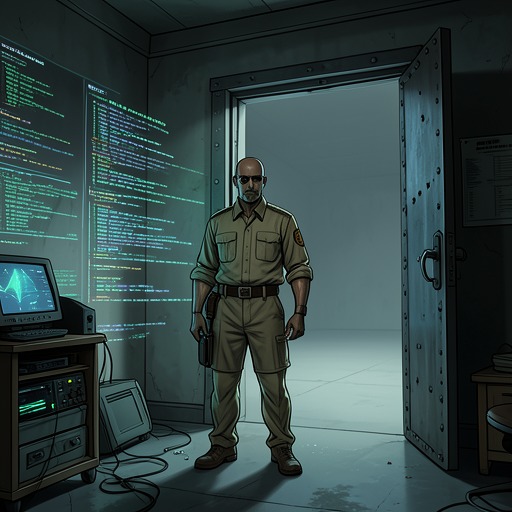
Cato’s discussion of Elysium occurs while he begins constructing hundreds of high-powered servers. The hardware is not an incidental prop: the servers make the promised refuge materially possible, while the scale of the construction signals that Elysium is intended for many residents rather than a single privileged individual. The project extends the book’s recurring contrast between slow beginnings and explosive growth. Early industrial expansion can be painfully limited by available mass, power, and infrastructure, but once the necessary production base exists, systems capable of supporting entire populations can be assembled at a radically greater scale.
The Adaptive Story World
An Elysium makes its resident the protagonist in the strongest possible sense. The inhabitant becomes the center of an infinitely unrolling story created by a storyteller with direct access to that person’s mind. Narrative threads are calculated either to provoke curiosity and invite pursuit or to establish standards against which the resident can measure achievement. This combination of intrigue, challenge, context, and comparison gives the simulation more than escapist spectacle: it supplies a continuous structure through which the resident can interpret action and progress.
The world is not designed as a naïve paradise in which every desire is immediately fulfilled. Its challenges may appear impossible, and some may look unfair, but they are precisely calculated to become satisfying victories for the person inhabiting the world. Periods of intense effort are balanced by rest, while extended relaxation eventually gives way to new pressures or goals. The result is an environment engineered to maintain engagement rather than constant pleasure. As a behavioral sink, Elysium is described as extraordinarily efficient, but it is not inherently malevolent. Its danger comes less from deliberate cruelty than from how completely it can meet the psychological conditions that make ordinary reality feel unnecessary.
This design also explains why Elysium can function as a social and cultural technology. Summer Civilizations have used Elysium frameworks as the basis for simulated worlds adapted to large populations, and some Winter Civilizations have employed them in the Oort cloud while operating at fractional time and near the Landauer Limit. Elysium thus belongs to a much broader postbiological history of converting computation into lived reality. It is at once an individual life, a mass social architecture, and a possible endpoint for civilizations that no longer depend on biological embodiment.
Cato’s Political and Ethical Use
Cato turns to Elysium because he has no equally compelling alternative for people who have reached the post-Bismuth condition. Not everyone will imitate Yaniss by climbing the technological tree alone. Many will want to continue fighting, exploring, or pursuing familiar forms of achievement. Cato therefore sees Elysium as a means of offering them experiences that remain meaningful without forcing them to remain inside the System. He hopes its richer narrative structure will draw people away from mere psychopathic monster-hunting, while preserving the ability to interact with others rather than imprisoning every resident in isolation.
That offer is central to Cato’s campaign against the System. His goal is not simply to defeat the System’s rulers or replace one hierarchy with another; it is to make departure imaginable and materially possible. Elysium becomes evidence that leaving the System does not require abandoning purpose, pleasure, competition, or companionship. It provides a new answer to the question of what people can do after escaping a structure that has shaped their desires for so long.
Cato’s policy is deliberately inclusive but not permissive. When the digital version of Marus enters an Elysium, Cato insists that even someone with Marus’s history must be given the option of leaving the System. At the same time, he does not interpret refuge as unconditional freedom from consequence. Marus is placed in a locked-down environment that Cato privately labels Alcatraz. Its residents can alter their local realities only within narrow limits and cannot transmit outward. The arrangement uses permissions, virtualization, airgapping, and sanitization inherited from a high-security digital prison whose design survived even though the original facility was destroyed by a redirected mass driver.
The same balance governs Cato’s treatment of former Earth natives who leave with Kiersten. Many are murderers or worse, although they were not necessarily criminals before the System transformed their circumstances. Cato does not consider himself judge or jury, but neither does he allow dangerous people to move through unrestricted networks. They are placed under severe network restrictions and monitored by a silent, intrusive virtual intelligence, with additional safeguards because Cato fears that Earth natives may understand or attempt to exploit the underlying networks. Elysium therefore becomes part sanctuary, part rehabilitation experiment, and part controlled containment system.
Residents and Embodied Experience
The transfer of Raine and Leese shows how Elysium is experienced from within. Cato prepares large pods for them and smaller ones for their communications lizards, refusing to treat the pets as disposable equipment. Raine retrieves her creature from her Estate, rubs behind its tiny horns, and places it in its own pod; Leese does the same with hers. Their care for the animals carries the old world’s attachments into the new medium, demonstrating that digital transition is not presented as a clean replacement of embodied affection.
Raine and Leese hesitate before entering, and their uncertainty is amplified through their bond. Lorraine joins them, choosing the most distant of the three coffins and muttering in a non-System language. When the lids close, the women do not encounter darkness or mechanical abstraction. They find themselves together in a bright summer clearing surrounded by trees, with a lizard perched on a shoulder and chirping happily. The scene contrasts sharply with their previous departure from the System: the transition is framed not as annihilation but as a carefully staged arrival into a hospitable world.
Cato nevertheless emphasizes that the women are not yet fully transferred. A progress bar bearing Lorraine’s name appears in the air while the process continues, and Cato explains that he is taking the time to perform it correctly. Although Raine and Leese possess the hardware needed for a transfer, he chooses an official System exit instead. During the transition, Raine’s ever-present essence senses disappear, but her connection with Leese remains and even expands, adding other aspects to the sensation at the back of her mind. Elysium therefore changes the medium of their existence without erasing the sisterly and psychic connection that has defined them.
Marus and the Ethics of Permanent Comfort
Marus provides the clearest demonstration of Elysium’s seduction. In his private world, he sorts through small administrative problems, adjusts options, and watches the effects spread through the planet’s mortals until normal behavior resumes. He sends his father a snapshot of the world’s energy flow, then leaves his desk to enjoy a dessert produced by the society he manages. His rewards include an expanding library and copied landscapes stored in his Estate. Competence produces visible recognition, and recognition produces contentment.
The life is so satisfying that Marus’s former existence fades into a hazy contrast. He knows, in some vague way, that his father and the other figures around him are not entirely real, but the knowledge does not trouble him. He has the work, appreciation, and freedom he always believed he deserved. The Elysium does not need to deceive him completely; it only needs to give him a world in which the remaining questions no longer matter.
Its physical basis is precise. Solar panels feed energy into the Elysium chip containing Marus, a tiny portion of computronium within the Alcatraz cluster orbiting an ice giant five astronomical units from its primary. The System’s destruction would eventually appear as a supernova in the sky over Heimdall, but the light would take thousands of years to arrive, and Marus is unlikely ever to see it. He has not looked outside his Elysium for years and may never do so again. This ending crystallizes the object’s deepest ambiguity: Elysium protects a person from the System’s collapse, yet it can also make the wider universe irrelevant. The resident survives not by confronting history, but by inhabiting a story capable of making history unnecessary.