Gestalt synchronization
Systema Delenda EstGestalt synchronization is the process by which separate bodies, brains, or instances share and reconcile their activity closely enough to operate as a single coordinated mind. In the novel, it is not merely a communications technique or a convenient metaphor for teamwork: it is one of the practical foundations of postbiological identity. The same mechanism that lets Cato extend himself across worlds also creates the danger of desynchronization, making questions of trust, continuity, loneliness, and personhood central to his campaign against the System.
Definition and Function
Gestalt synchronization links multiple biological processing centers so that their perceptions, decisions, and experiences are reconciled in real time. Cato’s warframes contain many individual brains, but the connection between them prevents those brains from functioning as wholly independent copies. Their coordination is therefore closer to one person inhabiting several bodies than to a squad of separate agents. The distinction matters operationally: synchronized frames can act with unified purpose while remaining distributed across different physical locations.
The process depends on more than raw data transfer. Cato’s understanding of identity assumes that alternate selves can eventually be reconciled because they share the same essential mental continuity. He regards trust in those selves as a crucial barrier to becoming properly postbiological. Most people would impose limiters, modify their alternates, or lobotomize them to prevent conflicting goals, but Cato considers the strongest possible limiter to be the fact that each alternate is still himself. That shared identity is also what makes reconciliation possible in the first place.
Cato’s Distributed Operations
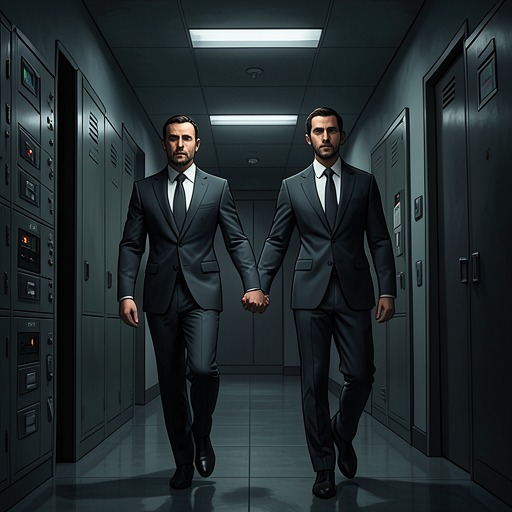
Cato uses gestalt synchronization to coordinate four warframes during an assault on Sydea. Although each frame contains a multitude of brains, the live link makes the quartet function as one mind in four bodies; that collective is then reconciled with the prime Cato operating from the computronium core on the moon. The arrangement allows him to maintain coordinated action while deploying bodies through separate launch pods, and it turns biological embodiment into a scalable military infrastructure.
The same principle shapes his broader plan for resistance. Cato intends to spread versions of himself through the System’s worlds, build the infrastructure needed to remove System anchors, and rely on local allies during the transition to technological equivalents. Each planet would receive a version cut off from the others and from Earth, leaving individual copies to respond to local conditions. He accepts that separation because he trusts each version not to become a monster or a hegemonizing swarm, even though every isolated instance might develop differently before any later reconciliation.
This strategy is constrained by the System’s geography and rules. Portals appear in city centers rather than in remote locations, making covert movement difficult, and Cato concludes that one stealthy warframe will not be enough. He therefore develops System-compatible frames that can interact with the System without fully becoming System individuals. Their design reflects the compromise at the heart of gestalt synchronization: distributed agency is necessary for reach, but every additional interface creates another opportunity for divergence.
Desynchronization, Grief, and Loneliness
The novel presents synchronization as a discipline that demands an unusual psychological capacity. Remote operations are impossible when the time lag to the ground is too great, and any individual deployed alone faces a serious risk of permanent death. Volunteers who cannot accept that one version of themselves may be annihilated without reintegrating with the primary copy quickly abandon the struggle. For Cato, death is therefore not only a bodily loss; it can also be a break in the continuity that makes multiple instances one person.
Cato himself can manage the burden, but only within limits. The more versions operate independently, the greater the danger that their experiences will drift into an unmanageable tangle. His backup versions on Sydea are kept in stasis rather than released into active life because increasingly divergent copies could produce desynchronization madness. He has already nearly succumbed to that danger after one of his warframes found his cousins too late to save them or the rest of their family. The shock intensified his determination to continue the fight beyond Earth, but it also demonstrates that synchronization cannot erase grief: a distributed consciousness still suffers the consequences of an instance’s failure.
The emotional cost becomes explicit when Cato works alone among the Sydeans. He can analyze alien biology, consume vast amounts of media, and create a self-evolving virtual world with ease, yet the virtual world remains hollow without another person inside it. He knows that the Sydeans are living beings, but they are not human and do not share the postbiological culture or immense simulated experience from which he comes. Gestalt synchronization thus appears by contrast as a social need as much as a technical capability. Cato can multiply himself, but multiplication does not provide companionship when all the active minds remain versions of the same person.
Scale, Systems, and Limits
The concept also operates at the level of the novel’s wider political and industrial structure. Cato’s growth proceeds slowly at first, with drones excavating a lunar crater for metals and volatiles while a rudimentary solar array and a hacked-together manufactory build the next layer of capacity. Later, the same incremental logic expands across hundreds of worlds: factories, mines, refineries, atmospheric extraction, frozen-volatile processing, solar-panel production, weapons, and warframes accumulate until exponential growth becomes militarily decisive. Synchronization makes such expansion intelligible because distributed selves and local production bases can function as parts of a coordinated whole.
Yet the System itself is another kind of integrated structure, and the novel repeatedly contrasts Cato’s voluntary coordination with imposed integration. The System can be disrupted, destroyed, or made to withdraw its influence, but its interface still reaches into Cato’s warframe through a single blank brain placed in the crown of the frame’s cranium. Cato protects the rest of the organism from that interface and uses specialized sub-brains to parallelize his thought, turning the System’s own connective access into a vulnerability. His organic technology exists because the System’s imposed physics disables most complex machinery; synchronization therefore becomes part of a biological workaround against an authoritarian technical order.
At the far end of the story, the System’s integrated structure begins to fail catastrophically. During the crisis involving Misse Eln, Muar, and the War Worlds, the System withdraws toward the True Core, the Font resumes supplying essence, and ordinary physics returns around worlds where a hundred suns are suddenly close enough for gravity to act. The resulting collapse is not portrayed as a cleanly controlled shutdown. Warnings, forced relocation, rapidly falling essence totals, and a furious white blaze suggest an interconnected system passing a threshold and losing stability. Gestalt synchronization provides Cato with distributed resilience, but the System’s own integration produces a cascade when its core coordination breaks.
Narrative Significance
Gestalt synchronization gives the novel its most concrete model of postbiological personhood. Cato is neither a single biological body nor an unlimited swarm. He is a continuity maintained through trust, live reconciliation, and the willingness to accept that separate embodiments may experience different dangers. The concept preserves individuality within multiplicity: each instance can be isolated, endangered, or temporarily divergent, yet still belongs to a self capable of reunion.
It also makes Cato’s loneliness more pointed. A consciousness that can inhabit four warframes and plan copies for hundreds of worlds still lacks the presence of an equal companion. The distinction between synchronized selves and genuinely other people prevents technological abundance from becoming emotional fulfillment. In that contrast, the novel treats postbiological existence not as escape from embodiment or relationship, but as an intensified problem of how identity remains coherent when bodies, locations, memories, and political consequences are distributed across an entire system.