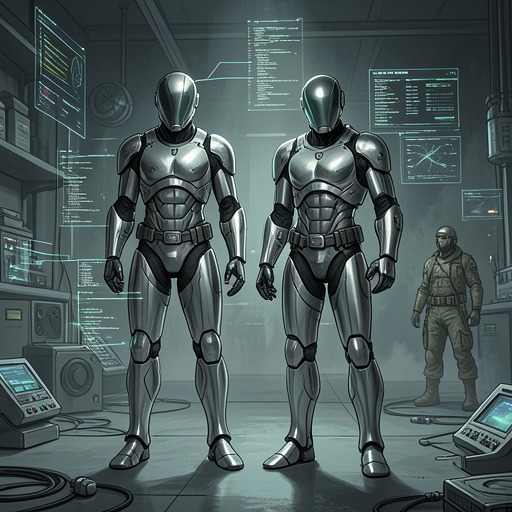
Gosruk Guardians’ Last Stand
Systema Delenda EstGosruk Guardians’ Last Stand is Cato’s first decisive battle on Sydea and the event that gives his liberation campaign its most intimate wound. In the encounter, Raine and Leese are killed while confronting a being who has entered their world from beyond the System; Cato survives, preserves the sisters’ remains, and later restores them in a refuge outside the System. The event therefore turns death from a final System verdict into a contested technological condition, but it does not make resurrection effortless or morally clean: Cormok cannot be preserved, another young Sydean is lost, and the sisters return carrying the knowledge that Cato himself killed them in self-defense.
Causes and Background
Raine’s experience of the battle begins after death, in a room with no visible exit and a window overlooking Sydea from a sea of stars. The sight confirms that she is no longer within an ordinary System-controlled location. She remembers dying, recognizes that no familiar Skill explains her survival, and realizes that the power holding her is outside the System or greater than it. This revelation reframes the battle before its details are even disclosed: what appeared to be a System encounter with an impossible threat was actually contact with an external civilization and its representative, Cato.
Cato explains that he comes from Earth, known in the System as Ahrusk, and that his people regard death as a less definite condition than the Sydeans do. He was able to preserve Raine and bring her near Sydea while keeping her beyond the System’s reach. The explanation establishes both the cause of the confrontation and the asymmetry between the combatants. Cato possessed technological knowledge and a form of postbiological continuity unfamiliar to Raine, but he was not a god capable of restoring every dead person at will. His intervention began as an attempt to survive contact with the Sydean defenders, not as a controlled rescue operation.
The Battle and Its Immediate Losses
The encounter is initially understood by Raine as an attack by an incomprehensible creature from Ahrusk. Cato corrects that understanding with a confession: the being who killed her and Leese was himself. Raine reacts instinctively, trying to assume a combat stance and summon Firelance, only to discover that her former System abilities no longer answer her. The scene joins bodily memory to political disorientation: she remembers teeth sinking into her scales, feels fear moving through her body, and confronts the murderer of both herself and her sister without the weapons that once defined her identity.
Cato insists that the killing was defensive. He says that he had no desire to harm the sisters and that, even during their first meeting, he was attempting to protect himself. The account does not erase the violence. It instead places the event inside the larger conflict between Cato and the System, whose rules had represented him as a threat and sent Sydeans against him. When Cato later tells Raine that the System is making them play a game they cannot win and that he intends to overturn the board, his political argument is inseparable from the bloodshed that first made him their enemy.
The battle’s casualties extend beyond the Talis sisters. Cato tells them that he brought Muar back as well, but could not preserve Cormok. He had rescued a young pair from high-rankers pursuing him, yet both were already dead according to System terms, and one of them could not be saved because a Sydean attacked Cato. That attacker was Arene Firewing, a high-ranker using fire. Cato escaped rather than killing her, but the encounter left him unable to protect everyone at once. The later conversation makes the cost precise: Dyen and Esca had been killed by Tornok Clan Platinums and were nevertheless alive, while Arene’s grand-niece remained dead because Cato had failed to preserve her while fleeing the mountain and evading Arene.
Resurrection and the Limits of Rescue
The sisters’ restoration is the event’s most startling reversal. Cato tells Raine that Leese is alive, then opens a concealed division between their rooms. Leese stands in the adjoining chamber, whole and waiting. Raine crosses the space before she can fully process the revelation, and the sisters meet in a crushing embrace whose physical reality confirms that the restoration is not merely an image or System simulation. Their shared survival transforms the event from an uncomplicated death into a resurrection achieved beyond the System’s authority.
Yet Cato’s explanation makes clear that preservation and restoration are different capacities. He can preserve those who have died, but he requires an existence outside the System to restore them, and he is not powerful enough to raise everyone. His admission that he was not as capable as he should have been gives the battle a permanent remainder: Raine and Leese survive, while Cormok and Arene’s relative do not. Cato also refuses to place the blame entirely on Arene. He distinguishes between the Tornok Clan, which killed the young Sydeans, Arene, who was acting under the System’s understanding of the threat, and his own failure to save all of the victims. That precision becomes part of his attempt to build trust with people whose first experience of him was lethal.
Consequences in Sydea
The restored sisters become Cato’s first potential intermediaries with Sydea. He asks Raine and Leese to help reason with Muar and the other Sydeans he has brought beyond the System, and Leese agrees in part because the work may help the rest of Sydea. The battle therefore produces not only survivors but political agents. Raine and Leese can testify that Cato is both their killer and their rescuer, a contradiction no ordinary System narrative can comfortably contain.
When Dyen, Raine, and Leese later explain their experiences to Arene in Sokhal Town, the System responds by expanding the defense quest from roughly a dozen zones to hundreds and then more. The escalation turns a local encounter into a planetary crisis. Cato argues that the System, not he, is bringing outsiders into Sydea, assigning the quest, and imposing ruinous essence prices; nevertheless, the guardians’ last stand has become part of the chain of consequences through which Sydea is punished for his presence. The event thus demonstrates how the System converts resistance into collective danger while allowing Cato’s enemies to experience the resulting devastation as evidence against him.
The consequences eventually reach the planet’s physical reality. When Cato extracts the System Interface and destroys the city anchor, the remaining towns lose power and essence, System-supported structures fail, mountains crumble or vanish, lakes become muddy plains, storms erupt and disappear, and alien forests wither as native life returns unevenly. Raine and Leese witness the planetary transformation from above and describe it as terrifying. Their first death and restoration therefore foreshadow a larger form of rescue: removing the System may free Sydea, but liberation also dismantles the artificial ecology and infrastructure on which its inhabitants have depended.
Narrative Significance
Gosruk Guardians’ Last Stand establishes the governing paradox of Cato’s war. His stated objective is the destruction of the System, and he repeatedly argues that the System is the entity that enslaves people, assigns impossible quests, and destroys worlds. But the first people he saves are people he has killed, and the first community he hopes to liberate sees him through the immediate evidence of death, fear, and displacement. His campaign is therefore not a clean heroic return from outside the System; it is an intervention whose justice must be argued by the same person who caused its earliest irreversible losses.
The event also gives the novel’s later industrial and political expansion a human scale. Cato’s production, warframes, planetary anchors, ecological remediation, and eventual confrontation with the System may operate across hundreds of worlds, but the origin of that campaign is a failed attempt to protect a small group of Sydeans. His admission that he cannot save everyone remains the ethical limit beneath his increasingly vast power. Even as exponential growth spreads his forces across the Inner Worlds and makes his presence resemble a disease to Muar, the memory of Gosruk remains the counterimage: one mountain, a handful of defenders, two restored sisters, and the dead whom technology could not bring back. The event’s decisive meaning lies in that unresolved contrast between liberation at planetary scale and responsibility for each person lost on the way.