Great Western Sea Ocean Zone
Systema Delenda EstGreat Western Sea Ocean Zone is the immense aquatic region of Sydea that becomes Cato’s concealed route across the planet. He enters it in a transformed aquatic body, travels beneath the reach of surface surveys, survives System-enhanced predators and toxic organisms, and uses the journey to collect resources and investigate the ruins of a civilization the System has erased. The zone is therefore both a physical refuge and a condensed image of Sydea: expansive, sparsely inhabited, biologically altered, and only partially understood through the System’s imposed categories.
Definition and Setting
Great Western Sea Ocean Zone appears on the System’s map as a designated oceanic zone, but its true dimensions exceed the simplicity of that label. Cato wonders whether the entire ocean constitutes one zone or whether a more aquatic world would receive a finer division of its waters. The question reflects the System’s tendency to divide reality into functional, standardized units rather than describe environments in their ecological or cultural complexity. The ocean itself is mostly wild and barely inhabited, and Cato observes that even people accustomed to enclosed habitats underestimate the physical scale of a planet.
The region extends across enormous distances between continents. Cato’s point of departure lies in a rough southern-hemisphere landmass, while his destination is a long mountainous strip crossing the equator at an angle and curving northward toward the pole. The map provides only limited coverage of Sydea’s land, but it gives him enough orientation to identify the continent and the tall mountains he needs to reach. After approaching the coast, he coordinates aquatic scouts and flying scouts so that his movement is concealed across multiple zones rather than traced to a single route.
Cato’s Passage Through the Ocean
Cato reaches the ocean by exploiting a narrow exit from a moon pool. Having converted himself into a sleek, finned aquatic form, he slips downward while a massive pseudo-crab leaves the pool to feed. The crab returns with enough speed to make pursuit dangerous, but the opening at the bottom is slightly too small for the creature to follow. Cato then accelerates through the water, using his streamlined body and cavitation effects to travel perhaps faster than he had on land.
He descends into the bathypelagic depths specifically to remain outside the range of surface surveillance. At that depth he must navigate partly by Sydea’s magnetic field, while small aquatic scouts spread in different directions to obscure his trail. The ocean contains creatures whose scale dwarfs even Cato’s ten-ton warframe. A building-sized serpent pursues him and nearly matches his speed, attempting to swallow him despite his formidable defenses. Later, an enormous jellyfish catches him in a net of fine filaments that his senses cannot detect and attacks with acids, neurotoxins, and cytotoxins. The substances are ineffective against his chemically resistant outer scales and bioweapon physiology, allowing him to cut himself free and continue.
The ocean also supplies materials for Cato’s continued operation. He filters trace elements from seawater, including gold, silver, niobium, neodymium, cadmium, indium, and scandium. He does not need these substances in bulk; their scattered presence is sufficient to support the exotic biomolecular machinery of his warframe. The journey therefore combines concealment, reconnaissance, predation avoidance, and industrial self-maintenance rather than functioning as a simple transit across open water.
Ecology and the Sunken Civilization
Cato’s observations of the Great Western Sea Ocean Zone provoke a broader criticism of the System’s environmental design. The System has produced immense abyssal monsters, but Cato finds them merely large rather than truly strange or elegant. He contrasts their limited forms and apparent lack of color variation with the elaborate life of other worlds, including the fractal patterns of Europa’s ocean and the sinuous benthic organisms of Enceladus. To him, the System has ruined ordinary ecology while also suppressing creativity, replacing complex natural development with standardized zones, brutalist settlements, and oversized but conceptually simple creatures.
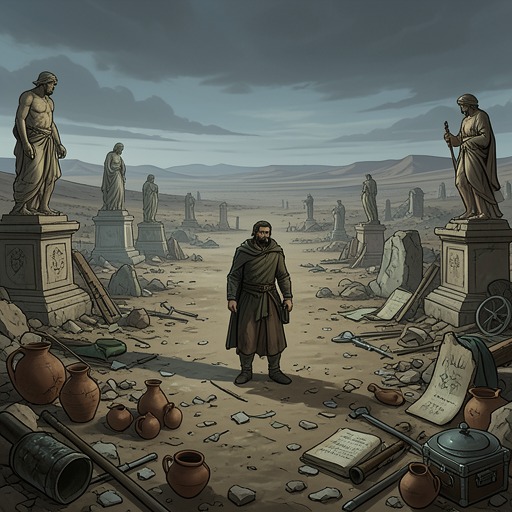
Near his destination, sonar detects sunken cities scattered across the seabed. Cato changes course to inspect one because its remains might preserve evidence of the native culture, evidence he could later use in persuading Sydea’s inhabitants to support him. The city is overrun by hostile sea life, but the creatures are too small and slow to stop his remote survey. High-powered sonar maps the ruins while revealing worn frescoes beneath algae: tailed figures looking toward two suns and three moons. A small horned statuette lies beneath sediment, its arms raised, and one of Cato’s scouts retrieves it as a surviving artifact of the people whom the System erased.
The ruins affect Cato more deeply than the tactical value of the expedition alone would suggest. Their greater grandeur contrasts with the small clusters of System-provided boxes that pass for settlements elsewhere on Sydea. The submerged city becomes an alien Atlantis, a material reminder that a civilization existed before the System reduced the world to administrative labels and functional infrastructure. Cato cannot reconstruct its entire history, but preserving even one statuette gives him a tangible fragment of a culture that would otherwise remain absent from the System’s account.
Relation to Sydea’s System History
The ocean’s inhabitants and ruins belong to a world altered by the System’s early arrival. Initik’s account elsewhere establishes that the System reached his people while they were still hunting rather than farming or living in settled communities. That history helps explain the broader condition of System worlds: the System did not merely govern mature societies but could intervene before agriculture, permanent settlement, and independent institutional development had fully emerged. The Great Western Sea’s erased cities represent the other side of that process, showing what can disappear when an external structure overwrites native ecological and cultural trajectories.
The zone also anticipates the planetary consequences of removing the System. When Cato later destroys anchors on Sydea, towns lose essence, System-supported structures fail, mountains crumble or vanish, lakes become muddy plains, alien forests wither, and native biology begins to return unevenly. The changes resemble terraforming in reverse and leave scars where transplanted life simply dies. The Great Western Sea is not separately described during that collapse, but its unstable ecology, System-enhanced monsters, and drowned ruins place it within the same planetary system of imposed biology and fragile infrastructure.
Narrative Significance
Great Western Sea Ocean Zone gives Cato a setting in which his technological and biological distinctiveness becomes visible without relying on conventional machinery. The System forbids most advanced electronics and complex devices, yet Cato’s warframe survives through engineered organic chemistry: resistant scales, fusion-based internal processes, scouts, sonar, and specialized bodily forms. The ocean turns those adaptations into practical capabilities, allowing him to outlast toxins, cross immense distances, extract rare elements, and evade surveillance.
At the same time, the zone complicates Cato’s position as an observer and would-be liberator. He studies the inhabitants and their artifacts because he wants to bring Sydea’s people to his side, but his first view of them is filtered through reconnaissance, classification, and strategic utility. The System has already rendered the world as a set of zones and species categories; Cato resists that reduction by seeking history in the ruins, even while using his own biological computing systems to map and control the landscape. The ocean thus stands between two forms of domination: the System’s standardized world and Cato’s determined effort to replace it with a reality he can understand, preserve, and eventually rebuild.