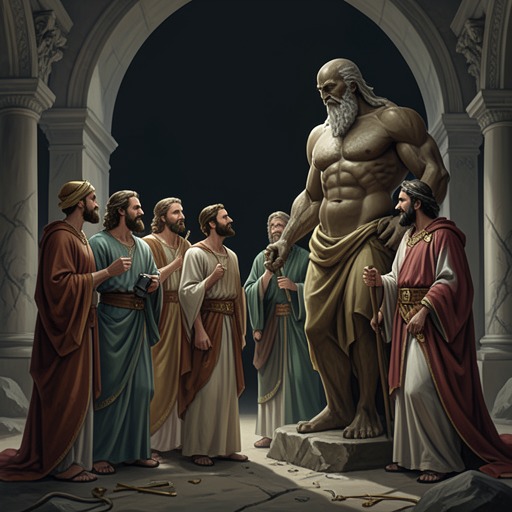
Independent Gods' Resistance
Systema Delenda EstIndependent Gods' Resistance is the organized but deliberately cautious effort by System-independent deities to survive the pressure of the Nine Great Clans. Its decisive significance lies in the coalition's double bind: the gods oppose annexation and planetary purges, yet their most effective potential protector is Cato, whose larger war aims include destroying the System itself. What begins as a meeting about political pressure becomes an underground defense structure, dependent on secrecy, coded instructions, and an alliance with a mortal whose power can preserve worlds but whose program threatens the order in which those gods have lived for centuries.
Causes and Political Background
The resistance forms because the Nine Great Clans are beginning to press the independent worlds into submission. Neyar reports that the pressure is no longer merely private maneuvering. Misse Eln is sending messages to both the Great Clans and the independent deities, presenting Cato as the immediate danger while making the larger objective clear: bringing everyone under the authority of the Nine Great Clans, preferably under Clan Eln. Cato's name therefore becomes a political instrument. The clans can invoke him as a justification for consolidation even when his presence has not been directly established in the Inner Worlds.
The threat is more severe than the familiar competition among powerful factions because the clans are now willing to countenance the purging of entire worlds. Neyar emphasizes that the independent gods lack access to the True Core, the region from which the highest System powers can decide whether a planet is destroyed. Their personal reserves may make them too expensive to displace by ordinary force, but wealth and individual strength do not protect them from a collective decision to erase their worlds. The resistance is thus born from a structural vulnerability: the independent gods possess resurrection and accumulated power, yet remain exposed to a superior authority that can turn planetary destruction into policy.
The Coalition and Its Secret Network
Mii-Es presides over a loose coalition rather than a centralized government. A dozen or so gods attend one meeting through scry-views, while additional deities belong to the wider alliance but are unwilling, unable, or not yet concerned enough to appear. The uneven attendance reveals the coalition's weakness and its realism. The participants are not united by a shared ideology so much as by a shared risk, and many still hope that the clans will not target them directly.
Mii-Es provides the first practical countermeasure. She distributes coded phrases and instructions to selected gods, beginning with those closest to Gyvestral and most exposed to a possible purge, then widening the circle. The messages describe an anonymous ally who can serve as a last resort for worlds targeted by the Nine Great Clans. Mii-Es does not identify Cato, because revealing the connection could compromise both the network and the people it is intended to protect. The information is not presented as a promise of victory; it is an emergency protocol for a disaster the gods hope never to trigger.
The secrecy is especially important because Cato's capabilities are difficult to believe. Mii-Es knows that he claims to be able to save the inhabitants of a world from a purge, but she also recognizes the danger of testing that claim. Exposure could reveal her cooperation with him, while any failure could destroy the very worlds the resistance is trying to protect. The coalition therefore operates through controlled disclosure: each deity receives enough information to act in an extremity, but not enough to expose the whole structure.
Debate over Strategy and Authority
The gods debate whether defensive secrecy is sufficient. One proposal is to use personal power, since many independent deities possess enough essence that the clans would not ordinarily spend the resources required to displace them. Another is to seize nearby worlds or threaten the clans' holdings in return. A third is to bribe another Great Clan into opposing the consolidation effort. These proposals reveal a resistance still thinking in the political language of deterrence, bargaining, and local retaliation rather than open revolution.
Mii-Es remains skeptical that brute force can solve the problem. The Clan gods may lack the stomach, spine, or skill to confront the independents individually, but the Elders of the True Core possess powers that make a planetary purge more than a duel between rival deities. The decision would not belong to one isolated god, and the System's deeper authority could convert a local conflict into a terminal administrative act. The resistance consequently treats open opposition as dangerous even when its members believe they could win a direct fight.
Initik's intervention gives the secret network an unexpected source of legitimacy. He publicly vouches for Mii-Es' anonymous backer, saying that the contact can be trusted in an extremity, though only in an extremity. His endorsement does not disclose Cato's identity, but it matters because Initik is regarded as standoffish, insular, and untrusting. If he is willing to cooperate, the other gods infer that the hidden ally is more substantial than rumor. At the same time, his careful limitation preserves the coalition's caution: Cato is not offered as a new sovereign or permanent political authority, only as a last-resort instrument.
Cato as Ally and Threat
The resistance depends on Cato because his conflict is aimed at the System rather than at the independent gods as individuals. Cato repeatedly insists that his grievance is with the System, not with its people, and he distinguishes the system's domination from the lives shaped within it. He has already argued that the System forces people to play a game they cannot win and that he intends to overturn the structure rather than merely compete inside it. Yet his promise to preserve people creates an unsettling contradiction: he seeks the destruction of the institution that gives their lives order, identity, and meaning.
Initik understands that contradiction from personal experience. When he first enters a temple on Uriva after existing outside the System, its atmosphere feels soothing, while the memory of the blank System-less space horrifies him. He associates the System with status, comprehension, progress, and purpose; without it, the world seemed silent and meaningless. His later cooperation with Cato therefore does not arise from a simple conversion to anti-System belief. Initik remains attached to his people and to the civilization he has protected for more than a thousand years, even while accepting that Cato may be able to save them from a worse fate.
Mii-Es faces the same tension in a more personal form. Cato has offered to bring back her race, a possibility she keeps secret because accepting such an offer could compromise her political independence. When she later tells Initik that Cato has made an offer she may not be able to refuse, Initik reveals that he has received an offer as well. Neither deity discloses the details of the bargain. Their exchange shows that Cato's most potent weapon is not simply military force: it is the ability to promise restoration to beings whose losses the System's existing hierarchy has left irreversible.
Cato does not pretend that leaving the System will be easy. He offers to exfiltrate anyone who wants to leave, but warns that life in base reality will not be the same. Advancement there will still require effort, though the work will differ from the System's progression. This warning prevents the resistance from becoming a fantasy of effortless liberation. The independent gods are not promised another automatic structure of rewards; they are offered the chance to survive outside the structure that has defined their existence.
Development and Consequences
The resistance gradually changes from a discussion group into a distributed emergency system. Mii-Es sends the coded protocols outward, beginning with the deities most at risk and expanding toward a broader circle. Initik confirms that he has been working with Cato for nearly a decade, while Mii-Es has known him for no more than a month. Their unequal timelines suggest that the coalition's visible formation rests on a much older and more private collaboration. Cato's influence is already present before most members understand that an alliance exists.
The movement's central consequence is a new political possibility: a threatened world need not accept absorption by the Nine Great Clans or await destruction by the True Core. It may instead appeal to Cato and seek severance from the System. That possibility is deliberately limited by the risks of the process, but it changes the strategic balance. The clans can still threaten annihilation, yet their threat is no longer absolute if Cato can remove a world from the structure they control.
The resistance also exposes the moral cost of replacing one hierarchy with another. Cato does not want to decide who should rule planets or who deserves access to advanced weapons, railguns, retroviral engineering, or digitization. Nevertheless, if he removes the System and its existing hierarchy, he must help construct a replacement. His campaign therefore makes him a king-maker even when he dislikes the role. The independent gods' alliance is caught between two forms of external power: the clans want to take what the independent worlds possess, while Cato has little interest in their possessions but possesses the means to determine whether they remain inside the System at all.
The resistance's final significance is that it makes resistance thinkable without making it safe. Its members do not share a single faith: Initik still understands the System as a source of meaning, Mii-Es weighs survival against independence, and Cato treats the System as an oppressive mechanism that must be dismantled. Their cooperation arises from this disagreement rather than eliminating it. By the time Mii-Es admits that Cato may save her people, the alliance has become a wager on a future none of its participants can fully imagine: a world preserved by an enemy of the order that once made that world intelligible.