Koren Sekai
Systema Delenda EstThe Core Worlds are the innermost region of the System and the destination toward which its portal network progressively narrows. They function simultaneously as a geographic center, a political stronghold, and a threshold: travelers approaching them encounter denser concentrations of high-rank essence, more powerful defenses, and rules that make return uncertain. Their decisive significance is that they turn Cato’s rebellion from a conflict spread across distant worlds into a direct challenge to the System’s central authority.
Definition and Setting
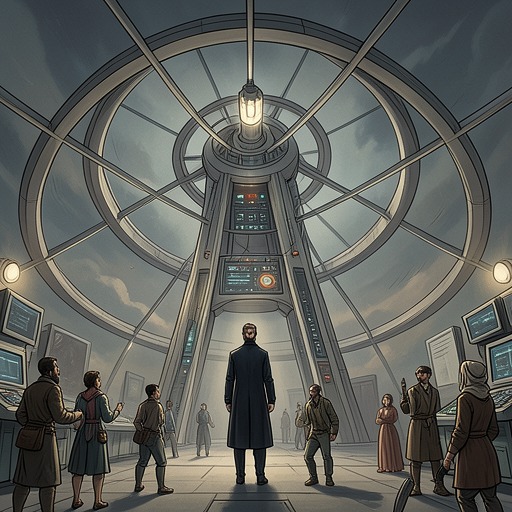
The Core Worlds stand beyond the Inner Worlds, at the deepest convergence of the portal network. Dyen’s route toward them passes through increasingly grand capital cities and increasingly concentrated portals before ending at a portal unlike the ordinary circles in space: a sphere hovering above a disk of Alum-ranked metal like a miniature world. The System warns a Bismuth traveler that return may not be possible, making the passage not merely a change of location but a potentially irreversible commitment.
The region’s political importance is reflected in its relation to the frontier. Misse Eln describes the Inner Worlds and the nearest frontier as containing independent polities whose gods have refused to join the Nine Great Clans. From the Core’s perspective, these worlds are not neutral neighbors. They are territories that may need to be brought into line, condemned, or otherwise controlled before they can form a unified response. The Core Worlds therefore define the System’s center not only by distance but by administrative reach and the authority to decide which worlds may continue to exist within the System.
Arrival and Access
Raine Talis and Leese Talis treat reaching the Core Worlds as a major new stage in their development after their ascension. They intend to go directly to the core, inspect it, circle through the Inner Worlds, and perhaps return toward the frontier from the opposite side. Cato supports the plan because knowledge of the higher-rank regions will give him more time to prepare. Their journey is thus exploratory and strategic at once: the Core is a place to be seen, understood, and eventually confronted.
Dyen reaches the same threshold under very different conditions. He follows Raine Talis and Leese Talis through the Inner Worlds for several days, using stealth and tracking abilities while hiding from Bismuth and Azoth travelers whose presence triggers his instincts. Unlike most Bismuths, who anticipate the opportunities and grandeur of the Core Worlds, Dyen has no interest in their cities, status, or high-rank society. His only concern is finding his targets and securing the revenge for his wife. The warning attached to the final portal turns his pursuit into a one-way risk, but he continues toward the Core rather than abandon it.
Political and Military Center
The Core Worlds are the base from which the Clans coordinate their response to Cato’s expansion. Misse Eln presents a map focused on independent powers in the Inner Worlds and nearby frontier, identifying those outside the Nine Great Clans as especially vulnerable to coercion. Her proposed method is sequential pressure: approach each polity individually so that no unified resistance can form. The Core’s authority consequently operates through both force and isolation, treating political independence as a danger that must be dismantled piecemeal.
Misse also authorizes Muar to distribute divine gifts that allow Azoth-ranked and higher agents to fight Cato’s creations beyond the protection of a world. A Nexus crystal mounted in a chain projects the System around those who venture into hostile darkness, making the Core’s military apparatus portable. The device is aimed chiefly at Azoths, while Alums are considered less likely to heed a World Deity unless sufficiently rewarded. This arrangement shows how the Core converts hierarchy, religious authority, and material incentives into an expeditionary response.
The region becomes even more dangerous when Cato’s forces and influence approach it. Dyen’s stealth fails as he crosses into the Inner Worlds and encounters protections covering the many portals of the expansive Nexus. Identification Skills and artifacts attempt to penetrate his concealment, and he concludes that the trap has been prepared specifically for him. The Core is therefore not an unguarded capital but a monitored gateway whose defenses can distinguish ordinary high-rank travel from a targeted intrusion.
Cato’s Expansion and the Core Crisis
Cato’s approach to the Core is built on industrial scale rather than immediate centralized force. Exponential growth begins slowly, but after years of expansion he has spread across hundreds of worlds, establishing factories, mines, refineries, atmospheric extraction, frozen-volatile processing, and immense solar-panel production. Each world develops its own armies and manufacturing capacity because portal restrictions prevent Cato from moving forces freely. The result is a distributed military-industrial network capable of retooling industrial infrastructure into weapons and Warframe production.
This strategy changes the meaning of the Core Worlds. They are no longer simply the place from which the System governs distant territories; they become the point toward which the accumulated production and political pressure of those territories is directed. Cato tells Misse Eln that his quarrel is with the System rather than with its people, while Misse insists that the two cannot be separated because the System shapes people and gives them purpose. Their disagreement crystallizes the Core’s central conflict: whether the System is an institution that can be opposed without destroying its inhabitants, or an inseparable order whose defense requires the suppression of every challenge to it.
When Misse and Muar restrict the System’s influence around the War Worlds, physics resumes there, and a hundred suns are suddenly subjected to ordinary gravitational consequences. The System then removes both figures to the Font as warnings erupt and the Core region becomes an unreadable field of furious white. Essence totals fall rapidly even under the fastest available acceleration. The crisis makes the Core’s fragility visible: beneath its concentrated authority lies a system dependent on essence flow, permissions, and central infrastructure, all of which can become liabilities when the conflict reaches the center.
Narrative Significance
The Core Worlds are the novel’s threshold between expansion and confrontation. Raine Talis and Leese Talis approach them with the exhilaration of finally seeing the higher-rank center; Dyen approaches them as a hunter willing to risk entrapment and irreversible passage; Misse Eln treats them as the administrative vantage point from which independent worlds can be subdued; and Cato treats them as the region that must be understood before his preparations can mature. These motives overlap without becoming identical, giving the Core a distinctly polyphonic function in the plot.
Their geography also embodies the System’s political structure. The portals narrow toward a central convergence just as authority narrows toward the Core, while the possibility that a Bismuth may not return suggests that ascent toward the center can sever a traveler from the worlds left behind. Yet the very concentration that makes the Core powerful makes it vulnerable to cascading failure. Cato’s distributed growth and Misse Eln’s central consolidation meet there, and the apparent heart of the System becomes the place where its defenses, hierarchy, and essence economy are placed under the greatest strain.