Kosch's Shadow Annihilation
Systema Delenda EstKosch's Shadow Annihilation is the decisive atrocity that reveals what the highest System ranks can do when the campaign against Cato reaches Haekos. Kosch, an Azoth of Clan Renni and a user of Shadow Affinity, releases a darkness that crosses an area roughly a thousand miles across, erases its living contents, and leaves System structures standing amid a sterilized moonscape. The action changes the meaning of the conflict: Cato is not merely fighting armies or defending a liberation project, but confronting a political order whose most powerful agents can treat entire populations as expendable obstacles.
Causes and Opposing Forces
Kosch appears while Cato is attempting to sever Haekos from the System. Cato has already warned a Platinum that allowing the portal to remain open could kill millions or even billions on the world beyond it, because the arrival of the System is apocalyptic regardless of the target civilization's technological level. The Platinum objects that Cato is attacking his own people, and Cato acknowledges the moral complication: nearly everyone inside the System is also its victim. His position is nevertheless that the System itself cannot be permitted to continue.
The appearance of Kosch answers that dilemma with a far more immediate form of annihilation. Raine identifies him as an Azoth of Clan Renni and reports his Shadow Affinity, while Yaniss supplies a brief intelligence file. Cato has previously encountered beings no higher than Bismuth Rank, but he understands that ranks above them increase in power exponentially. The description of an Azoth as a walking nuclear bomb is therefore not metaphorical exaggeration within the scene; it establishes the scale of the threat before Kosch acts.
Kosch's Demonstration
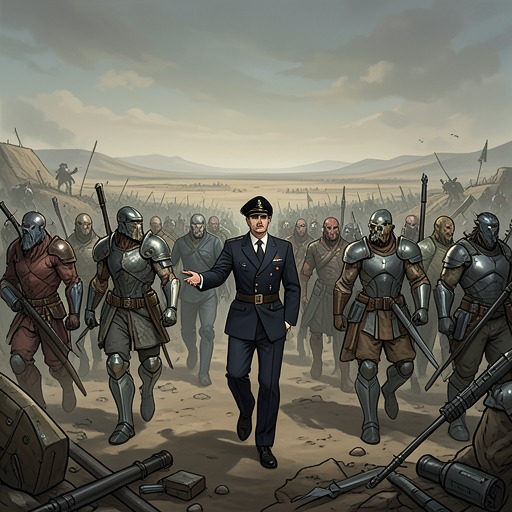
Kosch emerges from the Nexus in the capital city wearing armor that is not simply black but actively absorbs light, producing shifting shadows over a nearly two-dimensional, vantablack silhouette. His movements seem languid, yet he is moving at a speed comparable to framejacking at ten times normal. Cato addresses him through a Warframe and tells him that there is nothing for him to gain in Haekos, that the world will be severed from the System, and that he should leave before that happens.
Kosch dismisses the warning as mere words. He states that the gods have called a Crusade against Cato and declares that Cato's extensive forces are only insects fighting other insects. Kosch's confidence is not empty posturing. When he spreads his arms and bares his teeth, the shadows around him explode outward, destroying the Warframe Cato had used to speak with him before Cato can employ his most powerful weapons.
The wave expands visibly from orbit. It crosses miles in moments, covers half a continent in less than a minute, and forms a perfect circle of lightless emptiness. The effect is not a temporary obscuring of vision. Light absorption does not block radio communication, but the Platinum and the refugee convoy can see almost nothing as the darkness writhes across the surface. When the shadow withdraws, it has left no ordinary trace of the life it covered.
The Annihilated Zone
The aftermath resembles a moonscape. Cities, towns, dungeon entrances, and other System buildings remain intact, but the surrounding land has been scoured down to bare rock and earth. Trees, bushes, grass, monsters, animals, and every person inside the radius have been utterly annihilated. The contrast is precise and politically revealing: System infrastructure survives while the biological and social world around it disappears.
The Platinum survives only because he dives beneath the ocean and the rest of his convoy pulls the refugees under with him. That narrow escape emphasizes the indiscriminate reach of Kosch's power. The attack does not distinguish between soldiers, civilians, refugees, opponents, or victims of the System; survival depends on being outside the affected space or finding physical shelter beneath it.
Cato experiences the event through the feeds of his Warframes and drones, but his distributed existence does not make the destruction emotionally remote. His embodied versions feel sick, and his digital memory preserves the exact number of men, women, and children killed in the instant. His curse at Kosch is followed not by retreat or negotiation but by action: he fires one of the orbital particle beams. Leese is left almost speechless, while Raine answers with a grim-faced signal. Yaniss, more accustomed to the strategic implications of high-rank power, explains that Azoths do not bother with frontier worlds because only War Worlds can withstand them.
Consequences and Significance
Kosch's Shadow Annihilation turns the approaching severance of Haekos into a catastrophe with two distinct sources. Cato's planned System crash already threatens ecological collapse: once System support disappears, oxygen-producing life, alien biomass, altered oceans, and other dependencies may fail. Later remediation on Heyk demonstrates the scale of that danger, with massive flora die-offs threatening oxygen levels and alien remains unable to decompose without suitable native bacteria. Kosch's attack is different but complementary in its devastation: it is a concentrated act of direct extermination that removes living beings immediately while leaving the System's architecture behind.
The event also clarifies the hierarchy of power governing the System. Cato's counter-invasion relies on specialized sub-brains, orbiting weapons, Warframes, drones, communications devices, and careful logistical preparation, yet Kosch can destroy one of those Warframes and erase a thousand-mile circle in moments. Cato's organic technology exists because the System's imposed physics disables most complex machinery; Kosch's Shadow Affinity shows that the same world can host powers whose destructive capacity exceeds conventional military comparison.
Finally, the annihilation exposes the political meaning of the Crusade. Kosch invokes divine authority and the collective decision of the gods, but his demonstration protects neither the inhabitants of Haekos nor the System's ordinary subjects. It preserves the buildings that embody the System while eliminating the people living among them. The scene therefore makes mass death the clearest proof of the system's moral structure: those who claim to defend order can destroy an entire population, while Cato's attempt to end that order must proceed through a conflict whose humanitarian cost he understands with unforgiving precision.