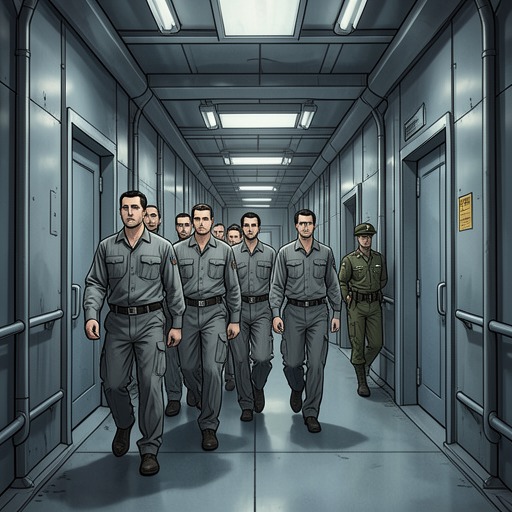
Leaving the System
Systema Delenda EstLeaving the System is the novel’s central alternative to life under an all-encompassing structure of quests, ranks, divine authority, and imposed physics. It does not mean merely changing allegiance or rejecting the System’s theology. It means crossing the boundary into a different mode of existence, one in which people may recover access to base reality, pursue knowledge and action outside the System’s incentives, and participate in rebuilding a civilization that is no longer governed by its infrastructure. Cato turns that possibility into both a liberation project and his most persuasive weapon against the System.
Definition and Conditions
Leaving the System is difficult because the System is not simply an institution layered over ordinary life. It shapes the physical rules of the worlds within it, controls interfaces and progression, distributes Skills and rewards, and makes its own reality feel like the only meaningful one. Cato’s counter-invasion therefore takes place under conditions unlike those on Earth: even when the System has been disrupted or destroyed on Earth, it remains active elsewhere, and its exotic physics suppresses most technology more complex than gears. Cato’s warframe can function only because Titan’s geneticists found ways to encode advanced machinery in biological form, while its System interface is confined to a vulnerable blank brain integrated into the warframe’s crown.
The material infrastructure of System life also reveals how dependence is maintained. A System map is a thin, flexible sheet that behaves like a technological object only while System support remains available; without that support, it falls apart, leaving Cato’s orbital specialists unable to determine what it is made of. The map can be updated through an information pylon, displaying cities, connections, dungeons, conflict zones, faction control, mines, quarries, and farms, but it covers only a fraction of a planet and offers nothing like the satellite view Cato would expect from base reality. Even communication requires workaround technology. Cato’s voice reaches Raine Talis and Leese through living communications lizards because ordinary worldwide communications would risk alerting the System.
Leaving also has biological and ontological consequences. Cato can rework bodies at the cellular level, using electromagnetic devices hidden inside apparently ordinary lounge chairs to render people unconscious while their bodies and nervous systems are altered. He deliberately does not offer every person a complete transfer of mind into another substrate, because many regard such movement as indistinguishable from death. The distinction becomes uncertain with Cato’s techniques, but the uncertainty remains ethically important. Leaving the System is therefore not presented as a painless escape hatch: it involves choices about embodiment, continuity, consent, and what counts as the same person after a transition.
Cato’s Liberation Project
Cato’s political position is carefully distinguished from simple extermination. He tells Initik that his grievance is with the System rather than its people, and later states his goal to Goyle with equal precision: he wants to bring down the System, but not the people within it. His agents accordingly offer escape to humans wherever they can find them. Raine Talis and Leese explain to Lorraine that they work for Cato partly because he wants a way out for every human possible. He cannot return them to Earth, but he has much of Earth with him and does not want to leave anyone behind.
The offer is extended beyond ordinary humans. Cato wants every Alum to have the opportunity to leave, even though approaching them is dangerous because an Alum may be able to eradicate his agents with a thought and remains vulnerable to the power of gods. Goyle is offered knowledge of light, including its relation to time, space, and the underlying substance of the universe, in exchange for secrecy and help persuading other Alums to negotiate with Cato. The bargain matters because it replaces the System’s promise of advancement with alternatives the System cannot easily provide: unprecedented fights, unprecedented vistas of knowledge, and the ability to pursue activities for their own sake rather than merely becoming stronger.
Cato’s strategy depends on curiosity as much as force. He uses the promise of a world beyond the System to create doubt in people who have never had a meaningful comparison. Mii-Es privately considers an offer that could restore her race, while Initik admits that Cato has made him an offer as well; neither knows the details of the other’s agreement. The secrecy protects each negotiator’s position, but it also shows how leaving destabilizes existing loyalties. A person cannot casually accept liberation when the offer may compromise an alliance, expose a people, or force a choice between familiar dependence and an uncertain freedom.
Experience Beyond the System
The contrast between System existence and base reality is most sharply expressed through Yaniss. Cato is careful with the term “base reality,” using it for the universe outside both the System and its virtual worlds, and he has never concealed the distinction from her. When Yaniss receives a body grown from her own unaltered genetics, she immediately recognizes that the difference is not simply a matter of stronger sensation. Her senses as a Bismuth and as a digital being were already extraordinary; what changes is that sight, smell, touch, and hearing arrive without an intervening filter. Experience becomes immediate and raw.
The transformation is made concrete through small acts rather than spectacle. Yaniss leaves a bed built to the diminutive proportions of the Ikent, dresses herself manually, and discovers that she is clumsy at tasks that automated existence had made unnecessary. She walks through a rotating habitat, smells greenery, and looks through enormous windows at the shining world of Ikent with her own eyes. The scene makes Leaving the System a recovery of neglected capacities as much as an escape from oppression. Imperfection becomes evidence of contact with reality: dressing badly, moving awkwardly, and feeling the physical environment without mediation are humbling but also refreshing.
For those who have lived within the System all their lives, the transition is more unsettling. Muar’s experience shows the opposite emotional response. After entering a temple on Uriva, he feels the System’s presence as soothing and experiences his time outside it as a terrible nightmare. The blank System-less space had seemed silent, lifeless, purposeless, and impossible to inhabit. He meditates for days beside the temple’s System crystal, seeking the flow of essence and the divine System, and is rewarded with the Divine Insight Skill. Muar’s reaction establishes that leaving cannot be reduced to an objectively liberating experience. The System supplies meaning and measurable progress so completely that separation may feel like the loss of truth itself.
Digital Refuge and Its Limits
Cato’s solution is not to insist that everyone immediately inhabit physical bodies in base reality. For people who have crossed Bismuth and become composed entirely of essence, existence outside the System is impossible without an alternative arrangement. Raine Talis explains to Lorraine that Cato has established digital aestivations, allowing those people to remain in a protected form after departure. The process is presented as an official System exit rather than a dramatic spiritual revelation. When Raine, Leese, and Lorraine enter the transfer chambers, Cato places them in a bright summer clearing while their transition proceeds, displaying a completion percentage as he performs the process carefully rather than rushing it.
Cato also prepares accelerated simulations for those who need time to adapt. He proposes using Summer Civilization technology to construct a deep-acceleration server where Raine and Leese can spend subjective years adopting different identities, especially identities suited to Ikent and other worlds. The simulation would use surveillance data and simplified inhabitants, but Cato refuses to raise an artificial intelligence under those conditions. Deep framejacking requires cooling, accurate simulation, strict entry and exit coordination, and safeguards against learning destructive habits from an inadequate virtual environment. The technology can offer preparation, but it cannot erase the responsibilities involved in creating or governing minds.
The new society Cato imagines is not unrestricted. He expects communities to police themselves where possible, but prohibits inter-habitat warfare and withholds access to weapons that could turn communications lasers, mass drivers, or industrial equipment into tools of mass death. This limitation exposes a tension within the liberation project. Cato rejects the System’s paternal control, yet he cannot safely hand unlimited power to populations emerging from civilizations where violence was necessary for survival. Leaving the System therefore requires institutions and safeguards of its own, and the danger is that protection can begin to resemble the control people were promised they had escaped.
Scale, Risk, and Significance
The project’s scale is deliberately overwhelming. Cato has hundreds of thousands of worlds still to close and an unknown number of Azoths and Alums in the Core to persuade. Millions, perhaps billions, of people could eventually enter Heimdall before the System is completely closed, and Cato even hopes to import gods. The proposed refuge is consequently not a private sanctuary but the possible foundation of a civilization assembled from populations, identities, technologies, and political traditions formerly organized by the System.
Yet Cato’s willingness to admit everyone includes people he distrusts. Marus is placed in a restricted digital environment that Cato calls Alcatraz, modeled on a high-security digital prison with locked-down servers, limited control over local reality, no ability to transmit outward, and carefully isolated permissions. Cato knows that Raine Talis and Leese will not be happy to find Marus included, but he considers even the worst monsters entitled to the option of leaving. That does not mean he will release them without safeguards. The distinction defines his program: departure from the System is a right or possibility that should not depend on moral worth, while freedom after departure remains subject to accountability and containment.
For Raine and Leese, the promise is emotionally double-edged. Their improved weapons, armor, reputations, and System ranks represent real progress, yet they know that they will ultimately leave those achievements and the System itself behind. The knowledge produces both dread and anticipation. They have seen enough of Cato’s capabilities to believe that something exists beyond the System, but the alternative is not the same as the only reality they have known. Their uncertainty is not a failure of faith; it is the psychological cost of exchanging a complete, familiar order for an open world whose truth must be experienced rather than certified by quests and Skills.
Kiersten gives that uncertainty its clearest formulation when she rejects an Elysium that would feel empty, useless, and like a playpen. She wants to live in the real world and do real things, but no longer knows how to determine whether any world is real. Cato does not answer by demanding trust in himself. Instead, he introduces her to Yaniss, someone who has undergone the same crisis and can speak from experience. The gesture captures the concept’s deepest significance: Leaving the System is not merely a destination but a contested process of learning how to judge reality, usefulness, freedom, and identity without the System deciding those meanings in advance.