Mass Digitization
Systema Delenda EstMass Digitization is the large-scale conversion of living beings into digital minds, usually through Cato’s mindrippers and associated biotechnological infrastructure. It is both a technological countermeasure against the System and one of the clearest ethical crises in Cato’s war: a means of preserving people from exterminatus that violates bodily autonomy, privacy, agency, and personal choice. Its decisive significance lies in that contradiction. Cato does not treat digitization as an ideal future, but as the only remaining alternative when the System and its gods turn entire worlds into disposable casualties.
Definition and Technical Operation
Mass Digitization depends on biotechnology designed to incapacitate living subjects, extract their minds, and preserve them on a digital platform with minimal trauma. Cato’s mindrippers are not ordinary weapons of indiscriminate destruction. They are engineered to render people unconscious and digitize them properly, while Chill Out bioweapons release neurochemicals that induce calm and forced lassitude. Because Cato possesses the genetics, biochemistry, and anatomy of the populations he targets, he can design agents for particular species rather than rely on a single universal plague.
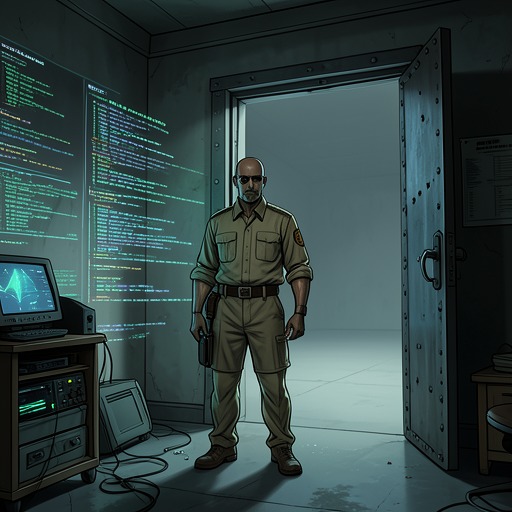
The process is supported by a distributed communications and computing architecture. During the Gyvestral operation, the Bug Bombs converted themselves into System-jamming smart biomatter while transmitting genetic, biometric, and relational information through the FungusNet network to dense satellite arrays. The digital population was then moved to a distant armored computronium aestivation built to Summer Civilization specifications. That installation could run millions of people, together with the environments and virtual intelligences needed for onboarding and maintenance, while framejacking or underclocking the inhabitants as circumstances required. The scale of the infrastructure is therefore as important as the mindrippers themselves: digitization is a planetary logistics system, not merely a medical procedure or battlefield trick.
Cato’s system also preserves social identity rather than treating each subject as isolated data. The transmitted information includes relational analysis intended to ensure that people are properly preserved and grouped. The method turns bodies into sources of biological and personal information, but it also attempts to prevent the destruction of communities when their physical world is lost.
Emergence as a Response to Exterminatus
Mass Digitization becomes necessary because the System can condemn worlds and destroy them on a timer. On Gyvestral, more than twelve million Copper- and Silver-rank inhabitants, primarily the blue-furred Gaekos, were condemned to death when the world was marked for exterminatus. The System’s action threatened not only individual lives but the apparent genocide of a species on its homeworld. Cato responded by distributing several million one-ton canisters of bugs. Half were intended to create a worldwide System-jamming network in the hope of disrupting the sterilization mechanism; the other half existed to carry out the digitization of the population.
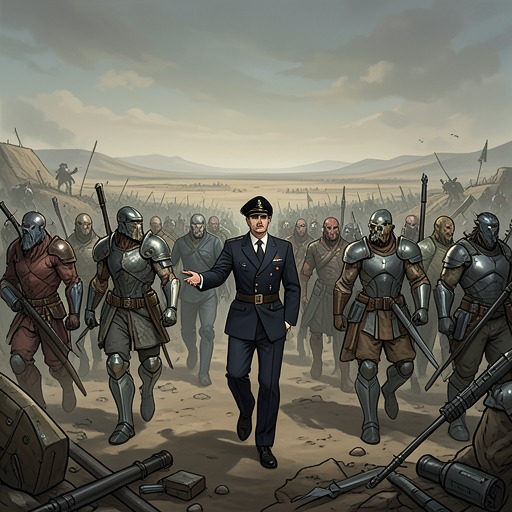
The jamming attempt failed, but the rescue operation did not. As the exterminatus timer ran down, Cato moved factories and machines into lower orbit, retained reserves at higher altitude, and prepared evacuation systems in case the local Azoth or the System attacked his hardware. After an Azoth appeared over the capital and declared that the world was doomed, Cato used a brief particle-beam strike as a warning, then activated the Bug Bombs. The insects flooded pacified settlements, wrapped around people’s heads, and transformed into temporary processing and communications structures. Cato confronted the Azoth through hundreds of voices in the city, demanded that the deity leave, and began assimilating the capital once resistance had been removed, while sending a specially sized warframe to negotiate with the Platinum population.
The completed evacuation preserved 16,412,892 souls, including a mindripped System Interface that functioned as a pseudo-AI. The digital citizens were placed in dedicated Summer Civilization technology shortly before Gyvestral’s destruction. Their final minutes of physical-world time were extended into weeks of subjective time through framejacking, allowing interviews and debriefings before the information was transmitted outward through FungusNet. The result was therefore not merely a mass escape from death, but a hurried attempt to create testimony, continuity, and usable knowledge before the planet disappeared.
Ethics, Coercion, and the Politics of Rescue
Cato regards the process as morally abhorrent even while deploying it. Extracting a person from a body and placing that person on a digital platform violates privacy, personal choice, agency, and what Cato understands as the self. The operation is not presented as a clean liberation from biology. It is an invasion undertaken under coercive conditions, with Cato deciding that survival in altered form is preferable to irreversible death.
That judgment exposes the political violence surrounding the technology. Cato believes the System-gods have deliberately denied him the option of destroying the System while limiting the casualties to Bismuth-rank individuals and above. Their exterminatus policies force him to choose between violating the lower-ranked population through digitization and allowing the System to kill them permanently. His rescue therefore reproduces, in a different form, the authority he opposes: bodies and minds become objects of emergency administration, and the population’s consent cannot be obtained before the deadline expires.
Cato nevertheless distinguishes preservation from annihilation. He wants to save everyone, and he tries to evacuate higher-ranked inhabitants through the portals where possible. Gold- and Platinum-rank individuals require more individual attention, but he is prepared to help those who remain rather than abandon them. When a Platinum figure might interfere, Cato considers the possibility of using particle beams against an Azoth if necessary, yet he also sends a diplomatic warframe to encourage digitization and avoid needless destruction. The technology thus sits between care and coercion: it is compassionate in its intended outcome, violent in its implementation, and inseparable from the larger contest over who has the right to determine what counts as survival.
Expansion Across Worlds and Limits of the Method
After Gyvestral, mass digitization becomes one of Cato’s central answers to the System’s strategic escalation. The captured Interface offers limited insight into planetary administration and essence economics, but the more important lesson is operational: the System’s exterminatus threat can be answered by moving populations into digital survival systems. This does not produce an easy victory. The Interface cannot explain what essence is, what generates it, how System physics are imposed, or how the System spreads. Cato gains no instant technical solution, only evidence that planetary operations cannot withstand the scale of his industrial sabotage indefinitely.
The method becomes much harder in the Inner Worlds. Their geography depends on System support and includes oceans of magical depth, caves reaching planetary cores, permanent storms, and Ceres-sized moons suspended less than ten miles above the surface. If the System collapses, such features could trigger catastrophic changes: moons might vanish, tides could fail, or enormous masses of water and rock could fall into ordinary physical conditions. Many Inner Worlds would therefore require mass digitization because their physical environments could not survive the transition intact. Cato would then need to manufacture moons, alter orbits and planetary rotation, reconstruct continents and oceans, and reseed entire biospheres, all with far more equipment and matter than he possesses.
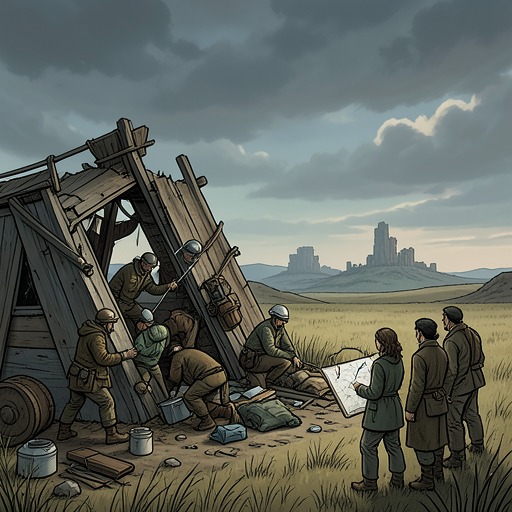
Even on less extreme worlds, digitization is selective and improvisational. During fighting elsewhere, Cato extracts minds from abandoned estates and sends them to distant servers rather than leaving gestalts in stasis while their physical counterparts continue living. On Tornok, however, a fighting retreat delayed his forces until only minutes remained before the moon’s fall and the world’s destruction. He saved only a few thousand people, almost entirely from the servant races, while millions of lower-rank inhabitants died. The contrast demonstrates that mass digitization is powerful but time-dependent: preparation, industrial capacity, portal access, and the length of the exterminatus countdown determine how many can be preserved.
Narrative and Thematic Significance
Mass Digitization crystallizes the book’s opposition between freedom and survival under systematized power. The System reduces worlds to administrable units, condemns populations through quests and timers, and treats planetary destruction as an available instrument. Cato resists that machinery with another vast infrastructure of databases, biomatter, satellites, orbital factories, and digital habitats. The conflict is therefore not simply between magic and technology. It is between competing systems for recording, moving, classifying, and preserving life.
The concept also complicates the usual rhetoric of technological salvation. Digitization offers continuity without the body, community without a homeworld, and survival without meaningful consent. Its success is measured in preserved souls and transmitted relationships, but its cost is the conversion of persons into data under emergency authority. The System’s inability to destroy Cato’s dispersed infrastructure and Cato’s inability to save every physical population produce the same unsettling lesson: at planetary scale, life becomes inseparable from logistics.
The method’s most important contrast is with Cato’s own ideals. He seeks to end the System so that people can choose their futures, yet exterminatus forces him to act before choice is possible. Mass Digitization is consequently a temporary bridge toward liberation that risks becoming another form of domination. Its moral force comes precisely from that unresolved tension: the technology preserves millions, but only because a world has been made unlivable and because Cato accepts responsibility for deciding which violation is less final.