Mesh-ia
Systema Delenda EstMesh-ia is the ancient name of Mii-Es’s avian species before the System transformed their world and culture. In the present, the people survive only as a recovered remnant: a score of Mesh-ia infants preserved in pods by Cato’s technology. Their return turns an extinct or nearly forgotten ancestry into a living political and emotional question, forcing Mii-Es to decide what kind of future a people can have after centuries of System-shaped existence.
Identity and Historical Erasure
Mesh-ia is defined first through memory. Mii-Es recognizes the infants as members of her own race, using the pre-System name that had disappeared from ordinary historical consciousness. Their feathers, colors, and beak shapes awaken recollections tens of thousands of years old, including the vague emotional traces of people she once knew. The children therefore represent more than biological specimens: they are fragments of a civilization whose continuity has been interrupted so completely that even Mii-Es had believed much of her own past forgotten.
The contrast with other System-integrated peoples establishes the scale of that interruption. On one observed System world, most inhabitants are lizard-people, while the remaining population includes crab-people, bird-people, rock-people, and other forms. The System can preserve bodies and organize populations across radically different species, but its universal structure does not preserve the cultural worlds that existed before integration. Mesh-ia consequently survives in the narrative as a recovered name, a biological lineage, and a memory that the System failed to carry forward.
The Recovered Infants
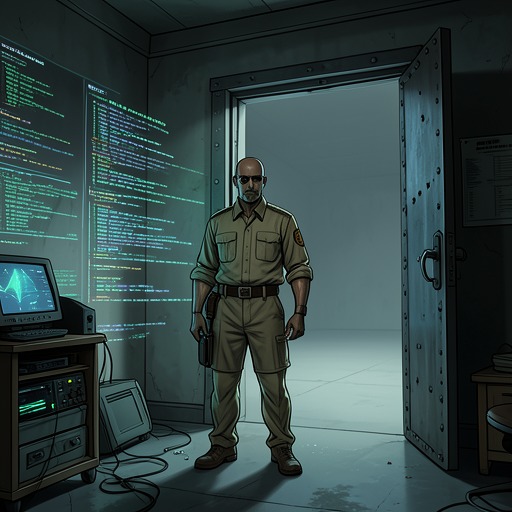
Cato’s intervention begins with the preservation of approximately twenty Mesh-ia infants in stasis pods, their chests rising and falling slowly while they await a viable environment. He can keep them alive, but he cannot yet simply release them into ordinary development. The children require a simulated lifecycle, suitable environmental interactions, and conditions adapted to the physiology of their species. Cato admits that he is not qualified to raise them and that the cultural matrices available to him cannot replace the lessons remembered by Mii-Es.
The practical obstacles are specifically biological rather than merely sentimental. Leese explains that Mesh-ia bodies contain ferro-organic compounds layered through the skeleton, and that these structures must align with the ionic components of the blood marrow so that cell formation works correctly under the gravity to which the species evolved. A global magnetic field must also be simulated before the environment can be considered adequate. The details make the restoration concrete: reviving Mesh-ia requires not only embryos, bodies, or memories, but a whole planetary ecology and developmental system.
Mii-Es responds differently from Cato and Leese. While Leese concentrates on magnetic fields, hormones, and environmental engineering, Mii-Es sees the pods as a miracle. She touches the protective artifice, studies each sleeping child, and chooses one who recalls someone from her remote past. The infant, later identified as Kuu-Sed, becomes the first child to be decanted. This selection connects the abstract recovery of a species to a personal act of recognition, even though the memory behind it survives only as a hazy feeling.
A World Reconstructed in Miniature
The first Mesh-ia child is not brought into a bare laboratory. Cato’s agents offer Mii-Es a small environmental chamber, a constructed landscape that resembles an outside world even though it exists aboard a vessel rather than on a planet. When she carries Kuu-Sed into it, the plants, colors, scents, running water, birds, insects, grass, and warmth of the false sun recall her childhood with painful precision. The environment is not literally her lost homeworld, but it reproduces enough of its sensory logic to make that loss present again.
Kuu-Sed experiences the chamber as a living world, gripping Mii-Es’s clothing while looking at the vegetation and animals around him. For Mii-Es, the scene joins two times at once: the ancient Mesh-ia past and a possible future in which the species can grow again. The chamber also reveals the asymmetry between technological reconstruction and lived inheritance. Cato can manufacture habitats and preserve bodies, but Mii-Es supplies the memory that tells the reconstruction what home is supposed to mean.
Mii-Es’s Choice and Bifurcation
The restoration of Mesh-ia becomes Cato’s most powerful offer because it combines collective survival with personal responsibility. He tells Mii-Es that she can leave the System and safeguard her people while another version of herself remains behind to perform her System duties. The process is uncertain: one self will return to those duties, while the other will be transmitted to Project Birdnest. Mii-Es will not know which version she is until the procedure is complete.
The danger is not simply physical separation. Cato cannot guarantee that the two selves will later reconcile into one person. They may remain permanently divided, producing two enduring versions of Mii-Es. He can keep them partly synchronized, but reconciliation is not universally possible. The choice therefore places Mesh-ia’s future against the assumed unity of personal identity. Mii-Es recognizes that the offer may contain an unseen cost, yet she also knows that Cato has restored her race from fragments and that she could now protect the children directly.
Mii-Es seeks Initik’s advice because she suspects that the desire to recover her people has compromised her judgment. Initik understands the temptation: Cato has offered to repair problems that afflicted his own people before the System and to provide a community where they can learn to live without it. Both deities fear that Cato, being utterly alien to them, may conceal a cost they cannot yet identify. Mii-Es nevertheless concludes that the Mesh-ia offer is worth any price. She accepts the bifurcation because the possibility of two selves seems preferable to abandoning either her divine role or the people newly returned to existence.
The Mesh-ia Future Beyond the System
After the procedure, one Mii-Es awakens in a fully synthetic frame near the infant pods. Her new body retains senses nearly comparable to those she possessed as a deity, but she is now positioned among Cato’s technology and servants rather than within her former divine identity. Raine and Leese attend the children, and Mii-Es immediately begins treating the apparatus as something to be understood rather than merely trusted. Her intention to investigate Cato’s technology suggests that Mesh-ia restoration will involve agency and scrutiny, not passive dependence.
The surviving Mesh-ia are also part of a larger argument about leaving the System. Their recovery demonstrates that severance need not mean simple extinction, but it also exposes the immense work required to replace System-supported life. When System anchors are destroyed, landscapes can collapse, lakes can become muddy plains, alien forests can wither, and biological cycles can fail. On Heyk, flora die-offs threaten oxygen levels, while the absence of native bacteria prevents alien biomatter from decomposing. Mesh-ia therefore cannot be restored by releasing them into a supposedly natural world; their survival depends on deliberate ecological engineering, cultural teaching, and the gradual reconstruction of a suitable home.
The species’ significance lies in this tension. Mesh-ia are neither merely victims awaiting rescue nor proof that Cato’s technology has solved the consequences of System rule. Their bodies require precise environmental conditions, their culture requires an elder who remembers what has been lost, and their future depends on a political decision about whether existence should remain organized by the System. In giving Mii-Es a living people to protect, Cato turns ancient memory into leverage; in accepting the offer, Mii-Es turns that leverage into a commitment to preservation, even at the cost of dividing herself permanently.