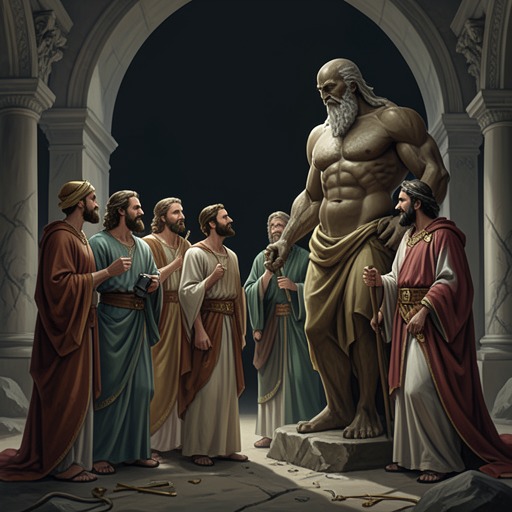
Meshan
Systema Delenda EstMeshan is an independent World Deity defined by possession, defiance, and responsibility in equal measure. Sulean is not merely an asset under his administration: it is his world, inhabited by millions whom he calls his people and defended by him for thousands of years. That conviction gives his resistance moral force, but it also exposes the contradiction at the center of his existence. Meshan has spent ages mastering a world within the System, only to discover that the authority he treats as sovereignty can be revoked by a higher power without negotiation.
Identity and Position
Meshan belongs to the independent deities most vulnerable to pressure from the Core Worlds. His planet is wealthy and successful enough to resist slow encroachment, but not wealthy enough to purchase protection from neighboring powers in the manner of Neyar. That intermediate position shapes his politics: he is too established to accept absorption quietly, yet too exposed to ignore the machinery of the Great Clans. When Mii-Es seeks his cooperation, she approaches a deity whose independence is real but constantly threatened by larger structures.
His authority is also personal and territorial. In his home, Meshan regards Sulean as his possession by both right and acclaim, rejecting the claim that Clan Eln or Clan Lundt can impose a superior title. He describes himself as the master of the world and emphasizes that he, rather than distant Core authorities, has defended its population against the Great Clans. Foreigners are unwelcome on Sulean, a policy that expresses his protective nationalism as much as his suspicion of outside interference.
Defense of Sulean
Meshan’s confrontation with the Clan representatives occurs in the dark wood foyer of his home, where one Eln representative and one Lundt representative arrive under pressure from a still higher authority. Their supposed cooperation conceals mutual dislike, and Meshan immediately treats their visit as an attempt to dress dispossession in the language of necessity. He refuses to yield Sulean and tells them that nothing the Core powers do can change his claim.
His refusal is not simply rhetorical. After the meeting, Meshan activates the defenses around his private System Space and the portals connecting to his world. He prepares both to repel hostile forces and to prevent incriminating material from being planted on Sulean or on his person. His reserves are deep enough to sustain those defenses for ages, and he believes that, if the Clan deities come in person, he can defeat them in direct combat. The preparations reveal a ruler who trusts accumulated strength, surveillance, and territorial control even while the larger System is preparing to invalidate all three.
Meshan’s confidence also contrasts with the behavior of other deities around him. He regards nearby World Deities as useless functionaries, while powers within the Clans are the only opponents he acknowledges as capable of matching him. This self-image is not empty boasting: when the opportunity appears, he is able to strike several enemy worlds in rapid succession. Yet the scale of his personal combat power cannot solve the institutional problem facing Sulean.
The Liquidation Decree
The decisive reversal comes through a notification from Meshan’s Interface. Sulean has been assigned for liquidation; its essence and resources are to be extracted, its connection to the System severed, and Meshan’s connection to the planet revoked in exchange for a one-time essence payment. A countdown appears beneath the declaration. The terms reduce a living world, its population, and its deity to items in an administrative process.
Meshan tries to use the Interface to overturn the decision, insisting through action that his authority should matter. Nothing changes. The order comes from the highest authority, the True Core, and therefore exposes the limit that Meshan’s centuries of defense had concealed. He can guard a world against invading powers, resist Clan pressure, and defeat lesser deities, but he cannot appeal the System’s ultimate ownership of the world. His status as World Deity is substantial within the hierarchy and powerless against the hierarchy’s source.
The crisis brings emotions Meshan has long forgotten to the surface. His anger is not abstract outrage at a rule; it is fear for the people who will be left without their world. When he tells Mii-Es to consider the fate of his population, her answer is that he must invoke the hidden contact she has provided. The instruction forces Meshan to move from solitary resistance toward a dangerous alliance.
Alliance with Cato
The contact is unlocked through a passphrase spoken first by one of Meshan’s priests and then supplied by a Silver-rank member of Meshan’s own species. Once the memory crystal opens, an accelerated recording from Mii-Es tells him that the contact is Cato. She presents Cato as a last resort because he has demonstrated the ability to save everyone on Gyvestral and has no interest in ruling worlds, even though he possesses the power to sever them from the System.
Meshan’s acceptance of this offer is not a conversion to Cato’s cause in any simple sense. He begins from distrust, pride, and urgency. Cato’s promise is credible enough to matter because the alternative is the liquidation of Sulean, but it also requires Meshan to admit that his own defenses cannot protect his people. The alliance therefore begins at the point where Meshan’s independent sovereignty fails and another kind of agency becomes possible.
The later conversation between Mii-Es and Initik confirms that Cato’s offers function as a potent weapon precisely because they address what powerful deities cannot secure for themselves. Cato can offer the survival or restoration of a people, while the System offers authority only on terms that can be withdrawn. Meshan’s bargain belongs to this wider pattern: he is drawn toward Cato not by ideological agreement alone, but by the ability to preserve lives that his official position cannot save.
Retaliation and Consequence
Meshan does not wait passively for Cato’s intervention. With only hours remaining, he attacks nearby Clan worlds, beginning with the World Deity of Hucayl. After defeating that deity, he rejects the prompt asking whether he wishes to claim the tethered world. The refusal matters: even in the middle of a revenge campaign, Meshan is not trying to expand his holdings or replace the authority he hates with his own. He is using the time left to make the Clans pay.
His surprise attacks rapidly damage the surrounding Clan structure. By the time he returns to his System Space nearly an hour later, the five nearest worlds are without a deity, and both Clan Eln and Clan Lundt have lost members. Meshan gathers most of the essence he has accumulated and sends it to Mii-Es so it can aid less fortunate independent deities rather than keeping it for himself. He then opens a portal to the surface, where Cato’s agent is waiting, and declares that the next stage can begin.
Meshan’s final recorded action in this crisis transforms his image. He remains violent, proud, and determined to punish those responsible, but his campaign is not portrayed as ordinary conquest. He declines a world, redistributes his accumulated essence, and accepts cooperation only after exhausting his own means. His story makes the System’s political order visible from the perspective of a ruler who has done everything expected of a deity—administered, defended, accumulated, and controlled—yet is still treated as an expendable intermediary.
Narrative Significance
Meshan embodies the difference between local power and ultimate sovereignty. His luxurious System Space and the extensive reserves supporting his rule belong to the same administrative economy that makes worlds productive and governable, but that economy ultimately permits the True Core to extract Sulean’s resources and erase his connection to it. His strength is therefore genuine without being final.
He also provides a sharp counterpoint to Muar’s devotion to the System. Muar experiences a temple on Uriva as a return from the horror of System-less existence and meditates at its crystal to receive Divine Insight. Meshan, by contrast, encounters the System as an authority that can declare his world for liquidation despite his service and defenses. Together, these perspectives show why the System can appear simultaneously as salvation, meaning, administration, and dispossession.
Meshan’s arc is consequently a movement from guarded independence to compelled cooperation. He does not abandon pride or responsibility; instead, the liquidation decree forces him to redirect both. His defense of Sulean becomes an attack on the Clans, and his accumulated power becomes support for other independent gods. By the time he reaches Cato’s agent, Meshan has not become less formidable. He has become newly aware that preserving a people may require joining a struggle against the structure that once gave his authority its shape.