Misse Eln's claim of True Deity
Systema Delenda EstMisse Eln's claim of True Deity marks the moment when the System's threatened order acquires a new sovereign at its center. After discovering that the ancient rulers of the True Core had apparently departed, Misse selects the only available option, accepts the mantle of [True Deity], and immediately turns unprecedented administrative authority toward the emergency created by Cato. Her ascension does not simply increase her personal power: it changes the political scale of the conflict, making the survival of the System a question of central command rather than merely a series of frontier defenses.
Discovery of the Abandoned Core
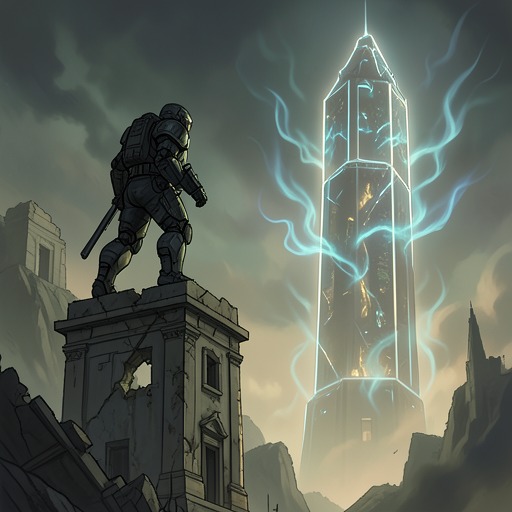
Misse's opportunity arises within the holiest region of the System. Elder World Deity Keppel Eln has described the True Core as an immense, globe-spanning cradle that joins the detached System Spaces of the gods to the richest and most desirable world in existence. The surrounding Vestibule is a place where combat Skills are forbidden both by custom and by the System's own declaration, and only a small portion of divinely affiliated beings may approach closely enough to commune with the System's heart. The deeper world is arranged around the Core's vast construct, with powerful clan worlds, war-worlds, and suns brought into relation with it; proximity grants access to greater stores of essence and to more intimate workings of the System. Misse realizes that the revered authorities of this sacred center are no longer present. The assumption that the elder gods had left had persisted as accepted wisdom, even though no one had acted on the implication. The True Core's responses through the Vestibule had continued to appear reasonable, allowing the absence of its former rulers to remain concealed by ritual, habit, and fear. Misse interprets the vacancy not as a reason to retreat, but as an invitation to claim responsibility. She also believes that most accessible Deities lack the vision to look beyond their own clans, while Cato's threat requires someone willing to act for the System as a whole.
The Claim and Its Authority
When Misse selects the Core's claim option, the Interface-like intelligence behind it appears to judge or at least recognize her. The mantle of [True Deity] settles upon her as her Interface merges with the vast intelligence, and a cascade of powers and possibilities becomes available. She closes the newly revealed options almost immediately, understanding that discovering what the authority can do, much less deciding what ought to be done, will require time. The gesture is significant: the event grants her immense power, but it does not provide instant mastery or a ready-made policy. The resulting authority is nevertheless structurally unequalled. Misse later determines that her new rank cannot be contested by anyone else in the System. Every function of the True Core is open to her alone unless she chooses to share it. That exception becomes important in her relationship with Muar. He has not yet reached Alum and therefore does not qualify for Deity status, but he is the only person Misse regards as firmly on her side rather than merely aligned with a clan or an established faction. Muar's loyalty is directed toward the System itself, and he considers Misse its most worthy representative; she therefore grants him access while retaining the decisive authority.
From Sacred Access to Systemic Knowledge
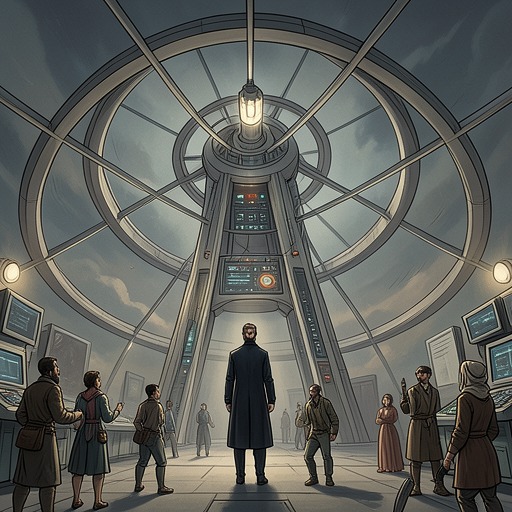
Misse's new Interface gives her information unavailable to ordinary World Deities. Sitting with Muar in an office she creates on the first floor of the essence nexus, she examines the True Interface, an immense and complicated system from which the other Interfaces are patterned. The room contains her personal effects and fragments of artifacts left by the previous rulers, but she gives those relics little attention. Their incomprehensible Appraise results belong to an ancient history; the current condition of the System is the urgent object of her rule. One of her first discoveries is an overview of essence flow. She can distinguish worlds that contribute essence from those that consume it, revealing that much of the frontier is close to neutral, with the outer fringes tending toward a net deficit and nearer worlds tending toward a surplus. A few worlds show striking deficits or surpluses, but the figures reflect the System's accounting rather than the narrower calculations of individual World Deities. The True Core itself contributes to the essence involved in quests, dungeons, and rank-ups in ways that are not immediately obvious from local administration. The Inner Worlds provide only a small share of the total surplus, while the War Worlds provide much more, and the most productive individuals include numerous Alums whose names Misse has never encountered. This knowledge changes the meaning of the crisis. Cato is not merely attacking isolated settlements or embarrassing incompetent gods; his campaign threatens the mechanism by which the System gathers and distributes the resource on which its institutions depend. Yet Misse also finds a limit to her new authority. Cato is truly outside the System: none of his works or his presence can be found within the True Interface's reach. She can see more deeply into the System than any predecessor available to her, but she cannot simply command the Interface to solve an enemy that does not belong to it.
The Emergency Program Against Cato
Misse responds to that limitation by converting authority into collective action. She tells Muar that he must resume ranking up and ascend to Deity as quickly as possible. His advancement is not a private ambition in this context; it is a staffing requirement for the defense of the System, and Misse needs an ally whose devotion is directed beyond clan interest. Her larger solution is severance. Earlier, Marus Eln and Initik had already used their authority as World Deities to suspend traffic to and from Sydea, formally declaring that movement between the world and the wider network had been halted. The two Sydean portals leading to Urivan faded gray and became unusable. That blockade illustrates the type of emergency power Misse now seeks to wield on a much larger scale: the ability to suspend ordinary circulation in the name of preserving the whole. Misse's claim makes that logic central rather than local. At a gathering of Clan heads and other celebrants, she summons the heads of the Nine Great Clans through individual portals, silences the music, and forces her new title to appear. She announces that the System has chosen her for a grave and transcendent duty, insisting that the System must become the focus of effort rather than the Nine Great Clans. Her declaration does not initially abolish territory or existing agreements; she explicitly says that she does not intend to usurp them. Instead, she presents the crisis as grounds for placing those arrangements beneath a higher priority. Misse identifies the cause of that priority without softening it. Because of incompetent individuals on the frontier, Cato has compromised essentially the entire region, and his destruction of worlds is simultaneously allowing him to steal essence from the System and grow stronger by consuming the infected worlds. Her proposed answer is simple in formulation and extreme in consequence: sever the frontier. The claim of True Deity therefore culminates not in private enthronement but in a public doctrine of emergency centralization, using sacred legitimacy to justify a rupture in the System's ordinary political geography.
Significance and Limits
The event's central tension is the contrast between Misse's unprecedented authority and the persistence of the enemy beyond its jurisdiction. She gains access to the source code of the world's sacred order, but Cato remains unreadable to that order. Her sovereignty is absolute inside the True Core while being incomplete at its boundary. This makes her claim both a solution and an escalation: it supplies the System with a center capable of coordinating a response, yet it also encourages the very concentration of power that the clan structure had previously distributed. Misse's action further reverses the meaning of religious obedience within the System. Muar experiences the temple and its crystal as a return from the nightmare of System-less existence, and his meditation there earns him Divine Insight; Initik likewise understands himself as the guardian of a people whose history began with the System's arrival. Cato, by contrast, insists that his grievance is against the System rather than its people. Misse's claim stands between those positions. She treats the System as something that must be defended and reorganized, not merely worshiped, while Cato's rebellion forces her to decide whether preserving its people requires preserving its institutions. The claim thus becomes the foundational act of Misse Eln's later rule. It confirms that the old custodians of the True Core are gone, gives her exclusive access to the System's highest functions, binds Muar more closely to her political project, reveals the hidden economics of essence, and produces a program to cut away the compromised frontier. Its decisive irony is that the authority capable of governing everything within the System cannot directly reach the one adversary who has made governance itself the battlefield.