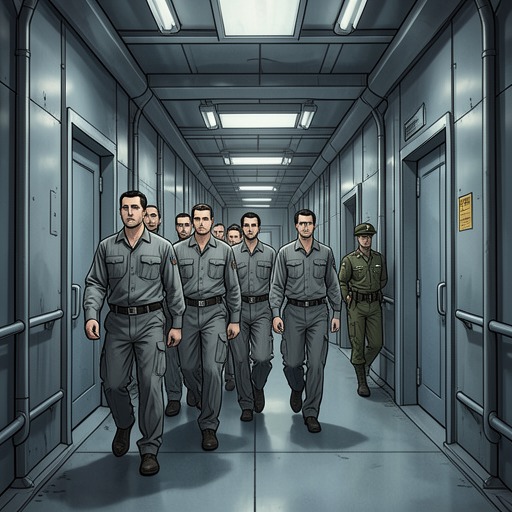
Morvan's Death
Systema Delenda EstMorvan's Death is the instantaneous dissolution of Morvan at Misse's command while the System's gods confront Cato's continuing assault on the Core. Summoned as a mortal source of technical knowledge, Morvan can identify only the broad principle of the weapon; his inability to provide a solution makes him disposable to Misse, turning the scene into a sharp revelation of how divine power treats both uncertainty and mortal life.
Circumstances of the Summoning
The death occurs during an attack whose scale has already exceeded the gods' understanding. Muar examines scry-views filled almost entirely with light, while the apparent directions of Cato's weapons lead into nothingness across the void. Misse acknowledges the attack's enormous scale but initially judges its damage non-crippling: the System is losing essence as air is restored across planets and war-worlds, yet the greater immediate wound is the scouring of vast surface regions, including ancient trophies in the Core that had been considered safe. The attack is still continuing, however, and Muar asks how long it can last.
Instead of receiving an answer from the scry-views, Muar summons Morvan from the War-Worlds. The arrival is deliberately disorienting and coercive: Morvan is taken from the middle of an activity and has no time to orient himself before the gods demand an explanation. Muar addresses him by name and identifies the phenomenon as Cato's final weapon, making Morvan's family connection to Cato the reason he is treated as a possible repository of useful knowledge rather than as an independent participant.
Morvan's Limited Explanation
Muar demands to know what the weapon is, how it works, and how long it will last. Morvan first reacts with anger at being removed from what he was doing, then looks at the screens and recognizes the assault as something resembling Cato's particle lances, but larger and operating from farther away. His answer is therefore concrete enough to establish a technological relationship between the new weapon and Cato's earlier weapons, yet too incomplete to give the gods a countermeasure.
When Muar asks what can be done, Morvan refuses the premise that the burden belongs to him. He points out that Muar and Misse are gods and tells them to solve their own problem. Misse, already exhausted by the crisis, demands whether he has anything useful to say. Morvan then supplies his most consequential conjecture: Cato may be using an entire star as the weapon's fuel. The statement does not explain how to stop the attack or predict its duration, but it gives the gods their clearest available model of the weapon's scale. Morvan also says that Cato possesses many tricks and tools that Morvan never accessed, emphasizing the knowledge gap between the cousins rather than presenting him as Cato's technical equal.
The Execution
Morvan's defiance becomes fatal because the gods measure him by usefulness rather than by kinship, identity, or the danger of killing him. Misse does not hesitate after deciding that his knowledge has no further value. Through her Interface, she removes him from existence. He has no opportunity to blink, resist, or continue the exchange: his body dissolves into dust and then into nothing.
The method matters as much as the result. This is not a conventional killing in combat, nor an execution preceded by judgment or ceremony. It is administrative erasure performed through the same System-mediated authority that governs worlds, ranks, and restoration. Morvan's death therefore repeats on a personal scale the larger machinery of purification and extermination surrounding the conflict. The gods' capacity to restore servants harmed by Cato's attack does not protect Morvan, because Misse treats his deletion as an acceptable exercise of authority rather than as damage requiring repair.
Immediate Consequences
Morvan's death yields no military solution. Muar is left frowning at the place where his summoned mortal had stood, and Misse concludes that they will have to wait and observe how long the attack lasts. The scene's practical outcome is thus negative: the gods lose the only consulted witness without gaining a defense, while Cato's weapon continues for a very long time. Misse and Muar turn instead to the System's options and spend resources restoring those injured or killed by the attack, particularly the mortal servants whom Misse believes should have been immune.
The killing also exposes the precarious position of mortals within the System's hierarchy. Earlier discussions had already treated World Deity Eis as a source of intelligence about other Ahrusk beings and regarded interrogation of mortals as beneath the dignity of the elders. Morvan's summons enacts that attitude directly. He is elevated briefly as a source of information, but the moment he fails to satisfy divine demands, the privilege becomes a death sentence. His knowledge is wanted; his person is not.
Narrative Significance
Morvan's Death is a value shift from possible usefulness to absolute disposability. The scene begins with the gods seeking an answer that might preserve the Core and ends with the destruction of the person who can offer only an imperfect explanation. Its tension comes from the gap between the gods' immense formal power and their inability to understand or stop Cato's weapon: they can erase Morvan instantly, yet can only wait for the attack to end.
The event also sharpens the contrast between Cato's methods and the System's institutional violence. Cato's weapons threaten worlds, populations, and infrastructure, while the System responds through exterminatus, portal and dungeon control, and the same logic of treating life as a system variable. Morvan's deletion is the intimate counterpart to those larger acts. The System's rulers condemn populations and erase an individual with comparable ease, revealing that their claim to divine order rests on control rather than reciprocal responsibility.
Finally, the death reinforces the political danger of being connected to Cato without possessing Cato's power. Morvan is Cato's cousin, but that relationship gives him neither protection nor decisive insight. His final usefulness lies in recognizing that the attack may consume a whole star; his final fate demonstrates that even a correct warning can be worthless under a regime that demands immediate mastery. The scene leaves Muar and Misse facing the weapon's duration without him, while Cato's assault continues beyond the reach of their understanding.