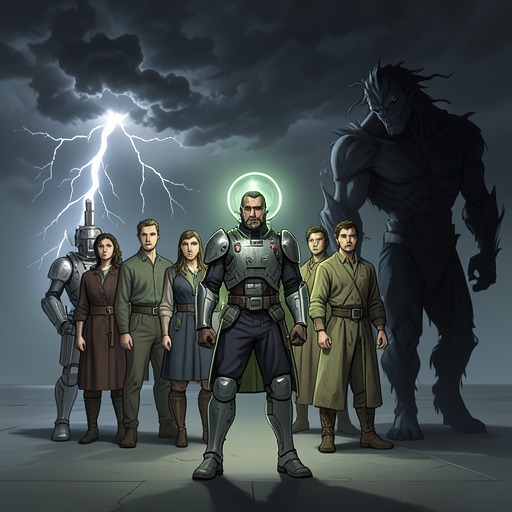
Nemesis
Systema Delenda EstNemesis is an apparently immortal and profoundly malevolent entity whose return unsettles the political and religious order around the Floating City. Its defining traits are not merely destructive power, but an inability to be permanently defeated, a hatred directed at the figures who oppose it and at creation itself, and a pattern of behavior so unusual that even Saint Misele cannot tell whether Nemesis is attacking, rescuing, or setting a trap. The character therefore functions as both a monstrous antagonist and an unanswered strategic mystery.
Nature and Ancient Hatred
Nemesis is encountered indirectly through the memories inherited by Sam after his reincarnation as a leviathan. Those memories belong to a former inhabitant of the body rather than to Sam himself, but they reveal an entity that knows the figures responsible for forming an enormous glowing sword and hates them with absolute intensity. Its hatred extends beyond particular enemies: it encompasses the world, creation, the fishes in the sea, and the birds in the sky. The memory describes Nemesis as unable to die and unable to defeat the figures opposing it, a combination that turns its existence into an apparently endless imprisonment within conflict.
The memory also presents Nemesis as calculating rather than merely enraged. When the golden sword forms above it, the entity follows a plan marked by deliberate, almost gleeful malice. It reaches beyond the world and beyond the sky, opens itself to the stars, and directs an immensely complex movement toward a precise point in space and time. The scene gives Nemesis a cosmic scale: its threat is not confined to physical strength or local violence, but involves access to regions beyond the known world and an ability to manipulate the boundary between one place and another. Sam finds the memory so vile that he regards its former inhabitant as undeniably evil, even while recognizing that the memory is also a warning about the kind of world he has entered.
Defeat, Return, and the Tashkali Crisis
Nemesis had previously been defeated in the far north, and the expected interval before its next appearance was a century. Saint Misele, who had opposed it throughout her life, therefore treats its reappearance after only twenty years as an alarming break in the established pattern. The heroes who suppressed Nemesis in the previous conflict are still alive, making the shortened interval even harder to explain. Its return is not a routine recurrence but a disruption of the timetable on which the Floating City and its defenders have based their security.
Captain Corocol reports that Nemesis appeared during the Tashkali civil war. Eyewitnesses, whose accounts were confirmed by memory magic, saw it strike a siege frostlance in midair. It then picked up several ships carrying refugees and departed with them. The action is difficult to classify. Nemesis is normally associated with slaughter, corruption, and the accumulation of power, yet here its most conspicuous act is the removal of refugees from a battlefield. Saint Misele initially fears that the tashi caught in its path have met a terrible fate, but Corocol finds no evidence that the inhabitants summoned Nemesis or served it: there were no summoning rituals, cultists, or blood sacrifices in the city beyond the ordinary bloodshed of civil war.
This intervention is precisely what makes Nemesis more frightening rather than less. Misele knows that it has never shown much interest in the tashi, while its preferred servants have traditionally been her own kind, whose subversion gives it particular satisfaction. Its early appearance, its lack of an obvious cultic cause, and its decision to leave with refugee ships all depart from the behavior she recognizes. The unexplained rescue becomes a possible tactical maneuver rather than proof of moral change.
Saint Misele’s Investigation and Suspicion
Saint Misele responds to Nemesis through investigation rather than certainty. She questions Corocol closely, tests the possibility that the tashi were in league with the entity, and weighs the absence of rituals against Nemesis’s known habits. Her reasoning is shaped by long opposition: she does not mistake an unfamiliar action for benevolence, because she understands that Nemesis’s conduct has historically been directed toward subversion and power.
Misele considers whether the previous battle was a feint. In that reading, everything Nemesis did, including allowing itself to be defeated, may have served to place it where no one expected it and draw its enemies into a trap. Corocol agrees that such an inducement is depressingly possible, though he warns against trying to interpret every twist of Nemesis’s mind. Misele accepts that excessive speculation can lead to madness, but she refuses to let uncertainty paralyze the defenders. She orders Corocol to prepare her skyship and resolves to bring the heroes back together.
Narrative Role and Significance
Nemesis embodies the horror of an enemy whose motives cannot be stabilized into a familiar pattern. Its hatred is explicit, its immortality makes ordinary victory provisional, and its most recent act combines apparent rescue with the possibility of hidden exploitation. The narrative withholds the meaning of the refugee ships and instead makes the uncertainty itself consequential: the defenders must act without knowing whether Nemesis has changed, begun a new phase of its plan, or successfully concealed its real objective.
The character also creates a sharp contrast between Sam’s moral self-correction and the inherited monstrosity associated with his leviathan body. Sam sees the former inhabitant’s hatred as a cautionary example and tries to avoid becoming the kind of being who treats the world as hell. Nemesis thus remains present even when it is offstage, as a memory, a reputation, and a model of what limitless grievance can become. Its early return forces Saint Misele to reactivate the old heroic coalition, while its unexplained movement through the Tashkali war expands the threat from a defeated northern enemy into a problem that may already extend across worlds, stars, and time.