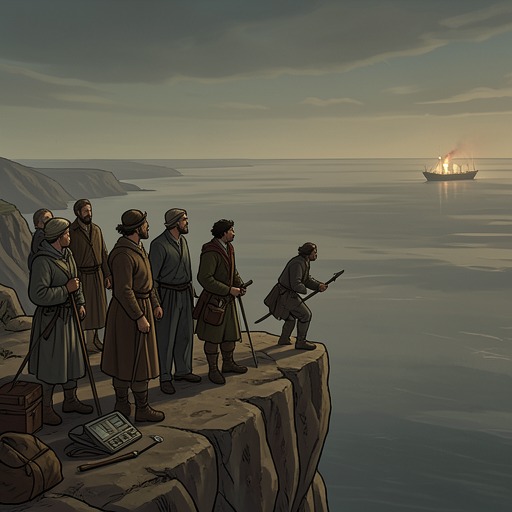
Neyar's Secession from the System
Systema Delenda EstNeyar's Secession from the System marks the moment when Neyar chooses uncertain independence over certain subordination. Facing pressure from the Core, the Nine Great Clans, and Cato's rapidly spreading forces, Neyar accepts a negotiated transition for his four worlds. The secession is not framed as a simple military conquest: Cato offers technical assistance, avoids claiming Neyar's authority, and presents withdrawal as a way to remove the Clans' hold without destroying Neyar's people. The result is an uneasy but consequential experiment in life beyond the System, combining political escape with ecological, administrative, and spiritual reconstruction.
Causes and Political Background
Mii-Es identifies Neyar as the independent deity most urgently exposed, especially because he openly defies the Clans despite being one of the most powerful among the independent gods. Her proposed solution is preemptive secession. Rather than continue resisting the Core, endure proxy skirmishes, or wait for the Nine Great Clans to close around his worlds, Neyar would move them out of the System and become fully independent. The proposal is attractive precisely because it changes the terms of the conflict: it removes the Clans' direct hold over him without requiring him to defeat them in conventional war. Neyar is suspicious of Cato's offer, but Cato's conduct gives the negotiation a distinctive shape. Cato states that he hopes to reach an agreement without harming Neyar or his people, and Neyar recognizes that the apparently unimpressive figure before him is either concealing his strength or deliberately adopting a diplomatic appearance. The central problem is practical rather than merely ideological. Neyar governs four worlds, and without the deity connection and the System's portals he would no longer be able to administer them all at once. Cato's answer is that this limitation may not remain permanent, implying that the transition can be supported by new forms of distributed administration.
Negotiation and Agreement
The Core's pressure makes delay dangerous. Kolokol warns Neyar that the worlds associated with the Hokar Clan will soon have to move regardless, and rejects Neyar's request for three weeks by granting only two. Neyar is eventually expelled from the meeting, but instead of simply refusing, he activates a communications device and contacts Cato through a Copper proxy modeled after Neyar's own species. The disguise protects Cato from their mutual enemies, while the compressed timetable reveals how little freedom Neyar actually has. Cato and Neyar then reduce the deadline still further. Neyar tells Cato that they have one week, and Cato responds without triumph. He supplies written checklists covering each affected piece of landscape, including Neyar's worlds and neighboring territories that might also come under Cato's control. This detail makes the secession resemble an emergency infrastructure project as much as a diplomatic treaty. Cato is not merely promising liberation; he is preparing inventories, procedures, and logistical coordination for a planetary-scale transfer. Neyar asks whether his private space contains base matter or is composed entirely of essence. Cato learns that everything is of divine creation and concludes that the environment is fully digital. He plans to send a pod directly above a town so that Neyar can bring it into his System Space. The pod arrives within hours, while Cato's larger forces remain several days away in the outer darkness. Their delayed arrival functions as a concrete gesture of trust: Neyar understands that Cato is interested in removing the System rather than immediately usurping Neyar's power.
The Secession Operation
Neyar grants the Cato within the capsule the blessing of Chosen, allowing him to move through Neyar's landscape without difficulty. The capsule then opens like a flower and releases millions of insects in a rising cloud. The image condenses the scale and strangeness of the operation: what appears to Neyar as an invasion force is also a technical instrument for replacing the infrastructure of the System. Neyar prepares his own population through the language of challenge and exploration. He believes his priests will listen if the transition is presented as a new venture against forces beyond their worlds rather than as the destruction of everything familiar. Cato welcomes this approach but immediately recognizes the communications problem. His other selves must receive the same message, so he proposes a leaflet campaign and offers whatever material support he can provide. The campaign is therefore both political and informational, designed to make a radical change intelligible to populations that have lived under System assumptions for generations. Neyar recalls high-rankers who are away from his worlds and issues quests directing them to return. He has deliberately kept such figures close to their homes and anchored to their local communities, which now becomes an advantage in the emergency. His intended replacement is an angelnet: quests, task guidance, and familiar administrative forms remain, but the range of possible achievement becomes far greater than anything the System permitted. Secession thus preserves selected surfaces of the old order while rejecting its ultimate authority. The decisive calculation is expressed in stark terms: between certain destruction and an uncertain future, there is no choice at all. Neyar's decision is not presented as uncomplicated faith in Cato. It is a forced but rational choice made under conditions in which preserving the old arrangement would leave his worlds exposed to Core intervention and the tightening power of the Clans.
Consequences and Wider Significance
Neyar's secession occurs within a much larger transformation. Cato's forces have reached every Inner World and established manufacturing or biological infrastructure in the darkness beyond the System's immediate reach. Muar realizes that Cato is not an opportunistic skirmisher but a spreading disease, while the Core confronts the political danger of admitting that its inner territories are compromised. Neyar's withdrawal therefore becomes part of a systemic crisis: worlds once treated as permanent possessions can now be detached, transferred, or rebuilt outside the old divine economy. The consequences of severance are materially severe elsewhere. When a planetary Nexus is removed, System-supported towns lose power and essence; lights fail, stores shut down, mountains crumble or disappear, lakes become muddy plains, and System-created forests wither. Storms appear and vanish in sudden bursts, while transplanted life can die rather than return to any pristine prior condition. Cato's planners consequently fear total ecosystem collapse, including the failure of oxygen-producing single-celled life and the disruption of oceans and coastlines. On Heyk, flora die-offs threaten atmospheric oxygen, and alien biomatter cannot decay because native bacteria cannot process it. Neyar's transition is therefore inseparable from the book's broader question of whether liberation from the System can be achieved without leaving worlds ecologically ruined. The event also exposes a sharp contrast between different understandings of the System. Muar experiences a temple on Uriva as a return from a blank, lifeless System-less void and believes that the System supplies truth, progress, purpose, and meaning. Neyar, by contrast, accepts that familiar functions may be retained in an angelnet while the System's authority is removed. Cato's project lies between these positions: he seeks to destroy the institutional control structure, not the people who have been formed by it, and therefore treats reconstruction as necessary rather than optional. Neyar's secession finally demonstrates that resistance to the System need not take the form of direct annihilation or total conquest. It can proceed through negotiated withdrawal, concealed proxies, checklists, pods, biological swarms, quests, and controlled explanations. The event turns political autonomy into an engineering problem and engineering into a new form of diplomacy. Neyar does not win by overpowering the Core; he survives by moving before the Core can decide his fate, accepting Cato's help, and building an alternative order whose familiar rituals point toward a much less restricted future.