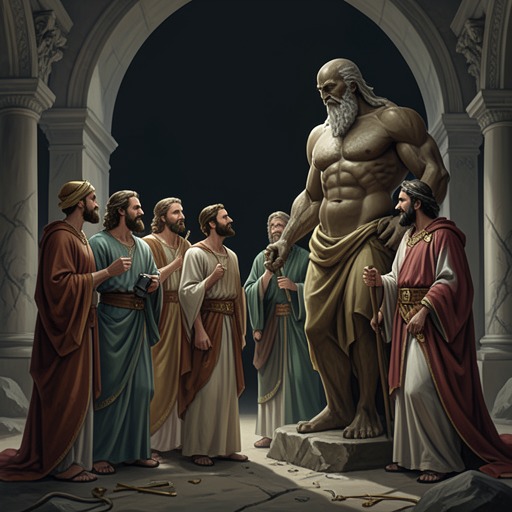
Neyar's System Space
Systema Delenda EstNeyar's System Space is the private, planet-sized domain of Neyar and the environmental expression of his sovereignty. It is at once a political refuge, a controlled habitat for four wealthy worlds, and a landscape through which Neyar thinks, remembers, and works through the prospect of severing those worlds from the System. As outside powers try to force him back under Clan protection and accountability, the space becomes the setting in which independence is tested not as an abstract principle but as a dangerous material transition.
Definition and Setting
Neyar's System Space is an Estate-like personal realm shaped by Neyar's deep connection to its essence. When Deity Ikei Hoskar and her companion arrive to pressure him on behalf of the Clans, the winds of the domain respond to his anger: orange grass ripples across the plains, storm clouds gather, and lightning and thunder interrupt Ikei's attempted reply. The reaction is not presented as a mere activation of an Interface. It comes from Neyar's intimate union with the surroundings, making the weather and terrain part of his authority rather than an external stage for it.
The domain includes a massive planet-sized expanse used to receive foreigners and visitors, as well as high cliffs and steep mountains along which Neyar runs after dismissing unwanted guests. Later, he crosses tall mountains, deep valleys, plunging waterfalls, and barren deserts within the same system space. These environments are varied enough to function as a complete world, yet personal enough to retain the character of a created private territory. The landscape simultaneously displays Neyar's power and preserves his origins; running through it recalls where he came from long ago and gives his political dilemma a bodily, geographic form.
Political Enclave and Vulnerability
The four worlds belonging to Neyar are wealthy, well-built, and well-traveled. They are few compared with the tens of thousands held by each of the Nine Great Clans, but their proximity to the Core makes them valuable prizes. The people living on them are not incidental assets in Neyar's accounting: he has deliberately ensured that they can rise against would-be conquerors and flourish. The domain therefore represents a compact but prosperous sovereignty whose worth lies both in its material resources and in the communities Neyar protects.
That sovereignty has survived repeated attempts to buy, bargain away, or bully Neyar into surrendering his worlds. His principal defense has been jurisdictional as much as military. He can ban the Clans from passing through his worlds, delving their dungeons, or using their buildings and cities; refusing favoritism keeps that threat credible, while his own prowess discourages anyone from simply taking what he possesses. Yet his independence has become newly fragile because Neyar lacks the levers over the True Core available to divine-oriented gods. The former quarrels among the Nine Great Clans once kept them distracted, but their changing alliances now make his four worlds more exposed.
The Proposed Severance
The crisis turns Neyar's System Space into the site of a decision about reality itself. Initik and Mii-Es argue that Neyar should move before the Core does and take his worlds out of the System, making them fully independent. Their proposal would end the need to resist the Great Clans, eliminate proxy skirmishes with invaders, and remove the Clans' direct hold over him, but it would also mean accepting a world no longer governed by the familiar System. Neyar does not welcome the prospect of treating with Cato, yet the pressure from Misse and the Core makes a conversation preferable to waiting until his choices disappear.
Cato's world is disturbing precisely because it makes reality and persons malleable. It can approximate the System or become something entirely different, with more guidance or less; people can be duplicated, frozen in time, or accelerated through thousands of years in a moment. Neyar's subjects might not perceive the full danger of those possibilities, but Neyar would bear responsibility for deciding which forms of Cato's technology could safely be offered and which must be withheld. The domain thus changes from a protected estate into a testing ground for political and ontological stewardship.
The transition also imposes concrete environmental requirements. Floating mountains, certain layers of ocean, and enormous caverns hollowing out entire mountains would have to be altered before the worlds could move from the System into Cato's reality, because leaving them unchanged could cause devastation. Neyar has already made some subtler adjustments, at little cost, while recognizing that he may soon lose almost all of his stock of essence regardless of which path he chooses. The physical architecture of Neyar's System Space therefore records the approach of severance: its most extreme features are liabilities to be corrected, while its essence is a resource whose future value is rapidly vanishing.
Movement, Memory, and Responsibility
Neyar repeatedly runs when political thought becomes unbearable. After Ikei leaves, he drops to four limbs and races along the cliffs and mountains to work off his annoyance. Later, after examining the coming and going of his worlds, their populations, foreign travelers using the portals, and the flows of essence between dungeons and conflict zones, he again turns away from his scry-views and runs through the terrain. The repeated movement establishes the domain as a cognitive landscape: its scale gives physical outlet to emotions that cannot be resolved by argument, while its familiar features return Neyar to his origins.
The space also contains the temptation of retreat. Neyar considers trading what he knows about Cato, Initik, and Mii-Es to the Nine Great Clans in exchange for being left alone. Such a bargain might be accepted because the Clans' own policy toward Cato would force them to accommodate Neyar's demands, but he rejects the comfort of an easy settlement. He understands that any agreement with Misse would last only while it served her, and that returning to the old order is impossible. At the top of a frigid mountain, watching wind erase his footprints in the snow, he recognizes an unsettling freedom in having little future left to plan for: everything he owns can be spent because the transition will soon make its former meaning irrelevant.
Narrative Significance
Neyar's System Space gives political autonomy a visible and vulnerable shape. It is powerful enough to produce storms, sustain four flourishing worlds, exclude the Clans, and hold immense natural variety, yet it remains exposed to forces concentrated in the True Core and to the revolutionary alternative represented by Cato. The domain's most important contrast is between permanence and mutability: Neyar has preserved it across millennia, but Cato's reality can duplicate, freeze, accelerate, or redesign existence itself.
As a setting, the space also links governance to environmental responsibility. Neyar's authority is not measured only by the number of worlds he owns or by his personal strength; it is tested by whether he can guide populations through a change that may require rebuilding the physical foundations of their worlds. The repeated image of Neyar running across his own mountains and valleys captures that burden more clearly than any political declaration. His private landscape is both the place he has defended and the reality he may have to alter, making Neyar's System Space the emotional and material center of his decision to confront, rather than evade, the coming rupture with the System.