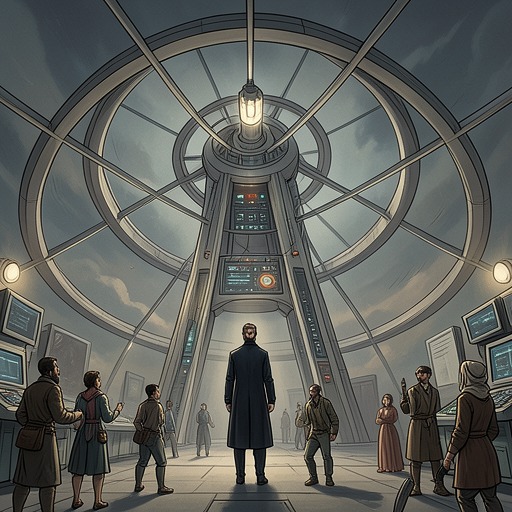
Nine Great Clans
Systema Delenda EstThe Nine Great Clans are the System’s central aristocratic power structure: a coalition of major divine lineages that seeks to bring independent worlds, gods, and territories under coordinated clan authority. Their defining significance is the way they convert crisis into governance. Cato’s campaign is presented as an existential danger, but the Clans use that danger to justify consolidation, pressure, eviction, annexation, and eventually a broader reorganization of the portal network. Against them stand independent gods such as Neyar and Mii-Es, who recognize that the proposed defense of the System is also a campaign to eliminate political autonomy.
Structure and Political Position
The Clans dominate the Inner Worlds and the nearest frontier, while independent polities remain outside their direct management. Misse Eln identifies these independent worlds as especially problematic because they have refused to join the Nine Great Clans and therefore do not automatically act according to what the Core considers necessary. Her proposed response is not immediate open war against all of them, but a staged approach designed to prevent a unified resistance: each polity is to be handled individually, while preparatory work begins at once. This reveals a structure that combines formal collective authority with competitive internal expansion. The Clans act as a bloc when confronting outsiders, yet the proposed consolidation is also a struggle over which clan will control the resulting territory. Neyar describes the pressure more bluntly. The Nine Great Clans are beginning to press him, while the Eln Clan sends messages both to other clans and to independent Inner Worlds. The language addressed to independents remains deliberately vague, but the underlying objective is clear: everyone is to fall under the purview of the Nine Great Clans, preferably under Eln leadership. Cato’s existence supplies the pretext. The Clans do not merely fear him; they use fear of him to make subordination appear unavoidable.
Crisis as a Method of Consolidation
The Clans’ political argument rests on collective security. Kolokol, a Greater Core Deity of the Hokar Clan, tells Neyar that the integrity of the divine System requires everyone to band together against an outsider capable of killing gods. Neyar rejects this framing, seeing avarice and naked greed beneath the language of emergency. His response is significant because he does not simply deny the danger. Instead, he challenges the Clans to prove their concern by inviting him into the clan structure and granting him the position he would deserve as an Elder Deity. The proposed promotion functions as a test: genuine security would require recognition and protection, whereas coercive consolidation merely demands surrender. The same logic shapes the treatment of independent gods near Core territory. Mii-Es warns that several are too close to the Nine Great Clans to remain safe and will be forcibly evicted whether or not they have taken any action. She asks Cato to reach them first and protect what they have built before the Core Worlds burn them out for refusing to hand over everything. Her request combines humanitarian and strategic motives. Rescuing the threatened gods would preserve their lives and holdings, but it would also deny the Clans an easy territorial victory and give the independent coalition more time to grow. Mii-Es further proposes that Cato remove portions from several areas rather than striking only one planet or small cluster. Such attacks would frighten the clans and make them hesitate before moving against independent gods, while also depriving them of future revenue. The calculation exposes the political economy beneath the rhetoric of defense: worlds are territory, populations are sources of essence, and purification is not only a military act but a transfer or destruction of long-term income. Even rumors of cooperation with Cato can therefore destabilize the Clans. The Eln and Lundt Clans are already at each other’s throats; the Hokar and Shoh Clans maneuver from the sidelines; and the loss of the Tornok worlds creates a power vacuum in which old scores can be settled through proxies or direct action.
Conflict with Independent Gods and Cato
The Clans’ pressure produces resistance rather than uniformity. Mii-Es expects local gods to resist assimilation even if some eventually fall into line, and she argues that infighting may delay what otherwise seems to be a foregone takeover. Neyar likewise looks for leverage against the Core Worlds, considering whether another Great Clan might be bribed into opposing the consolidation. These responses show that the Nine Great Clans are not a perfectly unified institution. Their common interest in absorbing independents coexists with rivalry over the distribution of worlds and offices. Cato’s military expansion intensifies this fracture. From Misse’s war room, assembled gods watch battles unfold across a score of worlds through a vast wall of scry-views. Ground perspectives show distant fire and sparks, while views attuned to the Nexus Shards carried by Azoths reveal dark craft in space. None of Cato’s creations is individually overwhelming, yet their simultaneous appearance on so many worlds changes their meaning. The Clans confront not one decisive weapon but a multiplying system of pressure, a form of exponential growth that becomes dangerous through scale. Their traditional ability to manage isolated worlds is strained by an opponent who makes dispersed action itself into a weapon. The resulting pressure also allows the Clans to demonstrate their own willingness to destroy. Mii-Es observes that the Elns have used the crisis both to prove that Cato is a threat and to consolidate their power by showing that they are prepared to burn their own planets if necessary. That demonstration places independent gods under even heavier pressure: refusing the Clans can mean destruction, while accepting their protection means surrendering autonomy. The choice is engineered so that either response strengthens the dominant bloc.
Portal Control and the Human Cost
The Clans’ authority extends beyond armies and territorial claims into the infrastructure that connects worlds. Through an anonymized System message, the portal network is announced as being rearranged over the following year to reflect the control of the Nine Great Clans. Independent worlds are conspicuously omitted. The announcement does not merely describe a technical change; it plants doubt about whether the System recognizes independents as legitimate political entities at all. Portal access becomes a mechanism for defining membership, visibility, and future survival. Muar supplies a counterweight to the Clans’ administrative abstraction. He notes that lower ranks will need time to return to normal after the portals reopen and that the long-term harm caused by their closure was considerable. His awareness of mortal consequences distinguishes him from gods who forget that mortals generate essence and give deities their purpose. The portal system is therefore not neutral infrastructure. Its interruption damages the populations on which divine power depends, even when the ruling gods discuss it as a matter of strategic alignment. The same tension appears in the aftermath of the Tornok purge. A Hokar visitor arrives at Neyar’s residence only weeks after an earlier visit, attempting to capitalize on the disturbance while it remains fresh. The timing suggests that the Clans treat political catastrophe as an opening for rapid acquisition. Their consolidation is path-dependent: every purge, evacuation, and portal revision changes the distribution of power, making later resistance more difficult and making the next intervention appear more necessary.
Misse Eln and the Clans’ New Direction
Misse Eln ultimately turns the Clans’ own logic toward a higher level of centralization. After celebrating the absorption of her planet into the Core, she decides that a few years of relative privation will be acceptable if the future becomes more deliberate and guided. She imagines replacing open struggles over annexation with direct allotment: worlds would be assigned to those deemed deserving, and clan competition would be redirected toward winning her favor rather than tearing territories apart. This is presented as a more prudent alternative to uncontrolled conflict, but it preserves the underlying hierarchy by placing Misse in the position of allocator. She then summons the heads of the Nine Great Clans through portals opened beside her. Even her father is brought through despite being nearby, and most of the clan heads appear startled because the System itself has summoned them. Misse forces her new title, True Deity, to display and announces that the System has chosen her for a grave and transcendent duty. She insists that the System, rather than the Nine Great Clans, must become the focus of their efforts, while claiming that she does not wish to usurp territory or overturn existing agreements. Her proposed solution is withdrawal to the Core, which she calls untainted, followed by measured expansion: one world for everyone who deserves one instead of fighting over uncontrolled annexations. The language changes the scale of the organization without abolishing its methods. The Clans are no longer to be the final center of political attention, but they remain the administrative instruments through which worlds can be allocated, protected, or excluded. When Misse later tells the elders that this is a time of renewal and that they will sever ties with the corrupted old world to build a better one, the Nine Great Clans become participants in a project that claims to transcend their factional politics while extending their reach through a new authority. That project ends in violent dislocation rather than orderly renewal. As Misse continues addressing the Clans, physics resumes around the War Worlds: a hundred suns are suddenly almost touching, gravity takes hold, and the System warns Misse and Muar before forcibly relocating them to the Font. The sequence turns the Clans’ promise of controlled reconstruction into an image of unstable transition. Their history is defined by the attempt to master crisis through hierarchy, yet each effort to impose order produces new exclusions, rivalries, and system-wide consequences.