Post-entropy age
Systema Delenda EstThe Post-entropy age is the System’s decisive threshold of material and biological transformation. At the Bismuth transition, people and objects do not merely become harder to damage: ordinary entropy stops governing their continued existence. The result is a form of System-mediated immortality whose promise of limitless persistence stands in sharp contrast to the devastation caused when the System’s infrastructure fails.
Definition and Physical Principle
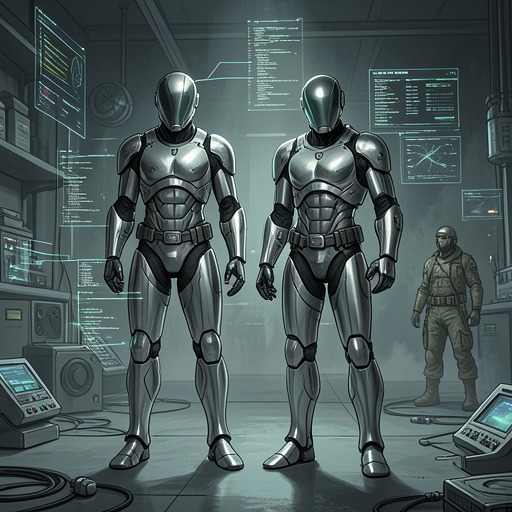
The transition alters the fundamental nature of both organisms and things. According to Yaniss’s investigation, a Bismuth being remains stable as long as some amount of essence is paid; the change is not ordinary durability, because the regular rules of entropy no longer apply to the transformed matter. Cellular activity can continue without the gradual accumulation of the errors and losses that normally make perfect functioning impossible.
This does not mean that thermodynamics disappears altogether. Heat can still move, objects can still warm and cool, and energy still requires transfer. The distinction is that the underlying processes occur without the inevitable flaw or degradation expected in an entropic system. The Post-entropy age therefore represents a selective escape from decay rather than a universe in which every physical law has been erased.
Essence and the System’s Economy
Cato’s analysis connects the transition to essence, the System’s exotic resource. His programs suggest that essence may ultimately be negentropic: instead of merely storing energy, it could generate more of itself. The conclusion is presented as extraordinary but not automatically useful, because the System’s Skill manifestations, monster creation, and information-processing functions already consume astronomical amounts of energy, and essence does not behave as though it were simply infinite.
That possibility also gives the Post-entropy age its moral danger. A self-generating resource could destabilize the universe if left without regulation, while the System appears to harness it for comparatively petty and destructive purposes. Cato therefore treats the discovery not as a gift to be appropriated but as further evidence that the System must be destroyed. The age’s physical wonder becomes part of the indictment against the institution that controls it.
Developmental Threshold and Postbiological Analogy
Cato interprets the Bismuth threshold through the structure of postbiological society. He was born fully biological and raised in a deliberately technology-light rural habitat, where he learned bodily vulnerability, fresh air, and the direct connection between labor and food. As he grew older, he could voluntarily enter more complex technological environments and accept the dangers accompanying them before finally choosing full postbiological life.
The System’s progression appears to follow a comparable logic. A threshold that grants access to immortality and effectively limitless energy would be catastrophic if placed in the hands of infants or children, just as unrestricted high technology would be dangerous before a person had developed the capacity to use it. Cato consequently considers the System a kind of ultra-advanced aestivation, possibly combined with a paperclip maximizer: a private habitat or civilizational mechanism that has expanded beyond its original purpose. He recognizes that this remains speculation shaped by his own background, and that the System might instead originate in an entirely foreign reality.
The Cost of Collapse
The Post-entropy age is defined not only by what Bismuth matter can survive, but also by what the surrounding worlds lose when the System disappears. After the System’s collapse, Heyk is left close to uninhabitable. Massive flora die-offs threaten oxygen levels, while the world lacks native bacteria capable of breaking down the alien biomatter; without intervention, the weathered organic husks would neither decay nor return to usable ecological cycles within months.
This aftermath reveals a sharp contradiction at the heart of the concept. Post-entropy matter can escape decay, yet a living world still depends on biological decomposition, recycling, and finite ecological processes. Cato’s liberation campaign therefore cannot end with the destruction of the System. On Heyk, survival requires remediation on a breathtaking scale, and even the inhabitants misunderstand the transition badly enough to burn grain crops instead of growing food. The new age offers freedom from System control, but it does not automatically provide the knowledge or habits needed to live without that control.
Narrative and Thematic Significance
The concept turns entropy into both a scientific problem and a political one. The System’s ability to defeat decay makes its hierarchy materially seductive, while its intervention on Earth has already brought technological failure, monsters, and billions of deaths. Cato’s opposition is consequently directed at more than an oppressive government: he is confronting an infrastructure that has made a near-impossible physical condition available while embedding that condition in domination, resource extraction, and catastrophe.
The Post-entropy age also makes the novel’s boundary between biological and postbiological life unstable. Bismuth bodies remain materially active rather than being remote puppets controlled by a central server, yet their cells operate through an exotic condition that ordinary biology cannot explain. The threshold is thus neither simple mechanization nor conventional evolution. It is a System-created state in which bodies, objects, energy, and consciousness enter a new material order, while the consequences of leaving that order behind remain painfully ordinary: damaged ecosystems, failed agriculture, and societies forced to relearn how to survive.