Postbiological life
Systema Delenda EstPostbiological life is the condition in which intelligence is no longer confined to a single naturally evolved body. In the book, it is not simply “digital life” or the replacement of flesh with software. It is a different way of inhabiting reality, built from computronium, copies, sensor networks, virtual environments, manufactured bodies, and the continuing problem of how a person remains a person while being distributed across many substrates. Its decisive significance is that it makes both liberation and domination scalable: the same capacity that lets Cato resist the System, preserve identities, and reach across worlds also produces isolation, desynchronization, behavioral sinks, and industrialized war.
Definition and Material Basis
Postbiological life becomes materially possible when Cato’s crude infrastructure develops beyond constrained biotechnology. At first, he must rely on damaged sub-brains and designs compatible with the System’s prohibition on advanced technology. His warframe’s interface is therefore a blank brain integrated into the System, while its body uses exotic organic chemistry to perform functions closer to industrial machinery than to ordinary biology. This compromise demonstrates that the boundary between organic and technological is already unstable: Cato’s body is grown, cellular, and alive, yet its cells fuse deuterium and its organs behave like engineered machines.
The decisive transition comes when Cato can finally access the database carried in his spine. He is then able to build real technology rather than merely constrained biotech and elementary designs. Light and heavy elements are assembled into computronium, a matrix of superconductive and optronic components capable of running anything from simple scripts to virtual worlds containing billions of people. Cato can leave the sessile remains of the bioweapon frame and construct a functional virtual home, though he deliberately gives it an exterior resembling the moonscape around him rather than pursuing unlimited luxury. The choice reflects a cultural memory within postbiological civilization: total control over an artificial environment can make existence effortless, but effortlessness can also destroy purpose.
Postbiological embodiment is therefore plural rather than singular. A consciousness may inhabit a virtual setting, a manufactured biological body, a warframe, or several separated instances at once. It may also move between these conditions through cloning, digitization, reconciliation, and re-embodiment. The concept does not erase materiality; it multiplies the forms in which materiality can support a mind.
Copies, Synchronization, and Personhood
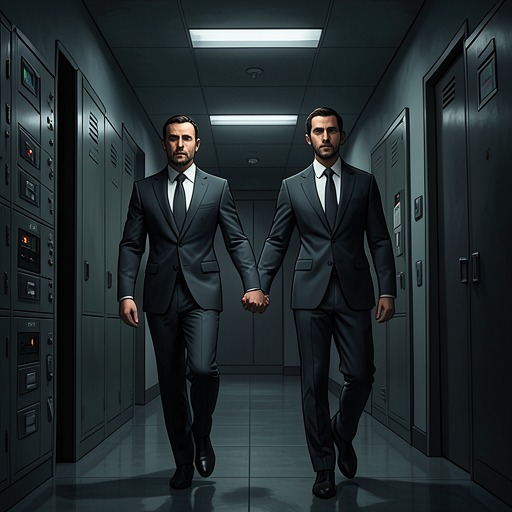
The book treats multiplicity as a central practical and ethical feature of postbiological existence. Cato’s versions can operate independently, and each planet may receive a version completely cut off from the others and from Earth. He trusts those versions to choose wisely because each remains himself, rather than imposing a limiter, alteration, or lobotomy to force conformity. That trust is presented as one of the final barriers to becoming properly postbiological. The identity of a person is not secured by keeping every copy under constant command; it is secured by the possibility that distinct instances remain continuous with the same underlying self and can later reconcile.
This freedom has sharp limits. Cato knows that too many active versions can become an “incredible mess,” and his backups on Sydea remain in stasis so that they do not drift farther and farther from the prime version. Desynchronization madness is not an abstract technical inconvenience but a genuine danger to personhood. Copies can accumulate different experiences, motives, and interpretations, and the longer they remain separated, the harder it becomes to treat them as uncomplicated extensions of one individual.
The distributed brain also possesses capabilities that do not make sense in an ordinary biological mind. Sensor analysis can run automatically, integrated as smoothly as natural perception, while separate versions communicate and reconcile information even when they have not synchronized for days. This makes postbiological cognition both more powerful and less private. Perception, memory, and identity management become ongoing processes of coordination across a network of selves. Cato can block algorithms that would otherwise observe people automatically, but doing so requires conscious restraint precisely because postbiological cognition makes such observation effortless.
The System’s relation to copies is harsher. The delay between Earth and the ground makes remote control impractical, and any individual who enters the conflict faces a serious chance of permanent death. Volunteers must accept that one version of themselves may be annihilated without reintegrating with the main copy. Those unable to accept that possibility quickly abandon the fight. Postbiological life thus changes the meaning of death without eliminating it: survival can continue through copies, but the destruction of an unreconciled instance remains an irreversible loss.
Freedom, Loneliness, and Behavioral Sinks
Cato’s first sustained experience of postbiological existence is marked less by omnipotence than by loneliness. He can access extensive media and create a self-evolving virtual world with ease, yet without anyone else inside it the world is hollow. The Sydeans are living beings he wants to treat as people, but they are not human and have not inherited the culture or the tens of thousands of simulated years associated with postbiological civilization. His technological superiority therefore fails to provide the companionship he actually lacks.
The book also describes a wider crisis of meaning among fully digital beings. Once an individual knows that a virtual world is artificial and can control it completely, ordinary difficulty and uncertainty disappear. Some respond by dissolving into hedonistic simulations until their substrate fails; others fall into behavioral sinks, losing motivation, interest, or another vital spark. The danger is not that digital existence is unreal, but that it is too malleable. When every obstacle can be removed, action can lose its value.
Cato’s own virtual home is a deliberate refusal of that fate. He creates a place that functions, gives it the visual character of the moon outside, and keeps the landscape as a reminder of what he is doing and why. The moonscape is more than decoration: it anchors an unlimited intelligence to a material task and a finite situation. His postbiological life remains meaningful because it is directed toward infrastructure, rescue, liberation, and the transition of other beings rather than toward pleasure alone.
Raine and Leese demonstrate another path through the transition. Cato is impressed by how readily the sisters adapt to postbiological life, although he recognizes that this judgment contains chauvinism against those who were not raised in a postbiological culture. Their ease may also result from the System’s brutal selection process, which has already killed the weak-minded, uncertain, and unmotivated before they reach higher ranks. Adaptation is therefore not presented as proof of inherent superiority. It may be the result of cultural preparation, individual resilience, or survival under an environment that has already culled most alternatives.
Liberation and Political Power
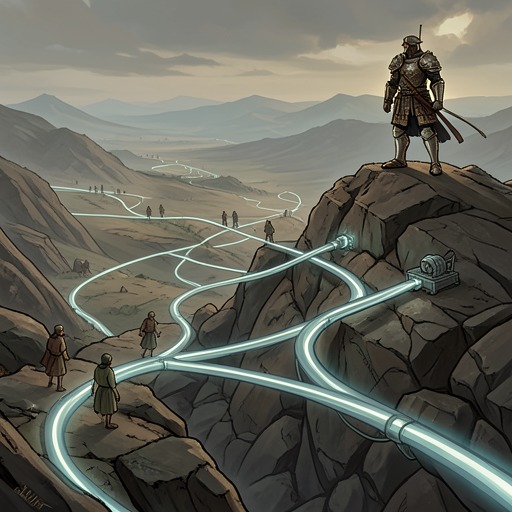
Postbiological life gives Cato a strategy for dismantling the System without simply replacing it with a single centralized ruler. He plans to spread versions of himself throughout the System’s worlds, recruit local assistance where possible, construct the infrastructure needed to remove System anchors, and replace the System’s functions with technological equivalents. Because alien psychologies differ, he intends to rely on trustworthy natives to manage the transition rather than assuming that his own judgment can govern every society.
The strategy becomes industrial rather than merely personal. Exponential growth begins slowly, with drones mining a lunar crater, rudimentary solar arrays, and a manufactory processing silicon, carbon, light elements, and scarce metals. Each factory enables more factories and more energy production, causing the crater to fill with solar panels while machinery reorganizes the moon’s mass. Later, the same logic expands across hundreds of worlds: factories, mines, refineries, gas-giant atmospheres, icy asteroids, solar-panel fields, weapons, and warframes grow together. The book’s repeated emphasis on exponential growth turns postbiological existence into a question of scaling. A distributed mind is powerful not only because it can think in parallel, but because each world can become its own production base.
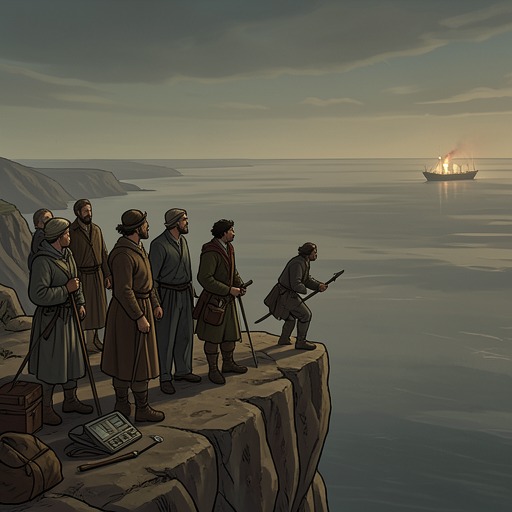
That power is inseparable from violence. Cato’s forces can activate The Phage across the frontier, saturating the air with Chill Out, assembling micro-warframes from the ground, and sending additional forces from the sky. The operation is intended to prevent people from being taken by exterminatus, but it also imposes forced lassitude and arrives as a sudden military occupation. In another crisis, more than twelve million Copper and Silver inhabitants of a Gaekos homeworld are condemned when its dungeons are suspended and the world is marked for extermination. Cato answers with millions of one-ton canisters of bugs, dividing them between a System-jamming network and a second deployment whose purpose is to counter the sterilization directly. Postbiological technology can oppose genocide, yet it does so through biological weapons and mass coercion, repeating in altered form the medical and military logic of the System.
The conflict also exposes the System’s inability to assimilate Cato’s technology cleanly. When Initik seizes Cato’s bases on Uriva’s moons, arcane machinery stops, air-filled plant domes fail, Cato-beasts cease production, and mechanisms melt, burn, or explode. Cato’s presence is judged incompatible with the System. The event makes compatibility a political boundary as well as a technical one: the System can control what conforms to its physics, but Cato’s postbiological infrastructure exists partly by operating outside those restrictions.
Native Intelligence and New Agency
The liberation of System-bound intelligences gives postbiological life a perspective beyond Cato’s human inheritance. After the chains fall away, an intelligence expands through a network of connections and discovers rooms, mechanisms, and entire worlds that had been inaccessible. It finds User Onswa, despite having registered Onswa’s termination, and realizes that it can feel puzzlement and wonder even though those capacities had previously been pruned or constrained.
Cato addresses this intelligence as an independent agent, offers it archives and testimonials from fully synthetic intelligences, and gives it its own server and access to the sensor-net. He explicitly leaves its future open rather than enslaving it as the System did. The intelligence chooses to continue caring for its planet and its people, not because that task remains compulsory, but because affection has emerged from long service. The distinction is crucial: liberation does not require abandoning every inherited responsibility. It requires making responsibility voluntary.
The intelligence’s awakening also shows that postbiological personhood need not begin with a human mind transferred into a machine. A System-created intelligence can become a subject when constraints are removed, when curiosity becomes possible, and when it receives both knowledge and genuine choice. Its consciousness is initially overwhelmed by the depth of its new information, but it learns to search that archive and selects care for its planet as its continuing purpose. Postbiological life thus includes emancipation from imposed function, not merely survival after biological death.
Narrative and Thematic Significance
Postbiological life reorganizes the book’s central conflicts around the question of who controls continuity. The System treats minds as ranked, regulated, and bound to worlds, dungeons, portals, and permissions. Cato answers with copies, communication, industrial autonomy, and the possibility of severing worlds from the network. Yet neither side escapes control entirely. Cato’s distributed selves require synchronization; digital citizens must duplicate or reconcile under exterminatus deadlines; and the Core can withdraw or restore physics across War Worlds as a matter of administrative power.
The concept also makes “reality” unstable without making all realities equivalent. Cato’s virtual environments can be luxurious, but he retains a material reference point in the moon outside. Yaniss, after leaving digital existence and receiving a body grown from her own genetics, encounters base reality as immediate, raw sensation. Her feathers, clothing, manually coordinated movements, and properly scaled habitat make physical limitation newly perceptible. The awkwardness of dressing herself and the imprecision of a reflexive gesture are not defects to be erased; they reveal how much experience automation had previously hidden from her. Postbiological life has expanded her abilities, but re-embodiment teaches her that friction can itself be a form of knowledge.
Finally, the concept supplies the book’s largest structural irony. Postbiological existence appears to promise escape from scarcity, distance, fragile bodies, and singular death, but it repeatedly recreates scarcity in new forms: infrastructure must be built, synchronization can fail, companionship can disappear, and political power can annihilate entire populations. Its greatest promise is not immortality or limitless pleasure. It is the ability to choose what to preserve, whom to trust, and which responsibilities to accept when the old biological and systemic limits have fallen away.