Raine
Systema Delenda EstRaine is one of the story’s most persistent figures of adaptation. She begins as a cautious but capable spellcaster, survives an encounter with a creature the System cannot categorize, and later becomes a technologically augmented, digitally backed-up, and politically consequential traveler across the System. Her changing names and bodies do not erase her continuity; instead, they make identity itself one of the central problems of her life. Whether appearing as Raine Talis, Raine Uriv, Raine Sunac, Raine Heimdall, Raine Sekhel, or Imel Miche, she is repeatedly forced to negotiate the distance between the person she has been, the role others assign her, and the person she chooses to become.
Identity and Introduction
Raine is introduced as one half of a long-established combat partnership with her sister, Leese. The two have spent more than five years adventuring with Cormok and Muar, but Raine and Leese remain the more cautious members of the quartet. As spellcasters, they lack the heavy defenses of the two frontline men, and Raine’s caution is therefore practical rather than timid: she understands exactly how exposed a caster can be when facing an enemy whose power is physical, immediate, and poorly understood.
That balance of caution and commitment is visible when the party investigates the devastation around the Ahrusk Portal Staging Area. The former camp has been reduced to blasted craters, some lined with molten glass, after a defense quest draws the party into a conflict that had already involved Golds and Platinums. Raine recognizes that the scale of the destruction exceeds an ordinary party’s assumptions, yet she does not withdraw. She and Leese prepare their defenses while Cormok and Muar engage more aggressively, establishing the difference between the sisters’ measured approach and the men’s willingness to gamble.
Raine’s first major ordeal also reveals the limits of the System’s authority. Her party can barely see the target even through fire, and the flames expose only a flaw in its camouflage. When Raine casts Appraise, the result is not a failed identification but the System’s inability to categorize the creature at all. The encounter turns the System’s interface from a source of certainty into a source of misleading confidence. The danger becomes personal when the creature hurls Raine into a tree, tears open her chest despite the heat of her defenses, and closes its enormous jaws while her battered companions charge too late. Her final realization in that moment is that the System had been drastically wrong about the target, a discovery paid for in blood and nearly in death.
Bodies, Names, and Technological Rebirth
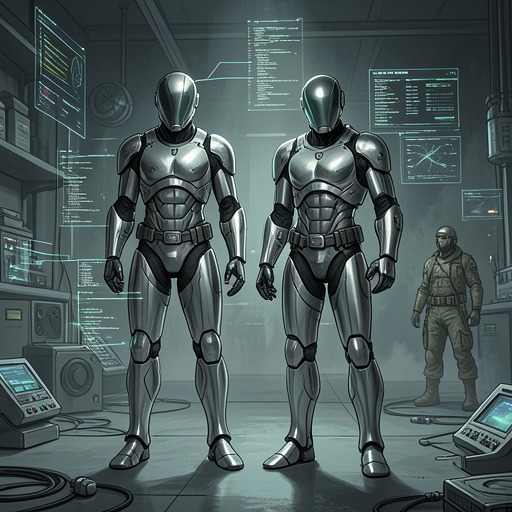
Raine’s later existence is inseparable from bodily transformation. When Cato operates through a Sydean frame, the body’s altered joints, scent processing, visual spectrum, and depth perception demonstrate that embodiment is not a cosmetic shell but a different sensory mode of being. Raine and Leese undergo a related transformation when they take bodies under the names Raine Uriv and Leese Uriv. Their new frames are closer to standard augments but incorporate improvements beyond raw strength, including full electromagnetic communications built into their biology.
The new bodies also change the conditions of survival. Raine and Leese can be tracked from orbit and backed up continuously, without relying on the earlier pseudo-bioweapon arrangement. Their existence becomes distributed across biology, communications infrastructure, and stored continuity. This does not make their identity simple. It creates a tension between the persistence of a remembered person and the technical systems that preserve, monitor, and reproduce her. The sisters’ transformation therefore extends a pattern already present in Raine’s first encounter: the System may provide information or structure, but it cannot be trusted to define the whole of reality.
Communication is equally important to Raine’s transformed identity. Cato restores contact through communications lizards worn on the sisters’ heads, explaining that obtaining secure communications without alerting the System is difficult and that worldwide communications are still incomplete. The device is more than a convenience. It allows Raine and Leese to remain part of a distributed resistance while concealing the channels through which that resistance operates. Their bodies, memories, and relationships become coordinated through technologies that bypass the System’s normal visibility.
Combat, Advancement, and the Choice of Movement
Raine’s progression through the rank structure is marked by disciplined combat rather than a simple appetite for violence. In the Platinum Rank Trial, she and Leese fight a hulking stone golem whose stone spikes and flechettes erupt from the chamber walls. Raine brings down the final guardian with her spear after the sisters gradually chip through its immense bulk; Leese’s concluding trial is less difficult, requiring them to cut through a swarm of amphibians. These trials show the sisters functioning as a coordinated unit while also confirming Raine’s ability to endure prolonged, technically demanding engagements.
Their later rise to Bismuth forces a more intimate decision. With Yaniss’s advice in mind, the sisters consider what kind of Skill should shape their future. Offensive Skills would draw them toward ever more combat, while defensive Skills would presume that they had something fixed to protect. Sensory Skills, like those chosen by Yaniss, would make them more esoteric. They choose movement instead. The decision is presented as more than a tactical selection: a Skill would influence how they saw the world, what they found attractive, and perhaps their basic nature. Movement suits them because they are already wanderers, but the choice also preserves an identity founded on escape, range, mobility, and refusal to remain confined by any single world or institution.
Raine’s movement is both literal and relational. During the guardian arena battle, Lorraine’s attacks send building-sized crystal lances across an arena a hundred miles wide, shrinking the available fighting space and sharply limiting safe positions. Raine shifts dozens of miles in a blaze of flame to evade one projectile. When the elemental becomes vulnerable after launching another lance, she shares a wordless intent with Leese, and they dive together, combining fire and ice against the cracks opened by Lorraine’s acid. Their victory depends not on isolated heroics but on timing, shared perception, and the ability to move as one combat organism.
Sisterhood and Distributed Selves
Raine’s defining relationship is with Leese. The sisters’ communication exceeds ordinary speech: when Raine receives a new weapon, she broadcasts her impressions and Leese responds with her own, allowing them to exchange perspectives and instincts in a single condensed burst. Years of relying on one another have made their link nearly automatic. It is simultaneously a combat advantage and an emotional structure, a form of intimacy that remains meaningful even as their bodies, names, and affiliations change.
Their relationship also extends across the many versions produced by lineage and technological divergence. Cato becomes aware of silent battles among other versions of Raine, many of whom share an interest in fighter craft and maintain comparable fleets in orbit. Even when those versions have diverged significantly, a recognizable pattern persists: Raine’s variants are drawn toward mobility, machines, and the strategic possibilities of space. Their similarity is not presented as proof that every version is interchangeable. Rather, it suggests that continuity can survive divergence through recurring desires, skills, and habits.
The naming changes make that problem visible. Raine appears as Raine Sunac in relation to Sunac, as Raine Uriv after the sisters take new bodies, as Raine Heimdall in another branch of existence, and as Raine Sekhel before becoming Imel Miche. The names register marriages, worlds, bodies, affiliations, and lineage positions. They are social interfaces imposed on a person whose life repeatedly crosses those boundaries. Raine’s story consequently treats identity less as a single immutable label than as a continuity maintained through memory, partnership, action, and recognition.
Political and Religious Contexts
Raine’s life unfolds against institutions that claim the power to interpret her. The System’s quests, rank trials, naming structures, and divine hierarchy repeatedly classify people according to rules that can be useful, oppressive, or simply wrong. Raine’s early encounter with the uncategorizable creature exposes the danger of treating System information as complete. Later, the sisters’ anonymity blessing allows them to enter the Core Worlds as welcomed elites rather than as suspicious outsiders. Their second journey there becomes difficult not because they are excluded, but because too many people compete for their attention. The change in reception shows how quickly social status can be transformed by a system of recognition.
Raine also inhabits the contradiction between devotion and disillusionment. Muar’s meditation at a temple on Uriva, communion with the System crystal, and sense of divine presence provide a religious model built on submission to the System. Raine’s own experience points in the opposite direction. She witnesses the System’s mistaken judgment, survives through technologies that evade its surveillance, and becomes part of Cato’s broader effort to oppose the institution that has pillaged worlds. The contrast does not make Raine a simple atheist or doctrinal rebel; it makes her a practical skeptic whose understanding is formed by consequences. What matters to her is whether an authority protects people, tells the truth, and permits them to choose their own future.
Cato’s political projects place Raine within that emerging alternative. He uses Raine and Leese as visible proof that the System has exploited people from other worlds, telling a king that the sisters’ presence is not coincidence but evidence of foreknowledge and preparation. Elsewhere, Raine is included in diplomacy concerning Uriva, its moons, and possible negotiations with Initik and other System-Gods. Her presence signifies more than military strength: she embodies the displaced population whose testimony gives Cato’s campaign moral and political force.
Change, Survival, and Narrative Role
Raine’s arc moves from vulnerable adventurer to mobile, technologically sustained, and politically significant survivor. The change is not a clean ascent. She is nearly killed because the System misidentifies her enemy; later, she must bargain with clan-backed institutions that exploit their monopoly, including a smith who demands four times the base price for equipment lasting to Peak Azoth because the sisters are not Clan members. Her anger at that treatment reveals that advancement does not remove structural dependence. Even powerful outsiders remain exposed to systems that control access to tools, ranks, and recognition.
Her response is neither passive acceptance nor reckless destruction. Raine keeps moving, keeps learning, and keeps working with Leese. She fights through trials, travels into the Core Worlds under protected anonymity, operates among orbital fleets, and participates in battles where the scale of the arena itself becomes a weapon. At the same time, she remains capable of uncertainty: on Uriva, she has no idea what to do with herself, an unusually direct moment of disorientation for someone whose life has been organized around action and movement. That uncertainty gives her development human depth. Mobility is her chosen principle, but movement does not guarantee purpose.
Raine’s significance lies in how she joins bodily transformation to ethical continuity. Her bodies can be augmented, her consciousness can be backed up, her names can change, and her variants can diverge, yet the relationship with Leese and the accumulated memory of being misjudged preserve a recognizable center. She is not simply a warrior progressing through ranks. She is evidence that a person can survive the collapse of inherited categories without becoming a mere copy, tool, or System entry. Her movement through worlds becomes the story’s counterimage to the System’s fixed classifications: where the System wants a readable target, Raine remains a living, changing subject.