Raine and Leese join Punchy Bastards
Systema Delenda EstRaine and Leese join Punchy Bastards after being drawn to the guild’s unusual combination of exclusivity, independence, and irreverent identity. Their admission is not presented as a routine registration but as a threshold crossing: two powerful outsiders enter a hidden organization whose status, internal structure, and members challenge their assumptions about the System’s upper ranks.
The Invitation and the Guild’s Reputation
Punchy Bastards first distinguishes itself from the other factions and guilds that court Raine and Leese after their appearance in the Inner Worlds through its name and its messenger. The name is deliberately irreverent in a political landscape dominated by grand factions, while the invitation comes from an Alum—the first one they have seen. The invitation itself is almost comically spare: an Alum appears, says that they should join, and vanishes. Its brevity makes the offer more mysterious rather than less consequential.
Raine and Leese investigate before accepting. Punchy Bastards is described as incredibly elite, with no clear recruitment policy, yet it is also entirely insular. The guild owns exactly one town on each War World and has no visible political maneuvering, recruitment campaigns, or attempts to cultivate influence. Unlike organizations tied to the major factions, it owes no fealty to them and operates independently. That combination gives the guild a reputation strong enough to draw Raine and Leese to its central hall on War World Lek, despite their uncertainty about what membership actually entails.
Their decision is also practical. They must affiliate with an organization because outsiders pay additional costs to use buildings, while some privileges of the highest ranks are unavailable to unaffiliated individuals. Among those restricted privileges are resurrections they have already earned. Joining Punchy Bastards therefore becomes both a strategic necessity and a test of whether an organization can provide access without demanding political submission.
Crossing into the Guild House
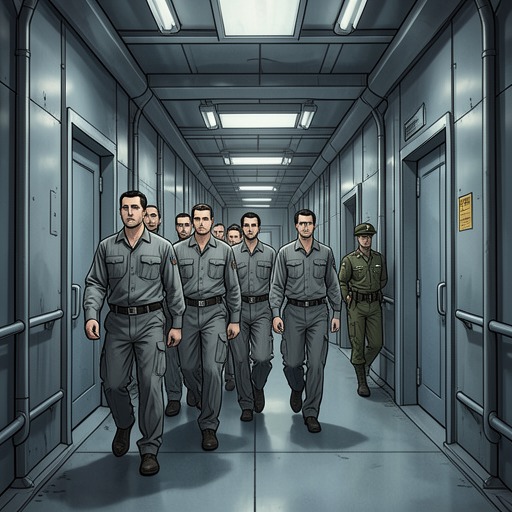
The Guild House of Punchy Bastards is smaller than Raine expected, but its modest exterior conceals a far larger and stranger interior. Instead of the ornate, oversized architecture associated with other Guild Halls, it retains the form of a white System block transformed into a dark-grey metal building with sturdy columns and large windows. The windows are opaque from outside, and sensory obstruction prevents Raine and Leese from determining what lies within. Yet the building does not display the obvious wards found in other cities, making its protection difficult to read rather than visibly imposing.
The threshold changes their perception immediately. When Raine touches the door, it opens silently. Once the pair cross inside, the protections fall away and the interior becomes perceptible. They discover four distinct Alum signatures and a dozen Azoths, a concentration of high-ranking individuals far beyond what they expected from the building’s exterior. The guild house contains crafting areas, sparring rooms, lounges, bedrooms, and the other facilities normally distributed through a city, but arranged within a single Guild Hall.
The building functions as more than a headquarters. Skylights admit sunlight from the surrounding world, while other windows open onto War Worlds and appear to function as portals. The hall is consequently closer to a Nexus than most capital cities. Its physical design embodies the guild’s institutional character: outwardly compact and unassuming, inwardly expansive, self-contained, and connected to multiple worlds without appearing dependent on the larger factions.
Shiel-Ruyu’s Terms of Membership
The Alum who invited them is Shiel-Ruyu the Punchy Bastard, a towering blue figure nearly twice Raine and Leese’s height. He has four muscular blue arms, a blue torso, white hair, three differently colored eyes, and an elongated, square-jawed face marked by exuberant cheer. His clothing is limited to simple pants and a white medallion hanging from a piece of twine, suggesting that reaching Alum rank has placed him beyond the equipment normally supplied by the System.
Shiel-Ruyu welcomes them with all four arms spread wide and says that they will fit in with the guild’s new blood. Leese, however, refuses to treat the invitation as self-explanatory. She asks what the guild actually is and makes clear that they want information before joining, discarding much of the deference ordinarily offered to someone of a higher rank. Shiel-Ruyu accepts the challenge without offense and leads them away from the vestibule with effortless physical grace rather than Skills.
His explanation defines Punchy Bastards by contrast. Other guilds are characterized by rivalry, maneuvering for higher positions, and compulsory missions. Punchy Bastards rejects those activities. Its purpose is simply to be good at being good: an elite association organized around ability rather than factional politics, formal advancement schemes, or outward expansion. The guild’s independence is therefore not merely a legal condition. It is also a cultural refusal of the competitive bureaucracy that structures much of the System.
The Guild Trial and the Human Ally
Shiel-Ruyu offers a spar before Raine and Leese sign up. He does not propose to fight them himself; instead, he points to Lorraine, a newly arrived human member of Punchy Bastards. Lorraine is one of the Ahruskians who entered the System several years earlier. Her presence is startling to Raine because she is another successful human operating at the guild’s highest levels, even though her body differs from Cato’s and from the golden forms of Cato’s cousins. She has long red hair, a more muscular build, and an augmented base form that appears less advanced than Raine and Leese’s but still exceeds that of most System natives.
Lorraine responds immediately when she hears her name and moves toward them with a movement Skill unfamiliar to Raine. The combat brains nonetheless identify the underlying physical enhancement and warn that she may possess advantages Cato has never considered. Raine also recognizes the strategic value of a human ally: membership in Punchy Bastards already marks Lorraine as an elite, and her success within the System could provide knowledge unavailable to ordinary System natives. Cato’s supplies include rations and meals intended for humans and other species, giving Raine and Leese a possible means of approaching her through practical generosity rather than abstract diplomacy.
The trial takes place in an arena that makes the word seem inadequate. It is not a simple circle but a miniature world covering several hundred square miles, with mountains and valleys large enough to require a full landscape because Azoths can clash across enormous distances. Even so, the terrain offers little protection from Raine and Leese, who can cut mountains in half; Lorraine can presumably do the same. The scale of the arena establishes the power level of the guild’s members before the fight begins.
The proposed contest is two against one, and therefore not a fair duel in conventional terms. Its immediate purpose is recreational and evaluative: Lorraine can show Shiel-Ruyu what she can do, while Raine and Leese can demonstrate their own abilities before joining. They remain careful not to underestimate a human, since Lorraine may be more skilled than they are or may match their combat brains and augmented biology through different advantages. Raine has to remind herself how to treat a spar as something other than a fight for survival, because most of her recent combat has been genuinely lethal. Against an Azoth, however, even a blow that would kill a lower-ranked opponent may amount only to inconvenience; a chest-piercing strike, as they learned in their battle with Muar’s people, does not necessarily kill, and life-saving artifacts can deflect or mitigate lethal damage.
Raine tells Leese that they should take the fight at least somewhat seriously. Leese agrees, and together they summon their Skills. At that moment, the guild initiation becomes an active test rather than a conversation about membership. Punchy Bastards has offered them entry, but entry is framed through demonstrated competence: the organization’s principles are not explained only by Shiel-Ruyu’s words, but enacted through a spar against one of its elite human members.
Meaning of the Accession
Raine and Leese’s joining of Punchy Bastards marks a movement from celebrated outsiders toward institutional belonging. Their previous power is not enough to guarantee full access to the System’s highest-rank benefits, and their unusual status has attracted multiple factions. Punchy Bastards offers a rare alternative to ordinary factional dependence: affiliation without fealty, elite resources without visible political obligations, and a community whose membership is defined by capability rather than public recruitment.
The event also expands the narrative’s map of humanity within the System. Lorraine’s appearance proves that Cato is not the only human to have achieved an exceptional position, while her connection to Punchy Bastards gives Raine and Leese access to a possible bridge between Cato’s off-world knowledge and the guild’s hidden expertise. The guild house itself reinforces that possibility. Its concealed interior, portal-like windows, concentration of Alum and Azoth members, and vast arena all reveal a society operating beneath the visible politics of the Inner and War Worlds.
Most importantly, the accession is conditional rather than ceremonial. Raine and Leese enter the guild’s sphere, but the final movement of the scene is toward combat. Their membership is defined by a test, and their future standing will depend on whether they can prove themselves among people whose abilities already make ordinary rank comparisons inadequate. Punchy Bastards thus becomes both refuge and proving ground: an independent home for exceptional figures, and a new arena in which Raine and Leese must establish what their own exceptionalism means.