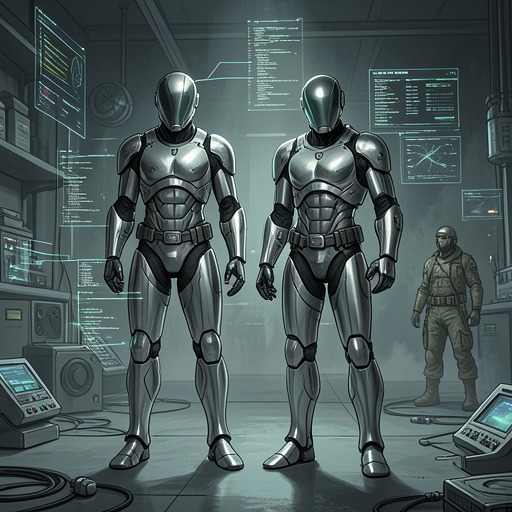
Raine and Leese’s Digital Rebirth
Systema Delenda EstRaine and Leese’s Digital Rebirth marks the sisters’ transition from embodied System adventurers into independently housed digital beings. Cato activates stored gestalts after the original versions have already carried his campaign onward, giving Raine and Leese a second existence in which survival is inseparable from questions of substrate, property, autonomy, and the difference between a convincing world and base reality.
Causes and Preparation
Cato reaches the decision to activate the pair while isolated on a moon, operating for the moment as little more than a solar-fed server surrounded by rock, methane, and water ice. His infrastructure is still being assembled, and molecular assemblers must produce enough computronium before he can create a proper virtual environment. The practical reason is strategic: the versions of Raine and Leese already active on the planet below cannot spread Cato rapidly enough across multiple worlds, and a campaign conducted one planet at a time risks allowing the System to isolate him again, as it did on Sydea.
The strategic calculation is accompanied by a personal motive. Cato is lonely and does not want to spend months watching resources accumulate in isolation. The gestalts of Raine and Leese have been stored in the same diamond-like crystal encoding as Cato, but he carefully distinguishes them from living persons, noting that gestalts are not necessarily people even when they are close to personhood. Once each sister has a separate substrate rather than being forced to share hardware, Cato starts them in a virtual world built with sufficient processing power to provide a full sensory experience.
Awakening in Cosmic Beach Aestivation
Raine Talis wakes abruptly in a pale blue room that initially resembles Cato’s habitat above Sydea, although the absence of essence and the unfamiliar details quickly disprove that impression. An ocean breeze enters through open windows, carrying salt and the warmth of sand, while the sound of waves fills the room. The apparent scenery then changes without transition: the windows become a gray square displaying an interface, which announces that she is in Cosmic Beach Aestivation and asks her to choose how she will interact with the system through direct feed or verbal commands.
Outside, the simulation presents an immaculate beach of white sand, an opalescent ocean, and a huge ringed planet suspended in a clear blue sky. Leese emerges from the neighboring beach house, and the sisters immediately respond differently to the setting. Leese accepts its apparent reality because it feels real enough to her, while Raine remains suspicious, certain that Cato’s involvement implies a hidden complication. Their shared environment is therefore pleasant but not innocent: its beauty functions as an introduction to the problem of digital existence rather than as an escape from it.
Cato enters only after both sisters accept his guest request. A patch of sand suddenly becomes a stone circle, and he appears in his Ahruskian human form. The abrupt materialization makes him seem almost magical to Raine, although the effect is produced by the capabilities of their digital environment. Cato explains that the original versions have already completed the plan they remember preparing: they delivered him to a moon on another world, and he is now building there. The beach is not that physical planet but a locally hosted private reality, originally intended as a vacation or retirement space.
Substrate and Autonomy
The sisters’ rebirth is defined by a new relationship to their own bodies. When Raine opens the Substrate Interface, she sees a diagram and perspective view of the substrate that contains her. It is smaller than her thumbnail, yet it is presented as the place where she lives. The interface reports energy consumption, permits her to alter her perception of time, and provides maintenance options. Leese’s unease at being represented as a small square exposes the central strangeness of their condition: an apparently expansive person has become a minute physical arrangement supporting an enormous subjective world.
Cato refuses to make that arrangement a form of ownership. He tells the sisters that controlling their substrates and virtual locations would make them slaves regardless of how kindly he behaved. Instead, they control their own substrates, possess the shared aestivation, and have access to the basic libraries in their databanks so they can remain independent. The distinction between assistance and domination is thus built into the rebirth’s technical design. Cato has provided the hardware, environment, and knowledge, but he treats bodily autonomy and property autonomy as necessary conditions of their continued personhood.
That generosity does not make the power relationship disappear. Leese recognizes that Cato has gone to extraordinary lengths for them, and Cato admits that total authority makes him feel unclean. His discomfort establishes a contrast with the System’s coercive control. The sisters’ digital life begins under Cato’s technological patronage, but it is deliberately structured to prevent patronage from becoming enslavement.
Identity, Coordination, and Wider Stakes
The rebirth also changes how the sisters participate in Cato’s larger campaign. The existence of multiple versions means that continuity is no longer simple: surface versions have already acted, stored versions awaken later, and future updates may be required to keep them coordinated. Cato expects to exchange information with the versions on the surface if communication becomes possible, while the newly activated sisters are given a virtual world in which they can understand their condition before taking on further work.
Their digital awakening occurs against the background of worlds being freed from the System and then exposed to severe material consequences. When a planetary Nexus is destroyed on Sydea, System-supported towns lose essence, lights and stores shut down, mountains crumble or disappear, lakes become muddy plains, alien forests wither, and native ecology begins returning amid enormous scars. Later, the collapse of the System on Heyk produces massive floral die-offs, declining oxygen, and biomatter that cannot decay because native bacteria cannot process it. Cato’s digital infrastructure therefore represents both continuity and emergency capacity: while physical worlds undergo ecological collapse, minds can be preserved, copied, distributed, and coordinated, but only through elaborate engineering and contested decisions about what counts as survival.
The same tension appears elsewhere in the narrative. A System interface is extracted from a gem through mindripper software, and Cato’s organic warframe bypasses technological restrictions by using biology whose cells and organs function more like industrial machinery than natural tissue. Yaniss later experiences the opposite direction of transition when she leaves a digital existence for an unaltered body grown from her own genetics in base reality, discovering the immediacy and clumsy imperfection of unfiltered sensation. Against these contrasts, Raine and Leese’s rebirth is neither a simple ascent nor a replacement of life: it is one branch in a wider struggle over whether technology can preserve agency rather than reproduce the System’s domination.
Consequences and Significance
Cosmic Beach Aestivation initially resembles a retreat, but its real function is preparatory and political. It gives Raine and Leese time to understand their new substrates, their adjustable perception of time, and the freedoms and responsibilities attached to digital embodiment. Cato’s insistence that the aestivation belongs to them prevents the scene from becoming a mere transfer of consciousness into a superior master’s server; the sisters are invited to inhabit a world they can alter and call their own.
At the same time, the scene refuses to let sensory realism settle the question of reality. The beach can be touched, tasted, and walked through, yet it is not the base universe. That distinction becomes increasingly important as Cato’s campaign expands across System worlds, as communication remains difficult and delayed, and as the collapse of imposed physics threatens entire ecosystems. The sisters’ awakening makes the novel’s central conflict intimate: resistance to the System requires not only destroying its anchors and surviving its disasters, but also inventing forms of digital life that do not quietly repeat its logic of control.