Rikel annexation campaign
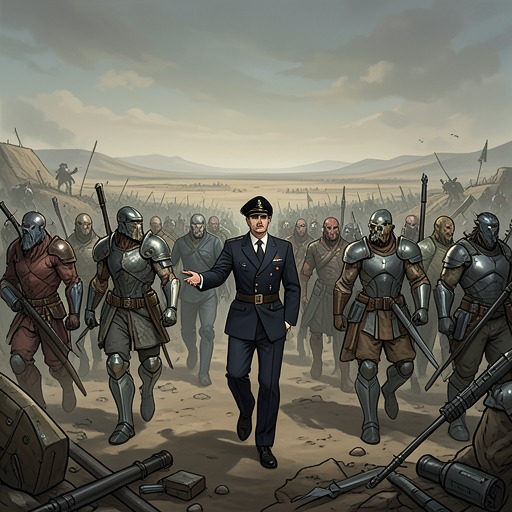
Systema Delenda EstThe Rikel annexation campaign is the defining prolonged confrontation of Cato’s expansion across the System’s worlds. It begins when the System annexes Rikel under conditions deliberately concealed from much of the wider power structure, then becomes public when the portal opens. Cato reacts almost immediately, moving forces that are already positioned beyond the System’s immediate boundaries. What follows is not a swift conquest but a six-month battle involving orbital fleets, particle beams, antimatter-shot craft, millions of Big Bad Bug Bombs, locked dungeons, System-reinforced defenders, and repeated resurrection. Rikel survives despite being surrounded by a war machine built over eleven years, making the campaign a rare instance in which Cato’s overwhelming material advantage fails to produce a quick victory.
Causes and Strategic Background
The campaign grows out of the System’s continuing annexation of worlds and Cato’s attempt to break the structure that makes those annexations possible. Earlier experience had taught Cato that the crucial objective was not merely to defeat defenders in the open but to reach dungeons and Nexus buildings, sever a world from the System’s network, and prevent the System from reproducing its power elsewhere. The System therefore treats dungeon access as a strategic vulnerability. On Rikel, the dungeons are locked down, as they are on several other nearby worlds, specifically to prevent Cato from repeating the strategy used against Gogri. The lockdown is expensive in essence, but assistance from the Core allows the System to sustain the burden, turning resource expenditure into a defensive weapon.
The annexation itself is handled as an intelligence operation. The Core Elders suppress the normal broadcast announcing Rikel’s emergence, hoping to measure how long Cato takes to discover the change and mobilize. The portal’s eventual opening cannot be hidden, however, and the news becomes public. Within roughly an hour, observers detect stars moving and identify the large artificial structures associated with Cato’s forces. The speed of his response suggests that he was already prepared near Rikel, though the defenders cannot determine whether he had been waiting for the annexation or had placed forces there in advance for another reason. Muar and Misse recognize that Cato is moving before the System can fully exploit the announcement, while Misse treats the possible loss of Rikel as acceptable if the campaign yields useful information about his capabilities.
This attitude reveals the asymmetry between the two sides. Cato sees Rikel as a foothold in a campaign to destroy the System, a project he had stated in uncompromising terms: he intends to eliminate the entity that repeatedly destroys entire planets. The System’s defenders, by contrast, can regard Rikel as a hunting world whose loss may be tolerated if it helps them understand how to counter the larger threat. The world is therefore both a battlefield and an experiment. Its inhabitants bear the immediate danger, while the Core studies Cato’s logistics, reaction time, and methods of force projection.
Forces and Course of the Battle
The campaign lasts six months, making Rikel the longest single battle in the more than fifty years of Cato’s war against the System. Cato-Rikel maintains an enormous war room in which materiel swarms above the atmosphere, extending from beyond lunar orbit down toward the region where System-imposed reality prevents his technologies from operating freely. Raine manages the orbital defenses, while Cato attempts to move additional deliveries past the Azoths. Even with the scale of the fleet, each shipment requires luck and misdirection because the System defenders generate immense fields of destruction.
Cato’s preparation for the assault has taken eleven years. He establishes manufactories throughout the heliosphere, concentrating them in a metal-rich asteroid belt containing four dwarf planets almost as large as Ceres. The lighter elements are more difficult to obtain: helium and oxygen come from hot gas dwarfs deeper in the system, while methane and ammonia are extracted from large icy bodies in the outer system and cracked into their components. Mass drivers send the resulting packages toward rendezvous points at the edge of Rikel’s sphere of influence. The logistics chain takes months from end to end, but once established it allows Cato to build an immense force rather than depend on a short-lived raid.
The resulting arsenal is almost planetary in scale. It includes millions of Big Bad Bug Bombs, billions of tons of war materiel, hundreds of particle beams, antimatter-shot fighter craft, enough warframes to saturate Rikel’s entire surface, and observation satellites supported by enough computronium to monitor every individual on the planet. The campaign thus makes visible the full material consequence of Cato’s postbiological civilization: distributed manufacture, autonomous warframes, orbital surveillance, and biological weapons that can be deployed in mass quantities. Yet the scale of the force does not translate into immediate control. Rikel absorbs everything Cato can safely throw at it, and Cato remains unable to drive the System from the world.
The fighting in orbit is particularly demanding because ordinary ballistic denial cannot reliably stop man-sized Azoths. Each target must be struck by antimatter or a particle beam, and even the best targeting algorithms struggle to account for erratic movement over enormous distances. Raine celebrates individual hits, but Cato treats them as temporary victories. The System’s extra lives apply even when its defenders are killed by methods outside ordinary System specifications. Some Azoths do not return, but enough resurrect that every apparent kill must be understood as a delay rather than a conclusion.
Muar becomes the clearest expression of this problem. Raine wants to kill him, but Cato expects Muar to possess numerous resurrections and is not surprised to find the head of the Crusade against him directing Rikel’s defense. Eight particle-beam hits have already struck Muar, three of them directly, without removing him from the battle. His survival turns the campaign into an endurance contest: Cato must spend resources and time against an opponent whose defeat is repeatedly undone, while Muar’s presence gives the System’s resistance a durable personal center.
Containment, Expansion, and Parallel Operations
Rikel’s defense cannot be separated from Cato’s wider strategy. While Leese pilots a frame near the surface staging area, another Lineage in a Jager Frame crosses into a different world and succeeds in placing one of Cato’s oversized spears into orbit. The operation is given poor odds, but a temporary intensification of the assault on Rikel draws the watching Azoths away long enough for the spear to pass through. That foothold is expected to take months to develop into infrastructure, yet the first orbital presence is enough to begin the process of crashing the System there.
This parallelism is one of Cato’s chief advantages. The Rikel assault is not an isolated army moving from one front to the next; it is one expression of a distributed campaign in which versions of Cato, Lineages, orbital factories, and autonomous organisms act across multiple worlds. The defenders see only portions of the whole and repeatedly struggle to determine how forces appear in different places. Some attacks contain more troops than others, suggesting that Cato may be manufacturing forces locally or redirecting them through methods the Ahruskians do not understand. The uncertainty itself becomes a weapon, because every apparent concentration may conceal a wider movement elsewhere.
Cato’s biological methods also operate on this planetary scale. When the System condemns more than twelve million Copper and Silver inhabitants of another world, primarily the blue-furred Gaekos, to death through exterminatus and suspends access to its dungeons, Cato answers with millions of one-ton bug cannisters. Half are intended to create a System-jamming network; the rest preserve the possibility of deploying biotechnology for other purposes. The episode clarifies the logic behind the weapons used around Rikel: Cato is not merely building bombs but developing a flexible biological-industrial system capable of jamming, disabling, or reshaping the mechanisms through which the System governs worlds.
The campaign also carries a historical memory of what the System has erased. Cato has seen the remains of an alien city beneath the sea, including algae-covered frescoes of tailed figures beneath two suns and three moons and a small horned statuette recovered from sediment. The drowned city is grander than the blank System settlements that replace native civilizations, and its destruction strengthens his determination to preserve people, artifacts, and the possibility of reconstruction. Rikel’s battle therefore stands against a background larger than territorial acquisition: every annexation threatens to reduce another world to System buildings, controlled populations, and eventually extermination.
Consequences and Unresolved Outcome
The immediate consequence of the campaign is stalemate rather than triumph. Cato has built for eleven years and deployed forces on a scale capable of saturating a planet, but Rikel remains under System control after six months of constant combat. The locked dungeons prevent him from beginning the severance process, and he hesitates to force the issue if doing so would ignite another war before he has determined whether the world can be cut away safely. The result is a holding pattern in which both sides continue spending resources while searching for a decisive mechanism.
The defense also pushes the System’s leadership toward the True Core. Misse concludes that ordinary System influence grows naturally until a world can be absorbed into the Core, while any way to accelerate or redirect that process must lie beyond the Vestibule, in the True Core itself. Nobody has entered that domain in living memory; Deities are expected to manage worlds, annexations, rank advancement, and the flow of essence, not breach the threshold where the System’s ultimate rulers dwell. Yet Rikel’s resistance creates a problem that ordinary meditation and petitioning cannot solve. Misse and Muar therefore prepare to cross toward the Core World Eln Estate’s connection with the Vestibule, with Misse warning that the True Core’s essence is denser and more potent than that of the Deities’ realms.
For Cato, Rikel becomes a lesson in the limits of abundance. Industrial scale, biological flexibility, distributed identity, and orbital firepower can create overwhelming pressure, but none automatically defeats resurrection, dungeon lockdowns, or the System’s ability to subsidize a local defense from elsewhere. The campaign proves that the System can convert its network into depth: a world may remain defended not because its own resources are sufficient, but because the wider structure can continue paying the cost. That realization points Cato toward the necessity of attacking the network and its upstream centers rather than treating each planet as an independent conquest.
The campaign’s larger significance lies in this shift from invasion to systems war. Cato began as an opponent determined to destroy the System because it had erased civilizations, imposed sameness, and turned its inhabitants into participants in a game they could not win. At Rikel, that moral conviction is tested against the practical burden of governing, supplying, rescuing, and defeating millions or billions of opponents without reproducing the indiscriminate violence he condemns. His forces can preserve a foothold, threaten annexations, and make the System spend itself, but Rikel demonstrates that liberation is neither instantaneous nor clean. The world remains the campaign’s longest battlefield precisely because the System’s deepest defenses are not only weapons: they are delay, resurrection, locked access, hidden information, and the ability to make every victory provisional.