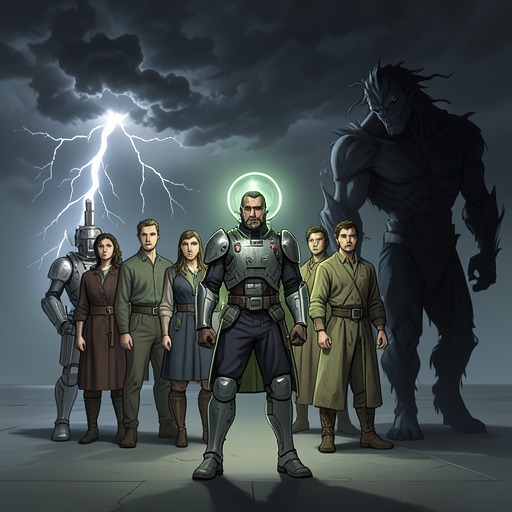
Sam’s reincarnation as a leviathan
Systema Delenda EstSam’s reincarnation as a leviathan is the decisive metamorphosis that converts Sam O’Doule’s criminal past into an impossible second life. After dying twice in rapid succession, he awakens underwater in the body of a true leviathan: vast, tentacular, many-eyed, and burdened with memories that belong to the being he has replaced. The transformation is not presented as a clean reward or a simple rebirth. It is an ordeal of bodily estrangement, moral reckoning, and uncertain agency, placing a man who once surrendered to the easy path of crime and alcohol inside a form shaped by violence, immortality, and alien hatred.
Death, Judgment, and the Second Beginning
Sam’s transition begins with two deaths in the same minute. The first occurs when the Rambau Boys fire a couple dozen bullets through the front door of his speakeasy, one of them striking him in the heart. The second follows when his still death-addled consciousness finds itself inside something enormous and tentacular, floating in a black sea while oddly attired figures cast strands of light into a blinding sword and cut him in two. The sequence makes reincarnation feel less like a seamless passage than a repeated sentence: the old Sam is killed, and the new body is immediately subjected to another annihilating force.
In the void afterward, Sam wonders whether he has earned a place in an afterlife. He does not regard himself as wholly evil, but he recognizes the moral grayness of operating a speakeasy in defiance of the Eighteenth Amendment and of doing business among figures such as Brownie York and the Rambeau Boys. He remembers that he never robbed another establishment, yet also admits that he knew the people with whom he dealt, knew who was being harmed, and continued because he had postponed repentance until some later point in life. His judgment is therefore internal as well as supernatural: the central failure was not ignorance, but weakness and repeated acceptance of the easy path.
That recognition gives the reincarnation its ethical direction. Sam decides that a second life cannot merely involve better intentions or private regret; he must actually become different. The thought arrives before he understands what he has become, so the new body functions as a challenge rather than a consolation. His past does not disappear when his human life ends. It becomes the standard against which every later choice will be measured.
Awakening in an Alien Body
When sensation returns, emotion strikes Sam with sudden panic. He cannot move or breathe in the familiar human manner, and even speech becomes uncertain because the anatomy that produces it is no longer recognizable. He attempts to open his eyes and finds a hazy sun above him, only gradually realizing that he is underwater. His first assumptions fail in sequence: he cannot hold his breath because he does not know how, yet he is breathing water successfully, feeling the cold, sluggish medium pass through whatever now serves as his lungs.
The physical environment intensifies the estrangement. Sam floats beside a cliff whose corrugated floor lies far below and whose surface is crowded with unfamiliar marine life. Reds, blues, greens, purples, blacks, and whites cover the rock in long spiny plants, fringed growths, suckered forms, vines, strange fish, and even swimming crystals. The scale initially seems threatening because many of the creatures have glowing teeth or wicked spines, but their smallness reveals the more important fact: Sam is enormous in relation to them.
His new form is not merely a large sea creature. It has enormous octopus-like tentacles hanging toward the depths, a shark-like body covered with many eyes, massive lateral fins, and ropelike tendrils coiled around the neck. One tendril uncoils, divides repeatedly, and ends in a fine mass of tiny threads that Sam can control completely. The body possesses capabilities he does not yet understand, while its movement sends nearby life fleeing. Looking at it makes him queasy, and floating helplessly in the depths leaves him without instructions, purpose, or even a clear account of what kind of being he has become.
The inherited memory is more disturbing than the anatomy. Fragments from the original inhabitant enter Sam’s mind, rancid with malevolence and spite. This other self hates the figures who wielded the glowing sword, hates the world and creation, and hates the creatures of sea and sky. It is unable to die and unable to defeat its enemies, so its hatred has become a permanent condition. Sam therefore awakens with a divided inheritance: a human consciousness trying to reform itself and a leviathan body carrying an ancient, seemingly unending enmity.
Metamorphosis as a Moral Trial
The event combines the transformation and adventure plots, but reverses the usual promise of heroic rebirth. Sam does not receive a human body enhanced by a new gift; he receives an alien body so powerful that ordinary orientation becomes impossible. The leviathan’s size, many eyes, tentacles, fins, and water-breathing anatomy create a novum that estranges familiar ideas of identity. The body is visibly powerful, yet Sam begins with no practical knowledge of its functions, no instructions for surviving the ocean, and only fragments of another mind’s experience.
This mismatch makes the body itself a test of agency. Sam is not simply rewarded with strength for having suffered, nor is he reduced to the inherited monster’s hatred. His first task is cognitive: he must remain capable of judgment while panic, unfamiliar sensations, and чуж? his predecessor’s memories press against him. The narrative treats reincarnation as a conflict between embodiment and selfhood. A body can carry reflexes, memories, and desires that do not belong to the consciousness inhabiting it, while consciousness can persist without knowing how to operate its own limbs.
Sam’s earlier life also gives the metamorphosis a precise moral contrast. He recognizes that he had known the damage connected to his criminal world and still failed to resist. In the leviathan’s body, the easy path is no longer ordinary vice but the possibility of becoming an immortal engine of inherited hatred. His resolve to do more than merely want improvement is therefore crucial. The second life begins not when he identifies the species of the body, but when he refuses to let confusion and power determine what he will become.
Contrast with the System’s Reward Logic
The reincarnation’s significance becomes sharper beside the System’s treatment of advancement. The System can extract basic facts such as Cato’s name and species from his mind, inject essence through killing, and make violence feel euphoric; after Cato destroys a plant-flesh blob, it announces a new rank and produces tokens, including a blue wafer marked for B-tier advancement. That reward structure turns killing into an immediately pleasurable route toward higher status. Sam’s leviathan body presents the darker counterpart: overwhelming power and inherited violence arrive before any meaningful understanding of their purpose.
Muar experiences the opposite relationship to the System. After entering a temple on Uriva, he remembers System-less space as a dead, purposeless void and concludes that the System provides direction, reward, and motivation. His faith depends on precisely the structures that Cato seeks to destroy. Cato, however, recognizes that quests and objectives can weaponize dopaminergic pathways and impose goals directly into System reality, making obedience feel like the path of least resistance. The Crusade becomes a great attractor that pulls people away from their previous lives, while even the Lineages must periodically leave System frames to clear their minds.
Sam’s reincarnation occupies the unstable space between these models. He is not given a quest that tells him what to do, and he does not awaken with a System-defined purpose. Instead, he receives a body, a hostile memory, and the burden of choosing what follows. His second life therefore dramatizes a question the System’s reward economy tends to suppress: whether transformation is genuine when behavior is shaped by pleasure, compulsion, rank, or imposed reality. Sam’s challenge is to become different without a visible mechanism guaranteeing that difference.
Narrative Function and Open Ending
As an opening transformation, the reincarnation establishes both scale and uncertainty. Sam’s former identity is concrete—an American bootlegger who operated a speakeasy, knew the criminal world around him, and postponed moral change—but his new setting is almost wholly unfamiliar. The underwater cliff, alien coral-like life, swimming crystals, and immense leviathan anatomy replace the social geography of the speakeasy with an environment in which even breathing is newly learned.
The scene ends before Sam receives a mission, explanation, or resolution. He is left floating in the depths, surrounded by life that is beautiful, strange, and potentially dangerous, while trying to understand what he has become and what he can do. That incompleteness is central to the event’s force. Reincarnation has not solved Sam’s moral failure; it has made every future action more consequential by placing his unresolved conscience inside a body capable of reshaping its world. The second life begins as a suspended possibility: a former weak man, an inherited monster, and an alien ocean waiting for the first deliberate choice.