Sydea
Systema Delenda EstSydea is the frontier world where Cato’s counter-invasion first becomes a planetary-scale struggle. It is at once a homeworld, a portal crossroads, a heavily System-dependent habitat, and the decisive proving ground for the possibility of liberation. Through Sydea, the narrative shows what System integration does to a planet: it replaces geography with incomplete administrative maps, concentrates safety in a handful of high-rank authorities, fills settlements with displaced outsiders, and makes ordinary physics and ecology dependent on an extractive technological infrastructure. Its eventual release is therefore not merely a military victory. It is the first demonstration that a world can survive the disappearance of the System and become free of its control.
Frontier World and Sydean Homeworld
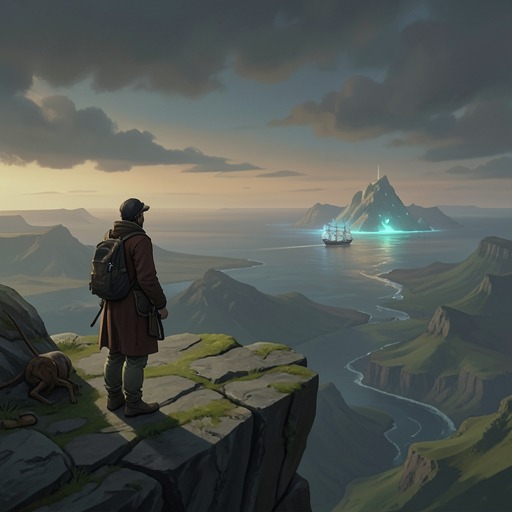
Sydea lies on what can be considered the frontier of the System, sufficiently distant and underdeveloped that Cato initially knows its position only through reports from System individuals who came through to Earth. The world is important precisely because its remoteness produces ambiguity. Cato does not possess precise geography, since cartography has become a lost art under System administration; he only knows that he needs a sufficiently tall mountain, or any elevation that can lift him out of the dense lower atmosphere. Sydea is therefore introduced less as a fully knowable planet than as a place whose terrain and political structure have been obscured by the system that claims to organize it.
The world is also the native home of the Sydean Lineage. In one town, nine out of ten visible inhabitants are lizard-people, suggesting that the species is not a colonial population but Sydea’s dominant indigenous population. Cato interprets the world as possibly only a few hundred years into its own System integration, making it a likely image of Earth’s future had the other powers of the Solar System failed to intervene. That comparison gives Sydea a double identity: it is an alien society in its own right, but also a warning about the fate that awaited Earth when the System arrived, bringing technological failure, monsters, game-like physics, and mass death.
Sydea’s physical and administrative structure is revealed through the System map Cato acquires. The map is a thin, flexible sheet somewhere between metal and glass, yet it disintegrates when System support is removed. Its updates behave like data downloads, flashing a blank surface with a detailed sketch of terrain and landmarks. It records cities, connections, dungeons, Conflict Zones, faction control, mines, quarries, and farming areas, but covers perhaps only a tenth of the planet’s landmass. The map’s incompleteness is significant: the System presents itself as total knowledge while leaving most of the world outside its usable representation. Cato’s immediate interest is practical—he needs a mountain—but the map also establishes the planet as a space partitioned into administratively legible zones rather than understood as a continuous geography.
A World Held Together by the System
Sydea’s apparent order rests on a narrow layer of high-rank authority. Onswa, Arene, Marek, Karsa, and Hirau are described as only five people capable of keeping an entire planet safe and secure, because anyone below their rank cannot handle the threats facing it. Even the Platinums are insufficient. They can deal with threats originating on Sydea, but the planet’s portals connect it to countless other worlds, allowing higher-rank outsiders to enter and act with impunity. Sydea’s vulnerability is therefore structural: its local defenders can control native dangers, but they cannot control the network that makes the world strategically exposed.
The portal system also explains why Sydea becomes the first major obstacle in Cato’s expansion. He needs to move beyond the planet, yet traversing a portal risks annihilation by the System-god of the connected world. The rapid response to his activity shows that the portal network is not passive infrastructure; it is an active system of surveillance, jurisdiction, and lethal enforcement. Cato is puzzled that Sydea’s own System-god has not yet taken a direct interest, perhaps because the Earth portal makes this frontier world more tolerant of irregularities than older, more established worlds. That temporary tolerance gives him room to act, but it does not make Sydea safe.
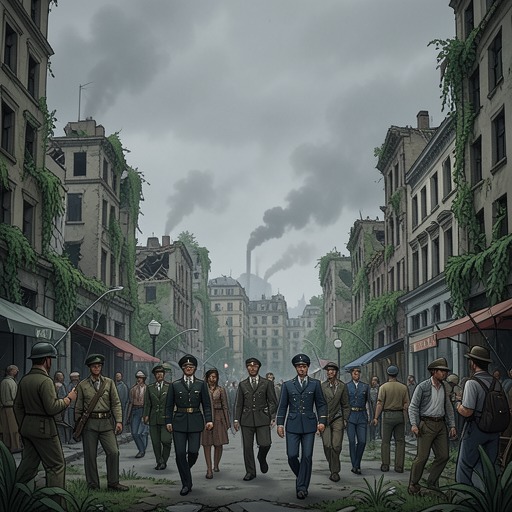
As Cato’s presence grows, Sydea’s settlements reveal a second form of instability. Small population centers become crowded with non-Sydean types who hunt his remaining scouts and appear to have poor relations with the natives. Several System towns are dark and dead, apparently after recent evacuations whose causes remain unclear. The planet is thus not simply divided between an invader and a stable indigenous society. It is already a pressured frontier, crowded by migration, portal traffic, factional competition, and the uneven withdrawal of System infrastructure.
The consequences of that dependence become visible when the System begins to retreat. Town after town loses power, or more accurately loses essence, the System’s universal energy resource. Lights go out and stores shut down. As the System-supported zones contract, ordinary physics, biology, and ecology spread into areas previously maintained by artificial rules. Mountains crumble or vanish, and broad lakes become muddy plains. What appeared to be natural geography had partly been a software-supported arrangement, and Sydea’s landscape begins to expose the difference between a living planet and a world stabilized by an external regime.
Cato’s First Planetary Campaign
Sydea is the setting in which Cato shifts from survival and reconnaissance to deliberate planetary engineering and counter-invasion. He studies the world through its incomplete System map, establishes orbital and industrial capacities, and uses specialized sub-brains to continue thinking in parallel while the System notices his counter-invasion. His objective is not confined to defeating local opponents. He must understand how Sydea connects to other worlds, how its System-god responds, and how a planetary system can be dismantled without destroying the population trapped inside it.
The conflict brings Cato into opposition with the world’s established elites. Muar eventually looks out from the Nexus building and recognizes that he was wrong to trust the Platinums to handle the threat. His disappointment is not merely personal. The failure exposes the limits of Sydea’s old warrior culture and its inability to produce a response proportionate to a threat from outside the world’s customary political and military order. Sydea’s guardians are powerful within the rules they know, but Cato’s presence makes those rules inadequate.
The world also becomes the origin point for the Global Defense Quest: Destroy the Incursion, a High Gold quest whose location is Southeastern Coren and whose reward is a B-Tier Skill. The quest frames Cato’s intervention as an incursion to be repelled, converting the defense of Sydea into a formal System objective. This is one of the clearest examples of the planet’s political reality being translated into game logic: a foreign force, a recommended rank, a designated location, and a reward replace historical explanation with a standardized task. The quest makes Sydea’s crisis legible to System participants while concealing the larger question of whether the System itself is the invading power.
Sydea also becomes a site of unusual contact between Cato and members of the System elite. One Sydean elite figure is unexpectedly cooperative, more interested in Cato and the origin of the quest than in Sydean natives or in completing the quest itself. When she leaves at Cato’s request, she nevertheless attempts to kidnap a version of him so that he will be forced to honor his promise to explain what is happening. The captive copy is lobotomized and mindless, and would have died once disconnected, leaving her with only a corpse. This episode reveals how Sydea destabilizes the System’s assumptions about identity, obligation, and the value of a body: even an apparently cooperative encounter remains entangled in the System’s ability to duplicate, damage, and treat persons as transferable instruments.
Severance and Collapse
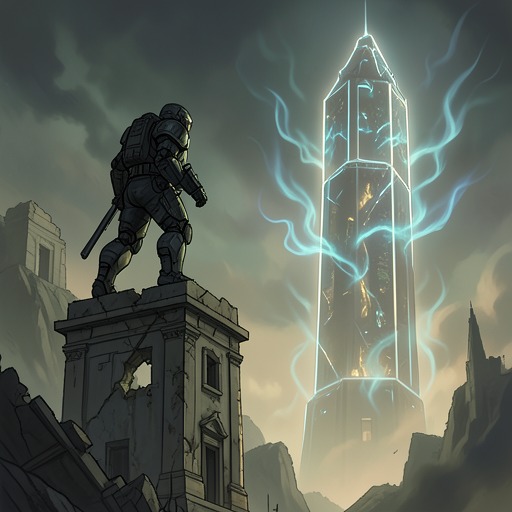
The decisive transformation of Sydea comes when Cato destroys the System’s material and institutional anchors. The final dungeon to fall is a Platinum-ranked site inhabited by massive burrowing metal wyrms that trouble four of his warframes without stopping them from reaching the core. Cato crushes the dungeon core, transmits himself away, and watches from orbit as the quarry where the dungeon stood wavers and disappears. The destruction appears to be the final blow. Transparent portals in the two major cities shrink together, waver, and vanish, severing Sydea from the wider System network.
The immediate result is liberation, but liberation arrives as an ecological and infrastructural emergency. The System had regulated atmospheres and maintained biological conditions that would not necessarily transfer through portals between worlds. Once that regulation disappears, Sydea faces the possibility of total ecosystem collapse, including the loss of single-celled organisms responsible for producing oxygen. The world must account for the physical details the System ignored: air, decay, recycling, microorganisms, and the continuity of life without automated support. Cato’s victory therefore creates a second task more difficult than the fighting itself—cleanup, remediation, and the reconstruction of a livable planetary environment.
Sydea’s severance becomes a model for later worlds, but not a simple template. Cato must deal with fallout while out of contact, unsure whether his distraction organisms have been destroyed or have reproduced beyond expectation. The planet hangs above him in space, near enough to taunt him yet still separated by roughly a hundred thousand miles, and the limits of energy and mass prevent him from repairing every failure immediately. Sydea is the first world he confronts, but it is explicitly not the last; it becomes the beginning of a campaign across many planets whose problems cannot be solved by force alone.
Memory, Reconstruction, and Legacy
Even after the System has gone down, Sydea remains the reference point for Cato’s later work. He finds pleasure in surveying alien solar systems for resources and hardened backups, but his practical exploration is haunted by the knowledge that a world’s survival depends on more than factories and weapons. Sydea teaches him that infrastructure must replace what the System supplied, and that technical knowledge does not automatically provide the wisdom needed to choose what should be preserved.
The planet also remains central to the identities of its people. Raine and Leese repeatedly carry Sydea with them as members of the Sydean Lineage. When Leese reflects on the loss of a Sydean figure, she notes that, aside from Muar, he was the only other Sydean they had seen. Later, a habitat contains a village modeled on Sydean architecture that Cato discovered during his initial surveys, updated for technological life and populated by Sydeans of many forms and colors. The village turns reconstruction into cultural continuity: Sydea is not preserved as a museum or reduced to a former System zone, but rebuilt as a society its people can inhabit.
That reconstruction also changes the future choices available to other groups. The senior Urivan pair establish a Sydean civilization they can join, partly through Summer Civilization time acceleration, and others begin following their example. Cato recognizes that, aside from the Sydean Lineage, the sisters do not possess the mindset for permanent digital existence, and some quietly leave the war effort. Sydea therefore becomes not only a liberated planet but an alternative to endless mobilization and digital permanence: a place where people can withdraw from the war and participate in a slower, embodied civilization.
Sydea’s meaning expands as the campaign moves toward the Core. Its closure is evidence that the System can be challenged, yet its small scale and frontier position also make it politically expendable compared with the Inner Worlds. The distinction matters: the frontier may be abandoned with little resource loss, while the Inner Worlds cannot be condemned so easily. Sydea is the first world to demonstrate the possibility of freedom, but it also exposes the unequal value assigned to worlds within the System’s hierarchy.
Its final legacy is therefore both material and symbolic. Sydea begins as a partially mapped frontier where Cato searches for high ground, passes through portal-linked danger, and confronts an alien population living under imported rules. It ends as a severed world whose portals are gone, whose dungeons have vanished, whose ecology must be repaired, and whose people can build a future beyond System authority. The planet’s liberation changes Cato’s war from an Earth-centered counterattack into a campaign for worlds, while its surviving architecture, inhabitants, and reconstructed communities preserve the fact that liberation is meaningful only when the world itself—and not merely its ruling interface—continues to exist.