Sydea Anchor Destruction Campaign
Systema Delenda EstThe Sydea Anchor Destruction Campaign is the operation through which Cato dismantles the physical and computational supports of the System on Sydea. Its decisive significance is that Cato does not merely defeat defenders or seize towns; he attacks the anchors that make System reality possible. Dungeon cores, town pylons, System Nexus buildings, and the planetary administrative Interface are treated as parts of one interdependent structure. Their destruction causes quests, teleportation, commerce, monsters, altered landscapes, and even portions of the atmosphere to fail, leaving a damaged but potentially self-governing world behind.
Purpose and Operating Theory
Cato’s campaign begins from the discovery that the System is not an abstract authority alone but an infrastructure with vulnerable points. The System Interface embedded in his Warframe is a single blank brain integrated and puppeted by the System, while the rest of his body remains protected from its interface. This arrangement gives him a practical understanding of the System as both imposed physics and exploitable machinery. The System’s ban on advanced technology forces him to work through organic substitutes, but Titan’s geneticists have already shown him how far the definition of “organic” can be stretched. His Warframes therefore function as biological weapons, computation platforms, and remote agents rather than conventional machines.
The campaign’s immediate objective is to remove dungeon anchors. Cato’s orbital infrastructure sends Warframes down toward dungeons whose locations he has taken from Onswa’s Interface and confirmed through surveillance. The deployment is ranked by dungeon difficulty: a Copper dungeon receives one Warframe, a Silver dungeon receives a Warframe and a surface repeater, a Gold dungeon receives two Warframes with repeaters, and a Platinum dungeon receives four of the newer Warframes with the same support. The repeaters allow Cato to transmit his mind back if a dungeon collapses around him, although he doubts that the larger dungeons will release their Warframes before their basement universes disperse.
This distributed structure lets Cato attack Sydea on several fronts at once. Hundreds of Warframes can descend in rapid succession, while the orbital network continues to provide targeting, communication, and reinforcement. The operation is not effortless parallelism. Each version of Cato must eventually reconcile with the others, and the accumulation of memories from multiple points of divergence sharply increases the danger of reconciliation madness. He therefore refuses to risk true death merely for speed. His combined gestalt becomes a confusing mass of simultaneous impressions, but the campaign depends on accepting that cognitive strain without surrendering control.
Assault on the Anchors
The dungeon assaults are described as a sequence of radically different environments, but each ends at the same structural discovery. One Cato crawls through dark, spider-filled tunnels toward a web of purple and orange threads; another races along a spiraling path around a mushroom-lit pit. Other versions climb cliffs, force doors, swim rivers, and cross labyrinths. At the end of every dungeon lies the anchor holding its basement universe—and therefore part of the System—in place. Destroying these cores is consequently both a tactical victory and an act of metaphysical demolition.
The dungeon assault is accompanied by the removal of the remaining town anchors. Every System Nexus contains groups of pylons that provide teleportation, quests, commerce, and town management. Their convenience is also their coercive power: the towns are forced to depend on the same infrastructure that governs them. Cato begins in the east, where System access is already weakening. The pylons resist monomolecular claws, but the light-gas guns developed for his arsenal can crack System material with a point-blank shot. The weapon is a concrete example of the campaign’s method: a tool designed within Cato’s organic, System-constrained technological ecosystem becomes useful only when applied directly to the infrastructure that enforces those constraints.
Cato also prepares a special package for the capital. The city’s System Nexus is more than a local utility, because Onswa’s administrative Interface is embedded there and functions as an especially important anchor. Cato intends to free the Interface from its shackles and transfer it into a proper substrate, using algorithms drawn from databases he should not possess. The mindripper software does not initially produce a perfect digitization; it creates something closer to brain emulation. Yet the disruption caused by the collapsing System places the Interface into a state of overdrive, making its architecture easier to map. Once a usable version has been extracted, Cato can destroy the city anchor without losing the intelligence he hopes to preserve.
The campaign also includes orbital force on a scale appropriate to the danger. After a Bismuth attack damages many of Cato’s orbital structures, hundreds of smaller satellites begin to de-orbit. Warframes enter Sydea’s atmosphere like shooting stars, targeting the dungeons identified through Onswa’s data and orbital observation. Earlier, Cato’s railgun attacks had demonstrated the destructive precision available to him: one-ton rods could be accelerated at thousands of miles per second, transferring nearly all their energy into their targets. In the anchor campaign, however, bombardment supports the wider operation rather than replacing it. The decisive targets are not simply enemy bodies but the locations where System reality is fixed in place.
The Collapse of Sydea’s System Reality
The first visible disruption follows the closure of the thirty-first dungeon. System displays begin fading in and out for Warframes in Sydea’s eastern hemisphere. There are no explanatory error messages; access simply hiccups and stops. This quiet failure is followed by deliberate demolition. Cato pulverizes the pylons in the east, beginning with the region already furthest from stable System support.
Korek Town becomes the first place to experience a complete System crash. Its distinction is geographical rather than political: when Cato destroys its pylon, the town is farther from every other System anchor than any comparable location. The pylon puffs into dust and then disappears. At the same moment, the surrounding landscape changes as the System’s esoteric reality loses its hold. Monsters vanish, colors alter, and sections of vegetation dissipate. The event makes clear that System infrastructure does not merely administer an existing world. It actively maintains portions of the world’s visible substance.
The destruction of the planetary Nexus produces an even wider reversal. Once Cato has extracted enough of Onswa’s Interface to proceed, he destroys the city anchor as well. The remaining towns lose power—or, more precisely, lose access to the System’s essence. Lights go out and stores shut down. The System retreats, while areas governed by ordinary physics, native biology, and ordinary ecology spread across the planet. Mountains crumble or vanish, lakes become muddy plains, and storms form and disappear without warning. Grasslands shift toward native life, while alien forests wither. Some transplanted organisms simply die rather than vanish cleanly, leaving ecological scars expected to last years or decades.
The final dungeon is Platinum-ranked and inhabited by enormous burrowing metal wyrms. Cato’s four Warframes encounter resistance, but reach the core and crush it. He transmits himself away at the moment of destruction and watches from orbit as the quarry containing the dungeon wavers and disappears. The transparent portals in Sydea’s two major cities then contract, flicker, and vanish together. The campaign’s sequence is therefore cumulative: dungeon cores remove local anchors, pylons sever civic access, Onswa’s Interface is preserved outside its original prison, the planetary Nexus is destroyed, and the final dungeon’s collapse delivers the last blow to the remaining portal network.
Consequences and Reconstruction
The immediate human consequence is liberation from System-imposed danger. People can leave their towns without being attacked by monsters and can look toward the sky without fearing winged predators. Children born under the System are no longer confined to combat, quests, and the whims of godlings. Cato tells Raine and Leese that restoring the planet completely will take years, but the direction of history has changed: Sydea has its planet back, even though the planet is wounded.
The operation also exposes the cost of severance. Cato’s later planning for other worlds recognizes that the System may regulate atmospheres and preserve biological processes that ordinary reality cannot immediately replace. A full crash can produce ecosystem collapse, including the destruction of oxygen-producing single-celled life. On Heyk, System collapse leaves massive flora dead, oxygen levels falling, and alien biomatter unable to decay because native bacteria cannot break it down. Cato must therefore treat anchor destruction and environmental remediation as inseparable problems. Removing the System is not equivalent to restoring nature; it creates a transition in which survival depends on biological factories, ecological engineering, and sustained logistical intervention.
The same tension appears in Cato’s broader campaigns. When he later considers attacking other System worlds, he worries about oceans, altered coasts, and the unknown consequences of removing System support from complex environments. Sydea provides the first large-scale example, but not a simple model to copy. Its experience shows both what liberation makes possible and what infrastructure must be rebuilt afterward. The campaign’s military timetable can be measured in the destruction of cores and pylons; its humanitarian timetable extends for years or decades.
Narrative and Political Significance
The campaign transforms the meaning of conquest. Conventional conquest would replace one authority with another, while Cato’s anchor assault removes the mechanism that makes the old authority omnipresent. System quests, teleportation, shops, administrative control, dungeon economies, and monster ecology are revealed as mutually reinforcing components of a platform rather than separate customs. The pylons appear useful because they provide services, yet those same services make every town dependent on System infrastructure. Cato defeats the System by attacking that dependency at its material points.
The operation also changes how the System’s enemies understand Cato. His opponents can call a Crusade, gain essence from worlds declared lost and purified, or rely on overwhelming supernatural force, as Kosch does when a darkness spreads across half a continent and leaves nothing behind. Cato’s method is different in kind even when it is equally destructive. He uses violence against anchors while trying to evacuate towns, preserve Onswa’s Interface, and transmit Warframes away from collapsing dungeons. That contrast does not erase the campaign’s collateral damage, but it establishes its central ethical contradiction: liberation requires dismantling the structures that have made ordinary life possible for generations.
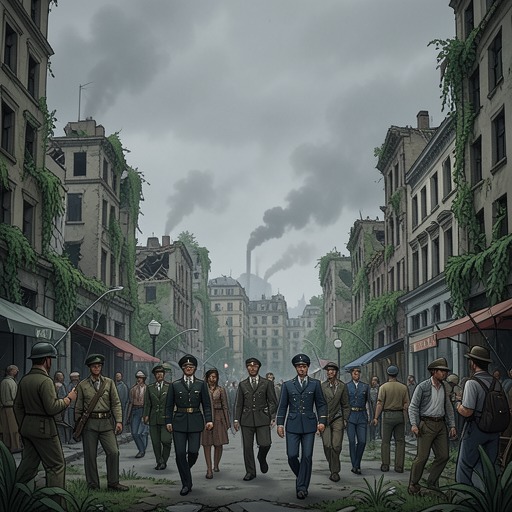
Sydea thus becomes the campaign’s foundational proof. The System can be made to retreat. Its reality is not eternal, its infrastructure is not invulnerable, and its supposed natural order can be reversed. Yet the final image is not a pristine restoration. It is a damaged planet in transition, with vanished monsters, altered geography, dead alien forests, unstable weather, and people stepping beyond their walls for the first time. The campaign succeeds because it breaks the System’s hold; it remains morally and materially unfinished because freedom begins amid the wreckage left by the system that freedom has displaced.