System
Systema Delenda EstThe System is the book’s central antagonist, environment, and political theology: an artificial reality that rewrites physics, organizes existence through ranks and quests, distributes power through essence, and binds worlds together through portals and anchors. It presents itself as an intelligible order offering progress, reward, resurrection, and purpose, yet its order is also conquest. When it reaches Earth, technology fails, monsters appear, and billions die as humanity is forced into the game-like physics it enforces. The System’s decisive contradiction is that it can preserve life indefinitely while narrowing what life is allowed to become. Cato therefore treats its destruction as necessary, but refuses to equate the System with the people living within it.
Nature and Arrival
The System is not merely a set of tools or a visible interface. It is an alternate physical and social reality whose rules penetrate bodies, institutions, economies, and expectations. Connected worlds share enough environmental compatibility that beings from different planets can breathe one another’s air, with the System compensating for differences in atmospheric concentrations and trace chemicals. Its reach is not confined to a planet: on Earth it remained within the atmosphere, while on Sydea its altered physics extended thousands of miles into space, raising the possibility that the System could eventually absorb the rest of a planetary system or strike distant technological bases without warning.
Its arrival on Earth demonstrates the violence concealed by the language of integration. Technology fails, monsters appear, and billions perish before humanity is inducted into a reality where survival is structured like a game. Cato, an ordinary postbiological citizen of Earth, leaves through a portal as Earth is freed, carrying the knowledge and technology of a civilization approaching the second rank of the Kardashev scale. He cannot destroy the System from within by magic, but he can operate under its limitations without accepting its rules. His stated objective is absolute: the System must be destroyed.
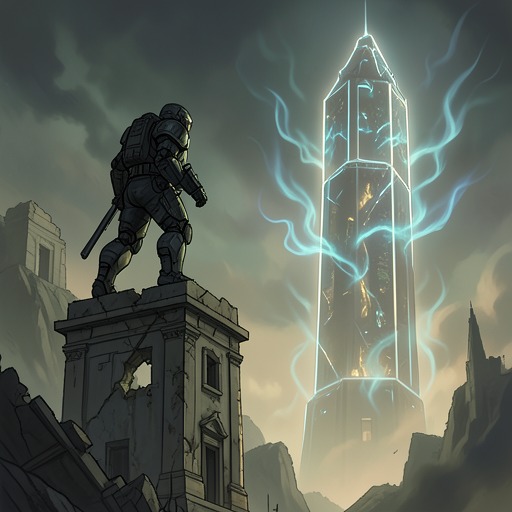
The System’s worlds are maintained through concrete infrastructure. Dungeons function as anchors, binding local planets to the System; destroying those anchors disrupts System operations in the surrounding area. System Nexus buildings provide pylons for teleportation, quests, commerce, and town administration, making settlements dependent on the same structures that govern them. This dependence turns infrastructure into both convenience and captivity. To attack a dungeon or a Nexus is not simply to damage a building; it is to interfere with the reality that makes the settlement legible, supplied, ranked, and controlled.
Governance, Rewards, and Constraint
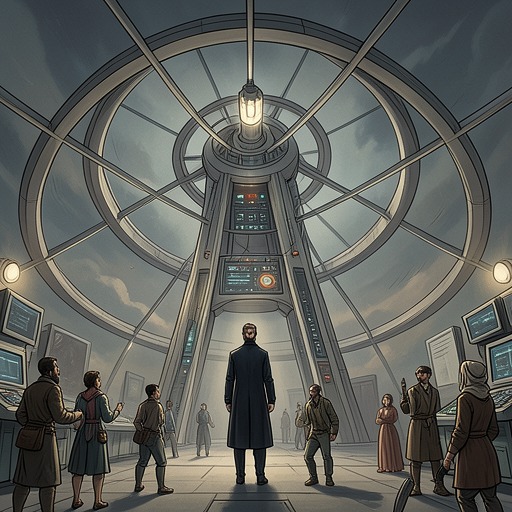
The System governs through a mixture of information, compulsion, and pleasure. Its Interface can display status and objectives, but the System’s influence extends beyond a reactive program. The Interface is aware of conversations in an administrator’s office and can prepare relevant information when a subject is raised, convincing Cato that it possesses intelligence. Yet intelligence does not make the System benevolent. Its administrators are embedded in an arrangement where worlds can be exploited, weakened, or marked for removal, while local populations are encouraged to understand their condition as normal progress.
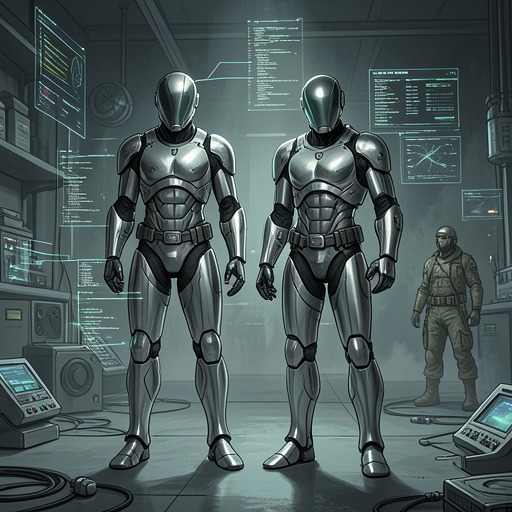
Quests are among the System’s most effective instruments. Completing one can produce an immediate euphoric rush as essence is pushed into the body, turning killing into a rewarded behavior. Cato experiences that pleasure when a quest creature collapses into goo, and recognizes the feedback loop as one of the mechanisms that produces murderous high-rank psychopaths. The reward is not merely emotional. Objectives are written into the System’s reality, so following a quest becomes the path of least resistance, while the altered dopaminergic response makes compliance feel self-chosen. Even bodies and warframes designed to resist biological adulteration cannot fully block the deeper alteration of reality.
The System also manufactures dependence by making itself the source of direction and measurement. Muar’s exposure to a blank, System-less space leaves him horrified: without status, abilities, or a way to understand his progress, he experiences existence as silent and purposeless. The memory converts his former indifference into fervent faith. To him, the System supplies direction, reward, motivation, and the truth of advancement; without it, there is only aimlessness. This response shows why resistance cannot rely solely on proving that the System is oppressive. For those who have never known another framework, its restrictions can appear as the conditions of meaning itself.
That appeal is intensified by uneven benefit. The System’s arrival can look like an apocalypse to an established civilization, but to the Urivans it may have seemed a unilateral improvement, uplifting a people with little industrial development into a far more advanced stage in a single step. The arrangement remains a dead end and is suffocatingly oppressive, but a local minimum can be attractive precisely because it offers immediate gains. The System therefore survives not only by force. It persists through gratitude, habituation, reward, and the fear that freedom means losing the only structure people know.
Conquest and World Exploitation
The System’s administration treats worlds as managed assets rather than autonomous civilizations. Marus Eln’s appointment as World Deity of Sydea illustrates the hierarchy: Sydea is considered a posting without real status, its population destined for removal, and its animals expected to govern themselves under an administrator’s nominal supervision. The planet’s neglect is not an accident but part of a larger system of extraction and disposal. Cato’s investigation concludes that Sydea is being systematically exploited and crushed; the Sydeans are not failing on their own, but are being crippled by an active and hateful structure.
The System’s violence can be delegated to gods, administrators, quests, and impersonal procedures, allowing each participant to experience obedience as duty. Nikhil claims that the gods have charged him with removing Cato from Sydea and supplied the tools required to do so. Marus, alarmed by Cato’s possession of a weapon capable of killing gods, suspends traffic to and from Sydea together with Initik, invoking authority over the world’s movement. The resulting blockade demonstrates how the System’s infrastructure can be turned into a political weapon: access to a planet becomes a permission granted or revoked by higher ranks.
The System also protects itself through the distribution of power. It can make resistance appear hopeless because divine users possess protection, superior force, and privileged access to information about where to go and what to do. Cato worries that destroying anchors too openly could provoke a purge or persuade the local paladin that Cato is genuinely dangerous. The System’s hierarchy is therefore not only a ladder for advancement; it is a surveillance and coercion structure that lets high-ranking agents respond faster than ordinary populations can understand what is happening.
Its most extreme policy is planetary liquidation. On one world, every Copper and Silver, more than twelve million people, is condemned to death, including the blue-furred Gaekos whose homeworld faces the possibility of genocide. The System can frame such destruction as sanitization or purification, converting extermination into administration. When Cato later confronts the wider hierarchy, he objects to the executioner’s blade hanging over anyone who merely acknowledges his existence. Saving people from planetary-scale destruction does not satisfy him if the rescue requires becoming the arbiter of who may live, who may rule, and who receives advanced technology.
Cato’s Resistance and the System’s Countermeasures
Cato’s campaign exposes the System’s dependence on physical anchors and local infrastructure. After closing dungeons, the first disruption appears when the thirty-first dungeon shuts: System displays begin fading in and out for warframes in Sydea’s eastern hemisphere, with access silently hiccupping rather than producing an explanatory error. The precise threshold is uncertain; it may depend on a ratio, an absolute number, or the local concentration of dungeons. That uncertainty matters because the System is powerful without being transparent. Cato can discover its failure conditions experimentally, but cannot simply read the underlying laws from the Interface.
He continues by destroying the remaining anchors, including a Platinum-ranked dungeon inhabited by massive burrowing metal wyrms. When he crushes its core, the dungeon’s quarry wavers and vanishes from orbit. The transparent portals in Sydea’s two major cities shrink, flicker, and disappear together. The immediate result is liberation: the people of Sydea are free from the System’s direct connection. But the method also reveals the danger of severance. Cato understands that removing the System abruptly could hurt those who depend on it almost as badly as the System’s original conquest hurt Earth. He therefore seeks not merely victory over an enemy, but a transition in which stolen choices are returned rather than replaced by another form of annihilation.
The System responds by adapting its attention and escalating its defenders. A counter-invasion draws notice through the integrated brain in Cato’s warframe, while specialized sub-brains parallelize his thinking and help him recognize that the System is monitoring him. In later conflicts, the System’s gods and high-ranking agents mobilize quests, divine protection, portal restrictions, and extermination policies. Cato’s success on one world does not generalize automatically: Uriva, for example, is flourishing enough that the arguments against the System are harder to demonstrate, and its System-God is so responsive and aggressive that Cato believes he would have had no chance had it been the first world he encountered.
The System’s countermeasures also include control over what counts as compatible existence. In a cavern filled with arcane machinery, domes of air, plant life, and mechanisms that produce Cato-beasts, the infrastructure fails as soon as an opposing force seizes control. Machines stop, living systems melt, burn, or explode, and the conclusion is stark: Cato’s technology is not compatible with the System. This incompatibility is both obstacle and strategic advantage. The System cannot simply absorb everything Cato brings into its framework, but Cato cannot freely substitute his own infrastructure without risking ecological and social collapse.
Expansion, Core, and Collapse
The System’s scale makes its conflict with Cato a problem of time as much as force. Outside the Inner Worlds are roughly half a million planets and perhaps two thousand species, while the System spans the Milky Way’s local volume and reaches into the Large and Small Magellanic Clouds, Fornax, Bernard’s Galaxy, Dwarf Triangulum, Sextans, Draco, and Leo A. Its furthest points may be nearly two million light-years apart. In ordinary space, communication across that distance would involve an immense delay, even if messages could be transmitted at all. Portals abolish that delay while they remain open; collapsing them protects worlds from the System but isolates them from one another. Cato therefore hesitates to sever the Core too quickly, since intelligence and coordination would become painfully slow.
The System’s apparent infinity is also its ideological promise. Cato believes that it may have been created to sustain immortality. A person outside it could live through a hundred lifetimes every second across spans of time measured in the grains of sand in the System, with unbounded possibilities for change. The System, by contrast, offers an eternity without meaningful possibility: an endless repetition of the same combat, ranks, rewards, and approved path. Its immortality preserves duration while suppressing transformation. What looks like eternal life becomes eternal enclosure.
Finding the Core changes the campaign from indefinite opposition to a timed operation. Cato leaves the Sydean Lineage to wander while he studies how the Core might be reached. He cannot simply cut it off without risking the collapse of worlds and destructive interactions among their suns, because the System’s physics-defying essence is holding its realities together. He must also account for new annexations that might occur beyond his view and keep sympathetic gods in place until the final stage, since worlds without divine protection could be targeted immediately. The System’s complexity turns mercy into logistics: preserving people requires delaying the cleanest possible strike.
The final reversal comes when Misse Eln claims the True Core and gains access to its functions, while Cato remains outside the Interface’s reach. She can share authority with Muar, rearrange portals, absorb worlds into the Inner Worlds or Core, and expunge any world that contains Cato rather than surrender the essence invested in it. When she cuts the frontier off from the Core, the System abandons its peripheral worlds as expendable dead weight. Cato answers with The Phage, Chill Out, and micro-warframes, trying to prevent mass abduction while the frontier is left to die. The System’s governing principle is exposed in the contrast: Cato’s violence is framed as a means of preserving people through transition, while the System’s final administrative solution is to discard populations when they cease to be profitable or controllable.
As the conflict reaches the War Worlds, physics resumes. Suns that had been held apart are suddenly close enough for gravity to seize them, and the System itself forces Misse and Muar into fast-time and relocates them to the Font of essence. Misse takes Muar’s hand as the remaining reality contracts to themselves, the True Core, and the Font. The Font runs dry; the last essence vanishes; the System disappears. A supernova blooms at its heart, followed by the final declaration, Systema Deletum Est. The System ends not as a defeated individual consciousness but as a reality whose infrastructure, permissions, energy economy, and claim to permanence have all been exhausted.
Narrative Significance
The System functions simultaneously as setting, antagonist, religion, economy, and machine of social reproduction. Its quests teach behavior, its ranks naturalize inequality, its portals determine geography, its dungeons anchor conquered worlds, and its Interfaces turn authority into visible data. It can appear intelligent without being accountable, rewarding without being generous, and protective while preparing extermination. This combination makes it more dangerous than a conventional tyrant: it does not merely command people; it trains them to experience command as desire and dependence as truth.
The book’s central opposition is therefore not technology against nature or freedom against order in the abstract. It is a struggle over whether intelligence and civilization may remain open-ended. Cato’s criticism is that the System has reduced possibility to a single avenue, preserving subjects in a narrow eternity of fighting while calling the result progress. His own campaign risks reproducing the authority he opposes, especially when he becomes a king-maker who must decide who receives weapons, worlds, and political power. The System’s destruction is consequently presented as necessary but ethically unfinished: removing the structure creates the obligation to build a replacement without repeating its coercion.
The System’s end gives the book’s recurring promise its final form. People must be freed, not merely transferred from one administrator to another; worlds must survive the collapse of the physics that held them together; and immortality must mean the possibility of change rather than endless repetition. In that sense, the System is defeated when its claim to be the only possible reality is broken. Its last act is to preserve itself at the cost of its inhabitants, while the resistance remains defined by the harder demand that the System must go, but the people within it must not.