System Anchor
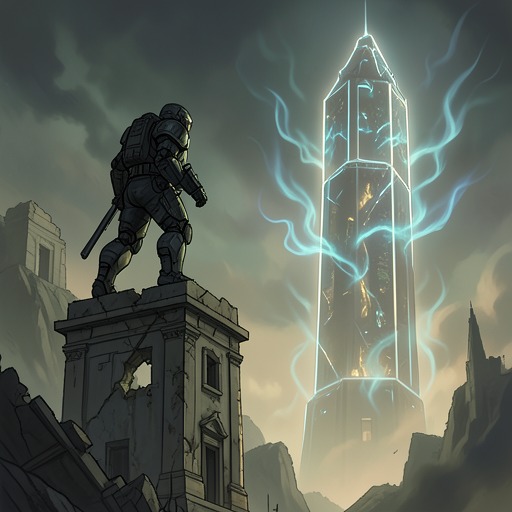
Systema Delenda EstSystem anchors are the physical infrastructure that binds the System to a world. They are most clearly encountered inside dungeons, where a dungeon core functions as an anchor embedded in the deepest layer of a pocket-like sub-universe. Because destroying an anchor interrupts the System’s local operations, Cato treats these structures not as loot or scenery but as strategic targets: removing them is the practical foundation of his attempt to replace the System’s control with independent technology and local administration.
Definition and Structure
A System anchor is a material object rather than a purely abstract connection. In the dungeon beneath Sydea’s chasm, Cato discovers the anchor as a crystalline core embedded in a stone niche at the bottom of the dungeon’s final flooded level. It is physically fixed in place and cannot simply be removed. The core governs the dungeon’s creatures and environments, including the electric eel-like forms and the enormous serpent guarding the deepest pool, linking the dungeon’s apparent fantasy structure to an underlying piece of System machinery.
The anchor’s placement reflects the strange architecture of System dungeons. Their entrances are located in ordinary physical space, but their deeper levels seem to occupy a basement universe with its own biomes, corridors, monsters, and physical rules. Cato suspects that this dimensional disjunction is the principal mechanism by which dungeons anchor the System to a planet, although other researchers have proposed competing explanations. Whatever the exact mechanism, the operational fact is clear: the dungeon is both a lethal training environment and a stabilizing node for System influence.
The anchor is also materially related to other System-created objects. Like the System map, whose System-dependent substance disintegrates without support, the dungeon core is constructed by the System rather than existing as an independent feature of base reality. Cato regards it as almost imaginary in its ontological status, but not harmless; its artificiality does not lessen its ability to kill people or sustain an entire hostile environment.
Function in System Control
The strategic importance of anchors became apparent during the campaign to reclaim Earth. Destroying them disrupted System operations in the surrounding area for a period of time. On Sydea, where the known dungeons are numerous and the conflict zones are comparatively small, that temporary disruption is essential to Cato’s movement. Without it, crossing from one zone to another would expose his position to the System immediately, especially where narrow boundary regions allow the System to monitor transitions closely.
This creates a built-in tactical contradiction. An anchor must be destroyed to weaken the System, but entering the dungeon that contains it can reveal an attacker’s location through the active System quest associated with the site. Cato accepts the risk because the dungeon’s quest has not escalated and his reconnaissance has found no pursuing force, while his bird scout remains above the canyon. The anchor therefore functions simultaneously as a vulnerability in the System’s planetary network and as bait designed to draw challengers into a controlled killing ground.
The System’s reach is not confined to a planet’s atmosphere. On Sydea, its altered physics extend thousands of miles beyond the surface, suggesting that, given enough time, its influence could spread to other planets in the same system. Anchors are consequently more than local dungeon devices: they are part of a wider mechanism of planetary integration whose expansion threatens Cato’s orbital bases and industrial infrastructure. His plan is to distribute versions of himself through the System’s worlds, build the infrastructure needed to destroy their anchors, and replace the lost System functions with technological equivalents while relying on trustworthy natives to manage the transition.
Cato’s Destruction of a Dungeon Anchor
Cato’s assault on the Sydean dungeon demonstrates the anchor’s physical vulnerability. The dungeon is rated for upper Silver and lower Gold ranks, a substantial increase over the immature dungeons known from Earth, but the System’s rank assessment does not account for Cato’s engineered warframe. He treats the dungeon as a murder-hole designed to normalize killing rather than as a genuine test of his abilities.
The final approach takes place in flooded canal-like tunnels. Cato’s acoustic mapping identifies both the dungeon’s final boss and the core itself. The serpent attacks with enough mass and force to destroy ordinary biology, but Cato reverses the expected balance of power: he drives through the creature’s open mouth and destroys its brain in seconds, then dives into the pool and reaches the crystal embedded in the stone.
Cato crushes the core with the warframe’s graphene-, boron-, and exotic-protein-based muscles. The destruction is not a symbolic gesture alone. The moment the crystal shatters, the dungeon’s basement universe begins to collapse. Essence thickens the atmosphere, water evaporates into nothingness, the ground cracks and seals, columns twist in midair, ice halts against invisible obstacles, and the corridors deform as though the entire space were drawn on a deflating sphere. Cato races upward while the pocket dimension folds behind him and emerges beneath Sydea’s twin suns, having converted a lethal dungeon into a direct wound in the System’s planetary presence.
From Local Nodes to Planetary Collapse
Anchor destruction scales upward from individual dungeons to cities and planets. After the System Interface is extracted from the gem in Onswa’s office, Cato is able to destroy the city anchor as well. Once the remaining planetary Nexus is removed, every other town appears to lose power, or more precisely, essence. Lights go out, stores shut down, and the System retreats while ordinary physics, native biology, and ordinary ecology spread into spaces that had previously depended on System support.
The resulting changes reveal how much of Sydea had been held together by the anchors and the larger System network. Mountains crumble or vanish, lakes become muddy plains, storms form and disappear without warning, grasslands shift toward native life, and alien forests wither. The planet does not simply revert cleanly to its pre-System condition: transplanted organisms die in place, leaving large scars that may persist for years or decades even as Cato prepares biological factories for reconstruction. Anchor removal is therefore liberation and catastrophe at once. It breaks the infrastructure of domination, but it also removes the artificial conditions on which entire ecosystems and settlements have come to depend.
The same danger governs later campaigns. The collapse of a System world can produce massive flora die-offs, falling oxygen levels, and alien biomatter that native bacteria cannot decompose. Any assault on the System must therefore include remediation and ecological replacement, not merely military victory. Cato anticipates total ecosystem collapse in later operations, including the possible loss of oxygen-producing microorganisms, because the System regulates environmental conditions without maintaining the biological cycles required by base reality.
Political and Narrative Significance
The anchor is the clearest material expression of the System’s power: a hidden crystal that turns an entire dungeon, settlement, or planetary environment into an extension of an external order. Its small physical scale contrasts with the vast consequences of its destruction. A single smashed core can collapse a pocket universe; a removed planetary Nexus can darken towns, alter geography, and expose the artificiality of a world’s ecology.
This structure also explains why Cato’s campaign is an industrial and organizational struggle rather than a sequence of isolated battles. Exponential growth allows his forces to reach hundreds of worlds, where factories, mines, refineries, solar arrays, weapons production, and warframe construction operate independently. Each world needs its own means to locate and remove anchors because forces cannot be moved through portals in a meaningful way. The campaign thus attacks the System at its points of attachment while building substitutes for the functions those points provide.
The political consequences are equally large. When Cato asks Misse Eln whether the absorption of Mishkell and the collapse of the frontier are her work, he frames the conflict around the same infrastructure of control: worlds can be absorbed, severed, or deprived of the System’s support. Misse argues that such measures are necessary because Cato is the enemy, while Cato insists that his quarrel is with the System itself. That dispute gives anchor destruction its central ethical tension. Removing the System may free worlds from a structure they never chose, but it also forces inhabitants to survive the abrupt loss of the reality, economy, ecology, and institutions that structure provided.
System anchors therefore operate as both object and concept. In material terms, they are crystals embedded in dungeon universes and linked to larger System nodes. In strategic terms, they are the enemy’s dependencies and the natural targets of Cato’s liberation campaign. In ecological terms, they are supports whose removal can trigger cascading planetary failure. Their destruction makes the System vulnerable, but it also proves that domination has become infrastructural: to end the System, Cato must dismantle the machinery holding worlds together and accept responsibility for what remains after the machinery is gone.