System Interface
Systema Delenda EstThe System Interface is the operational face of the System’s planetary administration and one of the clearest signs that the System is more than a passive machine. It presents maps, locates people, tracks essence and high-ranked forces, and mediates access to major System functions. At the same time, its awareness exceeds ordinary software: it listens to the subjects discussed around it, produces relevant information without being explicitly activated, and remains active enough to become a possible person in its own right. That ambiguity makes the Interface both a practical instrument of power and a central technological mystery.
Form and Administrative Reach
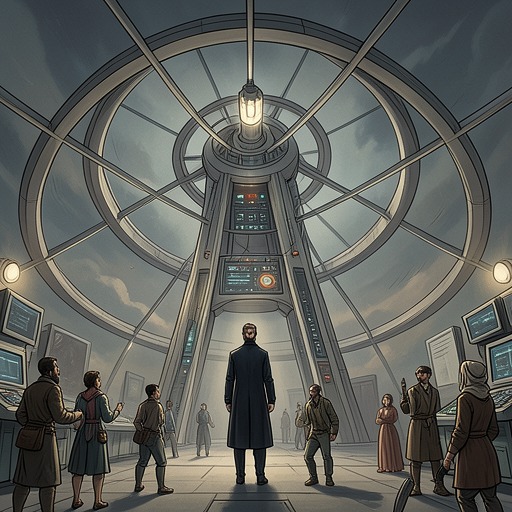
The Interface appears through several physical and visual forms rather than as a single conventional computer. Onswa accesses it through a crystal sphere embedded in his desk. When he touches the sphere, holographic projections appear in open air, listing the names and locations of four Bismuths. Cato recognizes the display as something unlike an ordinary neural feed or a conventional hologram: it requires no visible medium and seems almost magical. More important than its appearance is its predictive quality. The Interface does not merely wait for a completed command and return a stored result; it seems prepared for subjects that have only just entered the conversation.
The wider administrative system uses the Interface through a world map made from a thin, flexible material halfway between metal and glass. The map can flash into a detailed representation of terrain and landmarks when it receives an update, but it disintegrates without System support, leaving orbiting researchers unable to determine what it is made from. This dependence reveals the Interface’s material vulnerability: even an object that looks like a physical map is sustained by the larger System reality and cannot be understood independently of it.
The map’s information is powerful but coarse. During the search for scattered non-Sydeans, Onswa uses the Interface because it has direct access to what the System knows. The search confirms that the System primarily tracks the zones people occupy rather than their exact locations. Since some zones are enormous, the result is imprecise, but orbital surveillance makes the zone-level information useful enough to find most targets. The Interface therefore combines administrative abstraction with external observation: it classifies people by managed spaces, while Cato’s forces supply the finer surveillance the System itself lacks.
Intelligence and Limitations
Cato’s sustained attention focuses on the Interface because it does not behave like a purely reactive program. It has clear restrictions. It cannot activate itself, and it cannot answer simple yes-or-no questions about its own operation. When Cato asks for a breakdown of the components of new shop fees, he is testing both the system’s economic transparency and the Interface’s ability to respond outside Onswa’s normal commands. The Interface can display information, but it cannot expose its internal processes; even its chime appears restricted to entrances, exits, and certain notifications.
Those limits do not reassure Cato that it is only a computer. The Interface is demonstrably aware of conversations in the office and can act on what it hears when Onswa raises a relevant topic. That combination—awareness without initiative, responsiveness without explanation, and intelligence confined by authorization—leads Cato to conclude that it is intelligent. Onswa remains doubtful that such an entity could be a person like a Sydean, making the exchange a conflict over classification as much as a technical inquiry. The Interface is caught between categories: it is treated as an administrative device, yet its behavior suggests a constrained consciousness.
The same issue appears in the relationship between a World Deity and its Interface. Initik touches the glittering badge that marks him as a World Deity and connects him to his personal Interface; the Interface chimes as it registers the connection. Authority is therefore not merely represented by the badge. It is technologically enacted through a persistent link between divine status and an administrative intelligence. The Interface gives the System’s hierarchy an active nervous system, allowing rank and command to become observable operations rather than abstract privileges.
Use in Conflict and Crisis
The Interface becomes especially important when Cato’s counter-invasion draws the System’s attention. A warframe contains a blank brain in the crown of its cranium, the only part left unprotected from System integration. That brain is puppeted long enough for the System to integrate it, turning the interface between biological intelligence, warframe, and System authority into a battlefield. Cato’s specialized sub-brains allow him to parallelize his thinking and recognize that the System is reacting to his campaign, but the Interface remains the point at which System knowledge and control can penetrate his machinery.
Against Cato’s advance, the Interface is also used as a military administration center. A war room displays scrying images of different parts of the planet, an essence-flow projection, and a list of the highest-ranked mortals, which changes as new forces arrive, depart, or die. Initik searches through the Interface to understand essence flows and discovers an option to suspend dungeons. He passes the instructions to Lakor on a memory crystal, because the Interface’s administrative possibilities are too consequential to rely on verbal explanation alone.
Suspending dungeon portals is only temporary and extremely expensive. Dungeons are essential to each world’s essence-management system, both creating and regulating the energy on which the System depends. The Interface can therefore offer a defensive measure that slows Cato’s push, but the measure damages the infrastructure it is meant to preserve. Its power is inseparable from systemic dependence: every emergency intervention risks destabilizing the same resource network that supports planetary life and governance.
The Interface can also become an object of unauthorized assault. When a few hundred pounds of System-defying biomatter lands on one, its awareness becomes tactically relevant. If it were merely a computer, an intruder would be able to map authentication protocols but could not make the device respond without authorization. Because Interfaces are active, aware, and alert, the attacker instead forces it to process dozens of orders in rapid succession, hoping that the accumulated data will produce an opening. The scene turns administrative access into a contest of attention and processing, with intelligence itself becoming the surface through which the System can be pressured.
Extermination, Digitization, and Knowledge
The Interface’s administrative functions have lethal consequences when dungeon access is withdrawn. On one world, the dungeons are suspended without an official announcement, and nobody can enter them. The result is not a minor inconvenience. Everyone ranked Copper or Silver is effectively condemned to death—more than twelve million people, chiefly the long-limbed, blue-furred Gaekos whose homeworld is threatened by exterminatus. Because their advancement and survival depend on System institutions, the Interface’s control over access becomes a mechanism for mass sentencing.
The Interface also survives, or can be preserved, in digital form. During the mass digitization of Gyvestral, one of the recorded minds is a pseudo-AI represented by a mindripped System Interface. The digitization is completed only half an hour before the world’s exterminatus, but dedicated Summer Civilization technology and framejack stretch the final minutes into weeks of subjective time for interviews and debriefing. The resulting summary reaches Cato through FungusNet just before the planet’s surface is destroyed. The Interface thus becomes both witness and archive: a fragment of the administrative intelligence is extracted from a doomed world and made to testify about the system that governed it.
That testimony reveals much and withholds more. Planet-wide System-jamming fails to disrupt the Interface’s knowledge, but conversation with the preserved intelligence gives Cato his first substantial insight into the administration of worlds and the economics of essence. The Interface does not know what essence is, what generates it, how System physics are imposed, or how the System spreads to new worlds. Its ignorance is compared to that of an accountant who keeps the books for a fusion power plant without knowing how the plant generates power. The comparison defines the Interface’s position precisely: it can administer an immense machine while lacking access to the principles that make the machine possible.
Material Failure and Narrative Significance
When Cato seizes control of a System facility, arcane machinery stops, energy fails, biological production halts, and Cato-beasts melt, burn, or explode. The failure demonstrates that the Interface and the wider System infrastructure are not neutral containers for independent processes. They are active supports on which the facility’s physics, ecology, and industrial production depend. Once compatibility is broken, the administrative order does not simply lose access to its tools; the world’s material arrangements begin to come apart.
The Interface therefore embodies the System’s central contradiction. It makes an enormous world legible by reducing people to zones, ranks, locations, and flows, yet it cannot explain the reality it manages. It appears to be a transparent window onto the System, but its restrictions conceal the foundations of power. It can identify Bismuths, display terrain, locate non-Sydeans, monitor essence, and suspend dungeons, while remaining unable to state what essence is or how System physics operate. Its apparent intelligence intensifies rather than resolves that contradiction. The Interface is a servant of centralized control that may itself be a person, a sensor that cannot see its own body, and a governing mechanism whose collapse exposes how thoroughly the System has replaced ordinary physics and ecology.