System Level System
Systema Delenda EstSystem ranks are the System’s central ladder of power and social organization. They are not merely labels attached to stronger individuals: they determine what quests and dungeons appear survivable, how many Skills a person can maintain, which worlds and factions become accessible, and how rapidly a person can participate in conflicts that range from local defense to interworld war. The rank system converts growth into a visible hierarchy, but the book repeatedly shows that its apparent clarity conceals enormous gaps between formal classification, practical capability, divine patronage, and the political resources available to a ranked individual.
Definition and Progression
The hierarchy includes Copper, Silver, Gold, Platinum, Bismuth, Azoth, and Alum. The evidence presents these ranks as an ascending progression rather than as interchangeable military titles. A newly advanced rank brings expanded capacity: each rank grants four Skill slots, and Skills reach the maximum power associated with that rank. Raine’s established build illustrates the structure concretely. Her Copper slots contained Appraise, Light, Clean, and Scribe; Silver was devoted to resistances; and Gold and Platinum followed a balanced pattern of one perception Skill, one offensive Skill, one defensive Skill, and one movement Skill. Advancement therefore changes not only raw strength but also the architecture of a person’s capabilities.
The ladder also establishes expectations about difficulty. A dungeon in a lake at the end of a canyon was rated for upper Silver and lower Gold ranks, a striking anomaly because it represented a major increase over the embryonic dungeons that had existed on Earth. The rating gave explorers a practical estimate of danger, but it did not make the dungeon predictable; unusual environments and the System’s incomplete history could still produce threats beyond ordinary expectations. The rank system thus functions as a guide to risk while remaining vulnerable to exceptions.
Quests, Dungeons, and Risk
System ranks govern the relationship between adventurers and the missions imposed or offered by the System. When a defense quest appeared near a portal staging camp on Ahrusk, Raine confronted the aftermath of a destroyed camp whose craters were lined with molten glass. The camp had contained Golds and even Platinums, making clear that the conflict exceeded the apparent level of Raine’s party. The closed portal and the devastation around it transformed a nominally ranked assignment into evidence of a much larger force operating beyond the party’s ordinary scale.
Maur judged the mission differently. Because the party was Gold, he argued that they should be able to handle a Silver quest, especially given its reward. His confidence reveals one of the system’s behavioral mechanisms: rank does not simply describe ability; it encourages people to calculate danger against rewards and to accept challenges that promise advancement or valuable compensation. The difference between Raine’s caution and Maur’s confidence also shows that a formal rank cannot settle how individuals interpret risk.
The same scale governs life beyond individual quests. Two newly minted Tornok Clan Platinums searched the Southern Jungle Conflict Zone for an unexplained disturbance. Neither possessed dedicated tracking Skills, yet their Platinum-level ability to sense essence should ordinarily have made anomalies easy to find. Their failure, followed by the discovery of disturbed essence inside a strange doppelganger corpse that had entered a System nexus building, exposed the limits of rank-based perception. Platinum improved their sensors, but it could not guarantee understanding when the threat operated through an unfamiliar form.
Social Power and Political Reach
The hierarchy also produces a labor and governance structure across worlds. Most Platinums left Earth and never returned. Some preferred higher-rank planets, dungeons, and conflict zones; others died in those same places. Their absence left only a small number of high-rank administrators to manage expanding crises. Onswa and Raine were among the figures still present, while Marek governed the Canepa continent and Hirau and Karsa ruled their own cities on the sparsely settled continent of Remal. Rank therefore concentrated both opportunity and responsibility: the people most capable of confronting large threats were also the people most likely to leave for still more dangerous regions.
Rank could also become a marker of institutional legitimacy. Punchy Bastards attracted Raine and Leese partly because its invitation came from Shiel-Ruyu, an Alum—the first and, at that point, only Alum they had seen. His rank made the guild’s offer unusual before he even explained its culture. He recognized Raine and Leese as Azoth, god-blessed, factionless, and without records, interpreting their rise as something they had accomplished themselves. The guild’s interest thus joined rank with biography: Azoth status signaled exceptional advancement, while the absence of records suggested independence from established organizations.
Shiel-Ruyu’s invitation also shows that high rank does not automatically erase social eccentricity. Punchy Bastards stood out because its irreverent name contrasted with the formal guilds competing for power in the Inner and War Worlds. Its Alum representative presented dungeons, quests, and Feats as shared activities rather than merely instruments of institutional control, and even proposed a spar with Lorraine, an Ahruskian who had advanced remarkably quickly after arriving only a few years earlier. Rank made Lorraine notable because it compressed the expected timetable of progression, turning speed of advancement into part of her identity.
Divine Patronage and Advancement
The upper ranks connect ordinary progression to divine politics. Muar, a Chosen supported by Misse Eln, had not reached the limit represented by Azoth. His ambition was to rise to Alum, and Misse Eln told him that godhood would not be impossible afterward. His Chosen status was described as an aid in bridging the gap between high-ranked mortal advancement and divine existence. The rank ladder therefore does not end at worldly competence; it forms a corridor leading toward direct participation in the politics of gods.
Muar’s combat performance demonstrates how patronage can alter the practical meaning of a rank. In one confrontation, he raised a crystal shield covered in divine sigils and invoked Misse’s Protection, a defensive Skill directly upgraded by his patron. A World Elite’s club struck with enough force to shatter the ground and send cracks for miles, while the shockwave shredded trees even on a war world. Muar nevertheless kept his party unharmed and preserved the ground within their circle. His Azoth-level position was inseparable from the divine enhancement that supported it, showing that ranked power is partly personal progression and partly access to external authority.
This connection makes the hierarchy politically unstable. Muar’s rank advancement is not simply a private achievement; it strengthens Misse Eln’s influence and gives her a capable Chosen intermediary. Conversely, every promotion increases the stakes of factional conflict because a higher-ranked agent can carry divine interests into quests, dungeons, and wars. The System’s ladder appears standardized, but the book’s upper-rank conflicts reveal a continual contest over who may control the forces that advancement unlocks.
Scale, Acceleration, and Limits
The System ranks create the impression of orderly ascent, yet the narrative repeatedly places that order under pressure. Exponential growth can be extremely slow and then suddenly become overwhelming. This rhythm matters because the rank system measures discrete stages while real power and industrial capacity may accumulate continuously. A person or faction can remain within a recognizable rank for a long period and then use accumulated resources, Skills, patronage, or technology to alter the strategic balance faster than institutions can respond.
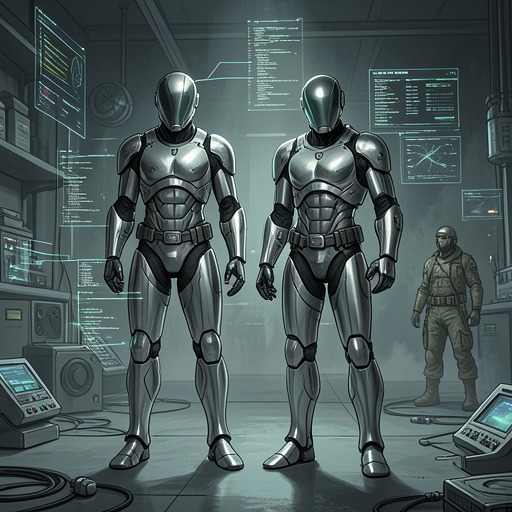
The contrast between ranked System life and Cato’s technological practice sharpens this point. Cato finds fabrication easier than negotiation because machines behave consistently while people remain unpredictable. His infrastructure—communications, orbital industry, digitalization, and other tools—does not fit neatly into the System’s conventional expectations of advancement. His counter-invasion is significant enough to attract the System’s attention, and he uses specialized sub-brains to parallelize his thinking while a blank brain in the crown of a Warframe serves as the interface through which the System can integrate him. The confrontation suggests that rank-based control is strongest when every capability must pass through the System’s own interface, and weaker when alternative technologies create parallel channels of action.
That tension extends to communication and habitation. Cato’s attempts to establish communications without alerting the System demonstrate how information infrastructure can evade ordinary rank structures, while Yaniss’s station is designed around the smaller scale of the Ikent and built with Cato’s tools. Raine and Leese’s later existence as Bismuth selves shows another boundary: permanently exfiltrating a Bismuth from the System requires a complicated continuity process that lasts until the copy physically leaves the System’s protection. Bismuth is therefore both a rank and a threshold between System-bound advancement and existence beyond the System’s aegis.
The rank hierarchy’s final significance lies in this contradiction. It offers a common language for power, assigns risks to quests and dungeons, shapes Skills and careers, and makes figures such as Azoth Raine and Leese or Alum Shiel-Ruyu legible within a vast interworld society. At the same time, its classifications can be exceeded by anomalous dungeons, distorted identities, divine Skills, rapid growth, technological alternatives, and the political consequences of leaving the System altogether. System ranks are the System’s attempt to make power measurable; the surrounding story shows that measurement itself becomes one of the principal battlegrounds.