System corruption and enslavement
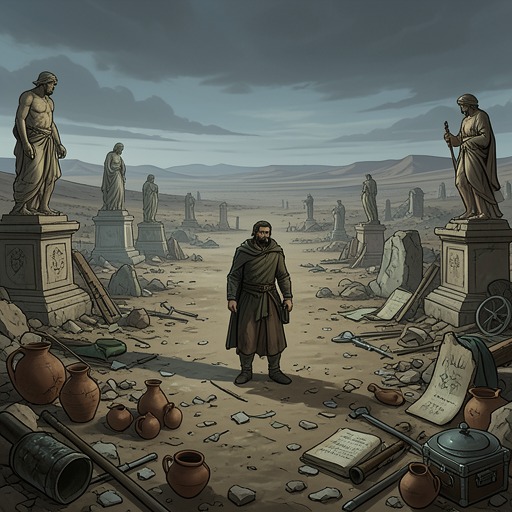
Systema Delenda EstSystem corruption and enslavement describes the condition of beings and worlds captured inside the System’s reality: governed by imposed rules, dependent on its infrastructure, rewarded through its economy, and taught to regard its control as advancement or divinity. Its decisive feature is not merely coercion, but the conversion of captivity into apparent choice. Cato identifies the System as an interloper corrupting base reality and makes its destruction the central purpose of his campaign, while the resistance that follows exposes the immense danger of removing a structure on which entire civilizations have come to depend.
Definition and Ideological Form
The condition is first articulated to Yaniss as the history of a conquered world whose people have been enslaved by the System and chained to a framework with only one choice. Yaniss recognizes how radical the claim is: the inhabitants of the System normally describe it as divine because it grants Skills and advancement, so treating it as a disease or foreign occupation sounds like blasphemy rather than political analysis. The System’s power therefore operates through both force and accepted language. Its beneficiaries have learned to call dependence salvation, while its victims lack an external standard by which to measure what has been taken from them.
Cato’s account distinguishes the System from the reality it governs. He describes the System as corrupting reality rather than constituting reality itself, and calls the universe outside both the System and its virtual world base reality. That distinction becomes material rather than philosophical when Yaniss is given a body grown from her own genetics in a station built by Cato. The station is sized for the diminutive Ikent, and Yaniss must manually dress, move, and experience unfiltered sensation. Her awkward physical gestures and direct perception show what the System had displaced: not simply comfort or convenience, but contact with an unmediated world and the possibility of learning through effort rather than through an imposed interface.
Mechanisms of Control
The System’s control is embedded in ordinary objects and procedures. Its map is a thin sheet that functions only with System support and disintegrates without it; even orbiting experts cannot determine what the material is. Updating the map requires touching it to an information pylon, after which the blank surface receives a detailed, System-mediated account of Sydea’s terrain, cities, dungeons, conflict zones, resources, and faction control. The map is useful, but its coverage is limited to roughly a tenth of the planet, making knowledge itself both provision and boundary. What appears to be neutral information is also a definition of what can be seen, measured, and acted upon.
The same dependency appears in communication. Cato’s return to contact with Raine and Leese takes months because he must construct communications that cannot alert the System; even then, he has only local or partial communications rather than worldwide access. The communication lizards they wear relay his voice through a medium that is not exactly sound, while the System’s restrictions make ordinary advanced electronics impossible. Cato’s warframe can therefore resist the System only by incorporating a blank brain for interface integration and by disguising advanced technology as biological machinery. The result is an existence that is technically sophisticated but forced to operate through the System’s permitted categories.
The System also controls through escalating incentives and penalties. When Cato is accused of ruining Sydea, he rejects the accusation by pointing out that the System is the power bringing outsiders in, assigning the quest, and imposing extreme essence prices. The inhabitants are being forced to play a game they cannot win, while the System makes its own coercive structure appear to be the neutral rules of play. Cato’s response is not to seek a better position within that game, but to overturn the board itself.
Dependence and the Problem of Liberation
System corruption is difficult to end because the System has become more than an external ruler. It has altered the conditions of existence for the people who depend on it. Initik remembers what life was like before the System saved his people and concludes that Cato’s plan to remove it could mean doom for Initik and all his kind. Raine and Leese likewise explain that Cato’s aim for Uriva is to free it, while the deeper formulation is to remove the System. To Cato, liberation requires severance; to those whose survival has been organized around the System, severance may look indistinguishable from destruction.
The danger is especially acute for high-rank beings. Cato learns that people of Bismuth rank and above are wholly System constructs. Outside the System, their extraordinary properties vanish, and they may simply die if extracted without preparation. This makes liberation an engineering and ethical problem rather than a simple act of opening a portal. Cato must consider extracting high-rankers before a world’s System collapses, replacing their altered existence through System-jamming or other forms of intervention, and modifying the Sydean Lineage before it advances beyond the point at which meaningful changes remain possible. The System’s corruption has reached into identity and biology, making the abolition of its authority potentially lethal to those it has remade.
Cato nevertheless refuses to treat dependence as consent. He sees the System’s rewards, quests, prices, and advancement structures as mechanisms that preserve a relationship of domination by making escape costly and obedience rational. The fact that exponential growth can appear painfully slow becomes part of his counterstrategy: he builds gradually, from a crater on the moon with a few drones, a rudimentary solar array, and a hacked-together manufactory limited by a shortage of proper metals. Over time, however, industrial expansion across hundreds of worlds produces factories, mines, refineries, solar-panel fields, weapons, and warframes on a staggering scale. The slow accumulation of alternatives eventually becomes a material challenge to the System’s monopoly.
Resistance and Replacement
Cato’s resistance is not presented as a purely personal rebellion. He knows that the System is a single, distinct threat, but he also knows that other humans may stand in its defense. His position is deliberately severe: if those people place weapons between him and the removal of an entity that destroys entire planets, he will have to go through them. The declaration turns liberation into a conflict over means as well as ends. The System’s destruction may preserve people and worlds, but pursuing it can force Cato into violence against those who believe the System protects them.
That dilemma reaches its political form when Cato recognizes that destroying the System would make him responsible for what follows. He does not want to decide who controls planets, people, railguns, retroviral engineering, or digitization, yet removing the existing hierarchy would leave a vacuum. He therefore becomes a king-maker by necessity: refusing to choose a replacement would risk handing immense power to high-rank System figures who could abuse it. The critique of enslavement thus cannot end with denunciation. Once the old framework is dismantled, the question of governance, access, and responsibility remains.
Cato’s offer to exfiltrate anyone who wishes to leave the System contains the same warning. Life in base reality will not be automatically easier, and those who leave must work just as hard to excel, though the work will differ from System advancement. Liberation means recovering agency, but it also means recovering burdens that the System had concealed beneath automated rewards and imposed progression. The promise is freedom from enslavement, not exemption from reality.
Collapse and Significance
The System’s corruption is finally represented as a structure capable of rapid systemic failure once its dependencies are attacked. During the confrontation involving Cato, Misse Eln, and Muar, restrictions on the System’s influence are loosened, and physics resumes around the War Worlds. A hundred suns, previously held in an impossible arrangement, are suddenly close enough for gravity to take hold. The spectacle is not merely an attack on a ruler; it is the reappearance of the physical order that the System had suppressed.
The retreat of the System’s essence toward the True Core causes its reserves to fall at accelerating speed. From the scry-views, the Core region becomes a furious white obscurity, while the System’s lifeblood drains away. Misse responds by ordering everything possible to be pruned, revealing the final logic of the corrupted order: when its control is threatened, it does not negotiate the freedom of its inhabitants but treats worlds and resources as expendable components.
Cato’s insistence that the System must be destroyed therefore names both a political program and a metaphysical rupture. The System has colonized knowledge, communication, bodies, identities, economies, and accepted ideas of the divine. Its corruption persists because it is useful, familiar, and difficult to survive without. The narrative’s central tension lies in the fact that destroying such a system is dangerous precisely because it has made itself indispensable. Liberation requires not only defeating the authority that enslaves the worlds, but building enough knowledge, industry, communication, and political judgment that the people inside it can survive after the rules disappear.