System region division
Systema Delenda EstSystem zones are the System’s method of turning planetary geography into an administrative, economic, and military interface. On Sydea, the categories distinguish places such as towns, dungeons, Conflict Zones, Resource Zones, and Border Zones, while making territory legible through quests, maps, control markers, and localized System effects. For Cato, learning how zones function is essential to surviving an unfamiliar world and eventually disrupting the infrastructure that binds Sydea to the System.
Definition and Territorial Logic
System zones divide a world into areas with different purposes and levels of danger. Cato arrives on Sydea knowing only that it lies toward the System frontier and that its geography is poorly understood because cartography has become a neglected skill under System rule. A world map, when updated through an information pylon, provides more than terrain: it identifies cities, connections, dungeons, Conflict Zones, faction control, mines, quarries, and farming areas. The map is therefore an administrative model of the planet, not simply a representation of its physical surface.
The map itself is a thin, flexible sheet that resembles a material halfway between metal and glass, but it disintegrates without System support. Updating it at a pylon produces something closer to a data download than to ordinary cartography, filling the blank sheet with a detailed sketch of terrain and landmarks. Even then, the available coverage reaches only about a tenth of Sydea’s landmass. The System offers thorough local legibility while preserving a larger planetary opacity, a limitation that turns movement beyond known areas into both a practical risk and a political condition.
Conflict Zones and Resource Zones
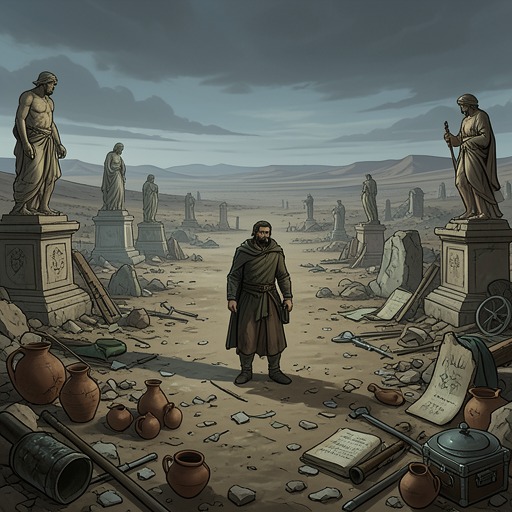
Conflict Zones are spaces where the System concentrates danger, monsters, and military objectives. Cato enters the Great Southern Ruins Conflict Zone and finds an overgrown, ruined city built from domes raised on large stone pylons above an abandoned flood plain. The remains suggest an industrial civilization, though the System’s habit of reusing or generating landmarks makes the ruins’ origin uncertain. The zone is occupied by distinctly System-made abominations: eyeless, scaled humanoids with enormous jaws and oversized arms, creatures unlike the merely enlarged animals of the Southern Jungle Conflict Zone.
Cato avoids remaining in the Great Southern Ruins Conflict Zone because it is small, and therefore easy for searchers to isolate. The System’s defense quest later identifies locations across southeastern and northeastern Coren, Mosaw City, Korel Town, and Mosul Town, showing how a conflict can propagate across several discrete areas. As the quest escalates, the listed locations expand to include the Azure Canyon Border Zone, the Rushing Depths Conflict Zone, the Endless Chasm Resource Zone, the Upwell Fields Border Zone, and the Pillared Halls Conflict Zone. The growing list is strategically important: it does not make Cato safe, but it forces the System to distribute its search across a wide geography while his fliers, seeds, and other decoys create simultaneous points of suspicion.
Resource Zones serve a different but connected function. Cato crosses the Low Hills Resource Zone and notices caves positioned where natural geology would not easily explain them, with neither nearby water nor volcanic features to account for their presence. He concludes that the System has deliberately designed the area for ore gathering. The deposits themselves are equally artificial, offering elemental metals in small nodes rather than proper geological veins. Such zones turn extraction into a quest-compatible activity and present resource scarcity as a managed feature of the System’s world rather than as an ordinary geological fact.
Border Zones, Dungeons, and Movement
Border Zones mark unstable transitions between territories and make movement especially hazardous. After leaving the Great Southern Ruins Conflict Zone, Cato skirts the surrounding hills, only to discover that the broad route is itself a Border Zone. Since he cannot avoid it, he chooses to cross quickly. The danger lies not only in hostile creatures or terrain but in the possibility that a narrow boundary will expose him to System surveillance. Zone borders are therefore operational boundaries: crossing them can change the rules of detection, quest visibility, and local System response.
Dungeons are among the most consequential zones because they anchor the System to a world. Cato locates a dungeon in the chasm beneath a river and understands that destroying it could disrupt nearby System operations. Sydea has more than fifty known dungeons, with an unknown number of additional sites, making the planet’s System presence distributed across many anchors. The same property that makes a dungeon valuable as a target makes it dangerous as a hiding place: entering one can reveal Cato’s location through the active defense quest. He accepts the risk because the surrounding zones are narrow and the disruption from destroying an anchor could conceal his movements during a crossing.
Zone knowledge also determines how Cato uses time and terrain. He leaves a bird scout above the canyon, descends at high speed through the chasm, and uses the map to identify a route toward a mountain high enough to escape the lower atmosphere. Since the warframe cannot safely launch directly from the surface, the distinction between local terrain and System classification becomes part of a larger escape problem. Zones provide the information needed for movement, but their very visibility allows the System to turn movement into a trackable event.
Collapse and Ecological Consequences
When Cato destroys anchors and removes System support, the zones reveal that their boundaries have never been purely symbolic. After the city anchor is destroyed, other towns lose power and essence. Lights go out, stores shut down, and the System retreats. Areas governed by ordinary physics, native biology, and ordinary ecology begin to spread into territory previously maintained by System infrastructure. Mountains crumble or vanish, broad lakes become muddy plains, and sudden storms appear and disappear as the planetary environment undergoes a rapid transformation.
The collapse resembles terraforming in reverse and in fast motion. Grasslands shift toward native life, alien forests wither, and System-supported monsters disappear. Yet the result is not a clean restoration of an earlier world. Transplanted organisms die in place, leaving scars that may persist for years or decades, while Cato prepares biological factories to support recovery. The zoning system thus conceals ecological dependence: a landscape can look like ordinary wilderness while relying on System essence to preserve its terrain, atmosphere, organisms, and infrastructure.
The same problem becomes more severe on Heyk. There, System collapse leaves the world nearly uninhabitable because massive flora die-offs reduce oxygen and native bacteria cannot break down the alien biomatter. Without intervention, the ecological failure would become catastrophic within months. The aftermath demonstrates that removing the System is not equivalent to simply removing an unwanted government. System zones are embedded in atmospheric regulation, food production, decomposition, and planetary life-support, so liberation creates a remediation crisis as well as a political opening.
Strategic and Political Significance
System zones are instruments of control because they make territory measurable, rankable, and actionable. Quests attach recommended ranks and rewards to locations; towns become search points; dungeons become anchors; Resource Zones organize extraction; Conflict Zones concentrate violence; and Border Zones define risky transitions. The System’s geography is consequently a feedback mechanism: classification generates behavior, behavior generates rewards or danger, and the resulting activity reinforces the authority of the classification.
Cato’s campaign exploits that mechanism rather than confronting every zone directly. His decoys spread across multiple regions, and the System’s increasingly broad quest listings make the search for him more difficult. When the System begins recovering from disruption, towns resolve first, while the numerous locations containing his distractions remain distributed across the continent. The zones become a battlefield of information, in which abundance and dispersion matter as much as force.
At the larger political scale, the distinction between frontier and Inner Worlds exposes unequal value within the System’s territorial order. Misse Eln recognizes that the frontier is politically important because many Clan gods administer it, yet it can be abandoned with comparatively little resource loss. The Inner Worlds, by contrast, cannot be condemned so easily because they possess greater value. Her response shows that zone-like divisions extend beyond local maps into strategic hierarchy: distance, governance, resources, and political prestige determine which worlds may be sacrificed and which must be defended.
The eventual collapse of the frontier and the absorption of Mishkell further demonstrate that territorial divisions are vulnerable when their supporting infrastructure fails. In the War Worlds, once the System’s influence is restricted, ordinary physics returns with catastrophic force; a hundred suns that had been held in artificial relation are suddenly almost touching, and gravity resumes control. System zones therefore function as managed realities, not just marked regions. Their boundaries can organize life while the System exists, but their disappearance exposes the physical and ecological costs of having made an entire cosmos dependent on centralized support.