System technology restrictions
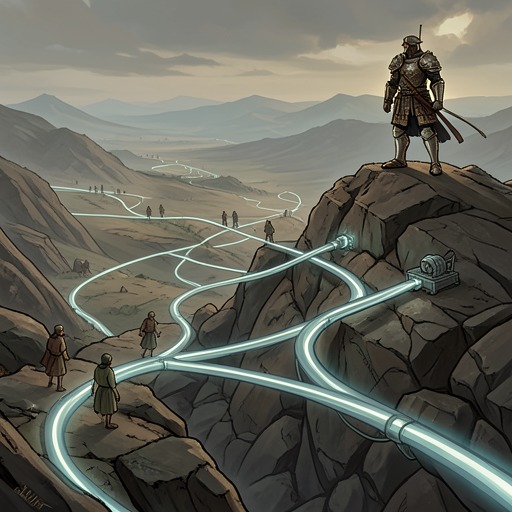
Systema Delenda EstSystem technology restrictions are the System’s central technological prohibition: an imposed set of physical conditions under which almost anything more complex than gears becomes nonfunctional. They are not merely a legal ban or a shortage of materials. The System’s exotic physics actively determines what kinds of machines can operate, forcing inhabitants to rely on System interfaces, quests, portals, anchors, magical weapons, and other approved mechanisms. Cato’s campaign against the System therefore begins as a technological problem as much as a military one: he must fight inside an environment designed to make his preferred tools impossible.
Definition and Operation
System technology restrictions work by making advanced conventional technology unusable. Cato would prefer real electronics, proper armor, and actual guns, but the imposed physics prevents those systems from functioning. The restriction is especially consequential because it does not create a neutral low-technology environment. The System itself continues to provide sophisticated capabilities through its own interfaces and magical mechanisms, allowing it to control maps, rewards, communications, portals, dungeons, and weapons while denying comparable independence to those living under it. The result is an asymmetrical technological order in which the System’s complexity appears supernatural and unauthorized complexity collapses.
The restriction also governs ordinary information infrastructure. A System map is a thin, flexible sheet somewhere between metal and glass, yet it falls apart without System support, preventing Cato’s orbital specialists from determining what it is actually made of. When connected to an information pylon, the map receives a detailed download of Sydea’s terrain, landmarks, cities, connections, dungeons, conflict zones, faction control, mines, quarries, and farming areas. The map is therefore highly capable but dependent: it provides extensive information while remaining materially unintelligible and unusable outside the System’s support structure. Cato’s preference for satellite views exposes the difference between System-mediated knowledge and independent technological observation.
Cato’s Organic Workaround
Cato circumvents the restrictions by redefining the boundary between biology and machinery. Titan’s geneticists discovered that “organic” could be interpreted broadly enough to permit extremely complex systems, provided that they were built as living matter rather than conventional electronics. Cato’s body is genetically described, but its chromosomes and acids use compounds associated with high-energy chemistry. It was grown in a womb that formed part of an industrial complex in space; its cells and organs fuse individual deuterium atoms instead of burning sugar; and its organs function more like industrial machinery than natural anatomy. The restriction has not made advanced technology impossible in absolute terms. It has made one material category illegal, and Cato exploits the ambiguity of the remaining category.
This workaround turns the bioweapon warframe into a technological counter-regime. Its neural lattice can produce thought-static that interferes with exposure to the System interface, while its specialized sub-brains parallelize Cato’s thinking and help him respond to the System’s movements. The warframe’s interface is itself a compromise: a blank brain is puppeted long enough for the System to integrate it, and that brain sits in the crown of the warframe’s cranium as the only unprotected component. Cato regards the arrangement as inelegant compared with real electronics, but it allows an organic machine to remain partially legible to the System without surrendering its entire operation to System control.
The same principle governs Cato’s manufacturing. His bioweapon includes chemical programming mechanisms that let him adjust genetic sequences and issue simple instructions through neural engrams without creating a complete copy of himself. He uses this capacity to produce stealth fliers, amphibious decoys, and other organisms with specialized functions. The fliers spread seeds along routes that diverge from his own path, muddying the System’s ability to track him; the amphibious decoys are deliberately denied reproduction and seed-laying abilities so that isolated versions of Cato do not lose contact with reliable intelligence. The restriction thus produces a peculiar form of distributed warfare: instead of radio-controlled drones and conventional autonomous machines, Cato grows temporary biological agents and must manage the informational dangers of living infrastructure.
Effects on Warfare and Expansion
System technology restrictions give native System forces a major advantage in projectile weapons and aerial combat. Cato is largely limited to close-quarters options because any reusable projectile system of serious significance would normally require combustion or electromagnetics. The System can provide such weapons through magic, leaving Cato to fight under rules that favor his opponent. Air users can project distortions like invisible spears and generate sonic bursts, while Cato must remain grounded because taking to the air would expose him to their control of the atmosphere. His warframe can manipulate biology and accelerate thought, but it cannot simply restore the industrial weapons architecture that would be available outside the System.
The restriction also changes the scale and tempo of Cato’s strategy. He plants seeds at rivers and oases to replenish deuterium, cultivates fliers to seed distant regions, consumes trees, stone, and water to replenish mass, and searches for rare elements such as selenium, ytterbium, tantalum, and tungsten. System materials used in armor and weapons are practically useless to him because extracting them requires too much effort. His biological metabolism can use almost any substance for elemental composition and relies on hydrogen and deuterium for energy, but even that efficiency cannot erase the need for raw matter. Organic production is therefore powerful yet materially hungry.
Over time, Cato answers the restriction not by making one perfect machine but by building an expanding industrial ecology. He establishes rudimentary solar arrays, drones, and manufactories in lunar craters, using silicon, carbon, and lighter elements to construct machinery while recognizing that proper metals remain irreplaceable. Exponential growth then changes the strategic balance. Across hundreds of worlds, factories, mines, refineries, gas-giant atmospheric extraction, frozen-volatile processing, and vast solar-panel fields create production bases that can be redirected toward weapons and warframes. The System prevents easy movement of forces through portals, but Cato’s distributed industry makes each world capable of producing its own armies. A restriction intended to prevent technological escalation becomes less effective once biology and industrial growth are distributed across many worlds.
Communication, Administration, and Planetary Change
The restrictions shape communications as strongly as they shape weapons. Cato eventually restores contact with Raine and Leese through communications lizards that they wear on their heads, but he explains that obtaining reliable communications without alerting the System is difficult. He does not yet possess worldwide communications and must continue developing them indirectly. The solution reflects the same pattern as the warframe and the fliers: communication is rebuilt through living or quasi-living systems that avoid the technological signatures the System can recognize or suppress.
They also complicate the transition away from System control. When a city anchor is destroyed, the other towns lose power, lights go out, stores shut down, and the System retreats. Ordinary physics and proper biology spread into spaces that had depended on System support, while mountains crumble or disappear, lakes become muddy plains, storms erupt and vanish, and alien forests wither. On Haekos, Cato anticipates that removing the System may cause ecosystem collapse, including the loss of oxygen-producing single-celled life. The System has regulated atmospheres and ecological conditions without requiring compatible pressure or composition across portals, but the physical world must supply the biological processes that the System had silently replaced.
The aftermath on Heyk demonstrates that the restrictions are inseparable from a broader dependency structure. After the System collapses, massive flora die-offs threaten oxygen levels, and native bacteria cannot break down alien biomatter, leaving weathered husks without a natural recycling process. Cato must intervene with remediation and biological factories, even as inhabitants resist the changes and attempt to burn grain crops rather than grow food. The restriction has therefore helped conceal how much of planetary life was artificial or System-maintained. Removing it is liberation from one imposed order, but it also exposes the ecological liabilities that order had been masking.
Strategic and Thematic Significance
System technology restrictions are the System’s way of converting physics into governance. By determining which machines can exist, the System limits who can communicate independently, who can manufacture weapons, how worlds exchange resources, and how much knowledge can survive outside System interfaces. The rule appears universal, but its exemptions reveal its political character: the System’s own complexity is permitted, while independent complexity is made physically impossible. Even the Elder authorities consider portal thresholds and rank restrictions as ways to cripple Cato’s supposedly low-ranked creatures, showing that technological limits are reinforced by classification and access control.
Cato’s response exposes the restriction’s main weakness. The System can suppress a technological form more easily than it can suppress a function. Electronics become neural lattices, drones become engineered organisms, factories become biological manufactories, and communications networks become living devices. The victory is not a simple return of forbidden machinery; it is an expansion of the meaning of machinery itself. Cato’s organic systems reproduce the System’s scale and coordination while remaining outside its preferred categories, making the restriction an engine of adaptation rather than a permanent barrier.
That adaptation also preserves an ethical tension. Cato’s workaround depends on bioweapons, disposable fliers, decoys, copied or partially instructed biological agents, and industrial organisms built to serve strategic objectives. His methods are less visibly mechanical than the System’s, but they are not free of control or exploitation. The System restricts technology to preserve its authority; Cato converts life into technology to escape that authority. The concept therefore carries the central ambiguity of the conflict: defeating a system of imposed dependence requires building an alternative infrastructure, and that infrastructure may inherit the same capacity to organize, direct, and endanger living worlds.