System-free world
Systema Delenda EstThe System-free world is the novel’s name for a world no longer sustained or governed by the System. It represents liberation from an imposed reality, but not a simple return to an untouched natural order. The severance removes the infrastructure that made System worlds stable, productive, and intelligible, exposing the physical and social costs that had been hidden beneath that stability.
Definition and Material Condition
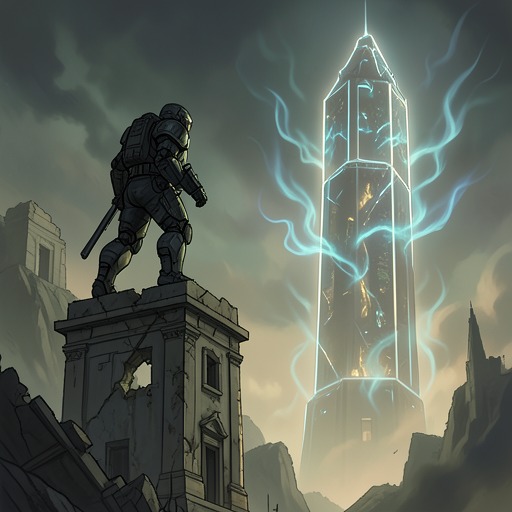
A System-free world emerges when the System’s anchors, interfaces, and essence support are removed or abandoned. The process is not merely administrative. On Sydea, the destruction of a city anchor caused power to fail across every other town, while lights went out, stores shut down, and the System retreated farther from the planet. Areas that had depended on System support began reverting toward ordinary physics, native biology, and ordinary ecology.
The transition was visibly destructive. Mountains crumbled or vanished, broad lakes became muddy plains, sudden storms appeared and disappeared, grasslands shifted toward native life, and alien forests withered. Much transplanted life did not vanish cleanly; it simply died, leaving enormous scars that would persist for years or decades. The world therefore becomes free through a violent material unmaking, with liberation expressed as the collapse of the artificial conditions that had organized existence.
Ecological and Social Consequences
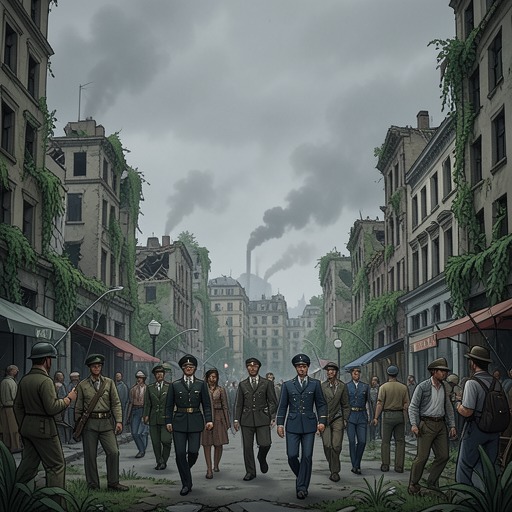
The collapse of System support can make a world nearly uninhabitable even when its inhabitants survive. On Heyk, massive flora die-offs threatened oxygen levels, while the absence of native bacteria capable of breaking down alien biomatter left weathered biological husks that could neither decay nor be recycled. Cato’s forces had to undertake remediation on a planetary scale rather than treating severance as the end of a military operation.
The danger extends beyond ecology. Cato expected total ecosystem collapse in the aftermath of a System crash, potentially reaching the single-celled organisms responsible for producing oxygen. He also worried about oceans and coasts, especially on Haekos, where System alterations were more extensive than those observed on Sydea. Cleanup, food production, atmospheric stability, and the recovery of biological cycles became urgent political responsibilities. The inhabitants of Heyk, unprepared for the transition, interpreted Cato himself as an unwanted apocalypse and even attempted to burn grain crops rather than grow food under the new conditions.
Cato’s Strategy and Expansion
For Cato, the System-free world is both a destination and an engineering problem. His counter-invasion began under conditions in which the System had already noticed his actions, and he had to work around the System’s prohibition on advanced technology. His warframe used organic machinery because the System-imposed physics rendered most systems more complex than gears nonfunctional, yet Titan’s geneticists had exploited the ambiguity of what counted as organic to create cells and organs that functioned like industrial machinery.
His method depended on distributed growth. Exponential growth began slowly, with drones mining a moon’s regolith for volatiles and metals, a rudimentary solar array supplying power, and a hacked manufactory processing materials despite the shortage of proper metals. Over time, that small industrial base expanded into hundreds of worlds. Each world developed its own factories, mines, refineries, solar arrays, and armies, allowing Cato to compensate for the limited movement of forces through portals by manufacturing local capacity everywhere.
The spreading of Cato’s forces made the System-free condition a networked political threat rather than a local rebellion. Raine and Leese Talis seeded worlds such as Kesul, moving between dungeon expeditions and new worlds while avoiding the region around Uriva and improving their equipment. Cato’s restored communications remained incomplete because any signal capable of alerting the System was dangerous; even after months, he had only begun rebuilding worldwide communications through the communication lizards worn by Raine and Leese.
Conflict with the System Order
The existence of System-free worlds destabilizes the hierarchy that had treated worlds as administrated assets. Marus Eln, formerly the World Deity of Sydea, returned with a large reserve of essence but lost his former position after Sydea’s collapse. He was reduced to an unimportant post on an inner world, where his duties involved assigning standard quests and directing conflicts among lower-ranked mortals. Sydea’s loss was easier for his superiors to accept because Clan Lundt had apparently lost a world to the same force, although its representative had not escaped.
The threat eventually reached the Inner Worlds. Muar recognized that Cato was not merely an opportunistic skirmisher but a disease spread across a much larger area than expected. Once it became clear that Cato’s artifice existed on every Inner World as well as throughout the frontier, the possibility of purging those worlds became politically dangerous. World-purging could be used against isolated independent gods or failed clan members, but destroying every compromised Inner World would expose the failure of the campaign against Cato and undermine the authorities’ assurances that he would soon be eliminated.
Cato rejected the attempt to define the conflict as a personal attack on the clans. In his confrontation with Misse Eln, he acknowledged her consolidation of power and connected the absorption of Mishkell and the collapse of the frontier to her actions, but insisted that his quarrel was with the System itself rather than with her personally. That distinction frames the System-free world as the intended political outcome of his war: the System must disappear, while the people living under it are meant to remain.
From Severance to Reconstruction
System freedom is therefore not self-sustaining. The withdrawal of essence can restore ordinary physical processes, but it also removes the artificial supports that had maintained atmospheres, infrastructure, food systems, and alien ecologies. Reconstruction requires biological factories, industrial capacity, communications, and careful management of the transition. Cato’s campaign turns liberation into a long-term program of remediation rather than a single act of destruction.
The condition also alters perception. Initik, the World Deity of Uriva, became uneasy after Sydea vanished from the System, even though no immediate disturbance appeared on Uriva and the Sydean prisoner he kept in stasis remained quiet. When Muar reported seeing Raine and Leese Talis—whom Initik had personally watched die—the disappearance of Sydea ceased to look like an isolated catastrophe and became evidence that Cato’s conflict was continuing through other worlds. Later, when Initik seized control of an installation, its arcane machinery halted, air domes and biological production systems failed, and manufactured Cato-beasts became inert, confirming that Cato’s creations were incompatible with the System.
At its broadest, the System-free world embodies the novel’s central reversal. The System presents itself as the condition that makes worlds habitable, connected, and orderly; Cato’s campaign reveals that the same support can conceal dependence and domination. Removing it exposes genuine physical reality, but also demands new forms of collective responsibility. A world becomes free only when its inhabitants can survive the disappearance of the power that once made every part of life function.