The Deep-Time Ikent Immersion
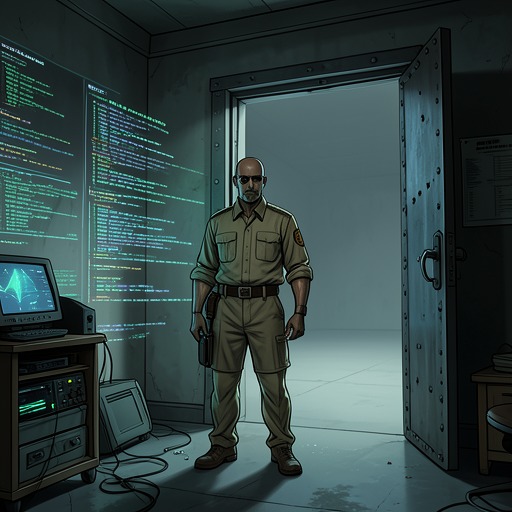
Systema Delenda EstThe Deep-Time Ikent Immersion is Cato’s long-duration identity simulation for Raine and Leese, a decisive intervention that allows them to become convincing Ikent citizens while developing capacities the System’s rank-driven life had never permitted them to cultivate. Built with Summer Civilization technology, the immersion turns subjective time into a strategic resource: five years of virtual experience pass while only a few days elapse in base reality. Its result is not merely better concealment, but a profound alteration in how Raine and Leese understand themselves, their possible lives, and the world they are preparing to resist.
Causes and Strategic Purpose
Cato proposes the immersion because Raine and Leese need more than new bodies or altered surnames to evade the System. Their identities are deeply associated with their former lives, and the System extracts names from what people genuinely believe about themselves; merely wishing to adopt cover identities therefore cannot reliably fool it. Cato also fears that closer involvement in his civilization could compromise the sisters’ understanding of the System, whose structures, procedures, and social instincts remain essential to their usefulness. He wants their perspectives as people formed inside the System, not merely their obedience to his plans.
The immediate danger is surveillance by a World Deity. Raine and Leese have appeared on Uriva with unusual knowledge, and Initik has already connected their new Urivan identities to the names of Cato’s agents. Cato’s restricted version on Uriva cannot freely communicate, while his larger operation possesses the industrial base and gestalt resources needed for resistance. The immersion is consequently designed as an additional layer of deniability: Raine and Leese will acquire Ikent identities through lived experience rather than superficial disguise, while other versions of Cato’s agents will undertake corresponding preparation for their own worlds.
Construction of the Simulation
Cato uses access to Summer Civilization technology to plan a deep-acceleration server. The simulation will draw on surveillance data, construct a detailed social environment, and populate it with simplified abstractions of people. Cato explicitly rejects raising an artificial intelligence merely to fill the simulated world, because a thinking being could not ethically be created and assigned labor as a slave. The inhabitants are therefore described as chatbots rather than persons, while the sisters remain fully conscious participants capable of learning and choosing their own activities.
The immersion is not intended to reproduce a System community. Cato says that Raine and Leese can continue their education and experiments instead of spending the entire period pretending to rank up, although he plans to provide tools that preserve their connection to their former selves and help them acclimate to new identities. The system must also be engineered carefully: extreme framejacking can separate subjective experience from base reality so radically that participants may acquire harmful habits, and entering or leaving the simulation requires precise coordination. Cooling, energy consumption, and simulation quality limit the acceleration rate. Cato estimates that the lower-complexity equipment will require roughly two subjective years of preparation while consuming less than eight objective hours during the actual immersion; the most powerful plans available to him could exceed a million-to-one ratio, allowing almost a thousand subjective years to pass between morning and dinner.
The Five-Year Ikent Life
Raine and Leese ultimately spend five years living within a virtual Ikent community, while only a few days pass outside it. Raine adopts the identity of Niya Talur, née Raine Ikent, and Leese lives under the guise of Karis Eili. The simulation gives them a complete break from their original lives, because continuing to do what they had always done would make genuine identity adoption impossible. They do not simply rehearse names or manners; they inhabit another social world long enough for its scale, bodies, routines, and possibilities to become ordinary.
Their interests diverge for the first time in a sustained way. Leese pursues biology, while Raine spends much of her time piloting different craft and commanding war games and troop simulations. These activities are strategically valuable for Cato’s campaign against the System, but their importance lies also in the freedom they represent. Outside the System’s pressure to rank up and become stronger, the sisters discover that they possess desires and abilities not reducible to System progression.
The simulation does not sever their relationships. They continue to see one another and work together, and Cato remains present, though his role changes dramatically inside the deep-time environment. Rather than functioning as their patron, he becomes merely their neighbor, even giving them vegetables while spending much of his own simulated time gardening or running simulations. This ordinary proximity creates a striking contrast with his external status as the distant power attempting to bring down the System. The life they build is sufficiently absorbing that they do not pause for breaks or return periodically to base reality; the activities available to them make interruption seem unnecessary.
Return and Consequences
When the five subjective years end, Raine and Leese return to the System and resume the routine of slaughtering their way to Silver. Their return is disorienting because the objective world has barely moved, while their inner histories have expanded by years. The virtual life disappears “like a dream,” yet it had lasted longer than their entire new lives in their altered forms. Their bird-people bodies, once strange, had become natural through duration and repetition; after immersion, feathers and reduced stature no longer feel like disguises but like remembered embodiments.
The contrast makes ordinary System advancement seem impoverished. The sisters are forced back into the same rank-based machinery they had escaped, repeating tasks that once defined their existence but now appear narrow beside the interests and skills developed in deep time. The immersion therefore produces a double gain and loss: it makes them better prepared to resist the System, while also teaching them what the System had denied them. Their experience of freedom becomes part of the burden of returning to constraint.
The training has concrete operational consequences. Raine’s piloting and military-simulation experience can support Cato’s future campaigns, while Leese’s biological work complements the technological and biological methods Cato uses to operate under System restrictions. Cato’s broader network also becomes more capable of tracking and backing up the sisters: their later augment frames incorporate full electromagnetic communication, and continuous orbital backup becomes possible without the earlier pseudo-bioweapon workaround. The immersion itself is thus one element in a larger transition from vulnerable agents to distributed, postbiological collaborators.
Identity, Technology, and Narrative Significance
The event treats identity as something acquired through lived duration rather than declared through intention. Raine and Leese retain their given names in some contexts and later take lineage-based surnames, but the System’s identity rules make belief and internal acceptance decisive. Their simulated Ikent lives provide the experiential foundation that makes alternate identities credible. The sisters are neither simply the same people beneath disguises nor wholly replaced by new personas; they carry their earlier selves through years of inhabiting other biographies.
The immersion also exposes the political character of technology. Cato’s warframe, communications systems, maps, and biological machinery all exist within a world where the System suppresses advanced electronics and imposes exotic physics. He bypasses those restrictions by exploiting the ambiguity of what counts as organic, but the deep-time server requires a different kind of technological freedom: enough cooling, energy, simulation fidelity, and safeguards to let consciousness cross enormous subjective distances without losing continuity. Summer Civilization technology is therefore not just a faster computer. It reorganizes education, identity, social life, and resistance by making years available as a resource.
Most importantly, the event gives the anti-System struggle an intimate dimension. Cato’s campaign is not only about destroying infrastructure or defeating enemies; it is also about preserving the people trapped inside the System and helping them discover lives beyond its imposed choices. Raine and Leese return with practical skills, new identities, and a memory of a community in which Cato was simply a neighbor. That memory becomes the immersion’s deepest consequence: the System can still force them back into its quests, but it can no longer plausibly claim that ranking up is the whole of existence.