The Formation of the Clanless Gods' Alliance
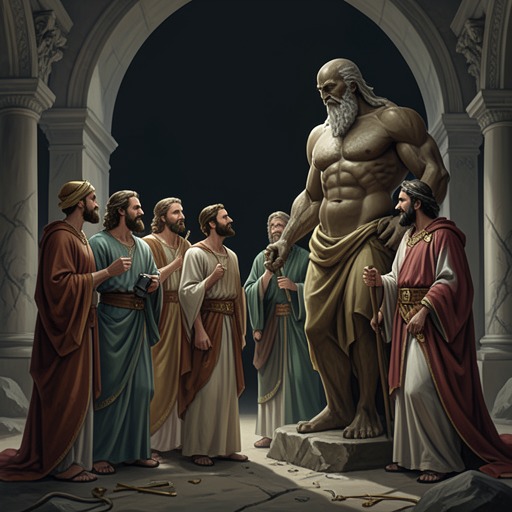
Systema Delenda EstThe Formation of the Clanless Gods' Alliance marks the moment when opposition to the Elder Clans becomes an organized political possibility rather than a private suspicion. Initik convenes Neyar and Mii-Es after the core worlds begin destroying entire planets, presenting cooperation among clanless gods as a necessary defense against both Cato and the authorities who claim the right to erase worlds at will. The alliance is cautious, incomplete, and shadowed by distrust, but it changes the strategic meaning of the war: Cato is no longer the only force capable of overturning the established order.
Causes and Political Background
The immediate cause of the meeting is the core worlds' decision to destroy whole planets. Initik accepts that ordinary danger and natural selection will always kill some of his people, including those whose carelessness, stupidity, egotism, or aggression endangers others. What he rejects is the wholesale destruction of inhabited worlds merely to deny them to an enemy. He recognizes the policy as characteristic of the core worlds: expedient, politically useful, and probably ineffective, since shutting down System portals would accomplish the relevant strategic purpose without sterilizing planets. Sydea has already demonstrated that portal closure can be used for that purpose.
The contrast forces Initik to revise the hierarchy of threats. Cato has not disclosed every secret, but Initik sees no evidence that planetary sterilization meaningfully impairs Cato's ability to coordinate forces. If the portals are essential, they can be closed; destroying worlds is therefore not a necessary response to Cato but an assertion of power by the Elder Clans. The crisis exposes a political danger distinct from the military one. Cato is an external problem that deities might fight together, while the core authorities are an internal threat with the power to decide which worlds may continue to exist.
Initik does not openly reveal that he is considering cooperation with Cato. He knows that the other gods would not entrust him with their deepest secrets, and he reciprocates that caution. Instead, he identifies the only figures he believes can make a substantive contribution: Neyar, a steady friend of centuries, and Mii-Es, who has become unexpectedly friendly since the Cato crisis began and clearly dislikes the major clans. Mii-Es's position managing Ikent rather than her own world, or a clan world, also makes her a useful confidante because Initik does not expect her to report his discontent to the clans.
The Meeting at Neyar's Domain
Initik sends messages to both deities. Their replies arrive within hours, unusually quickly because the war has left everyone on edge. Neyar prefers to remain in his own domain, which suits Initik: the situation around Uriva and Cato is too delicate for unnecessary divine visitors. Initik then crosses the System's between-space to Ikent, where he waits for Mii-Es to answer the chime at her domain.
Mii-Es appears in full regalia, her avian form dressed in silks, jewels, and ornamental armor. Her theatrical readiness contrasts with Initik's guarded practicality. She is delighted to meet Neyar and arrives eager to be seen at her best, while Initik responds with resigned restraint. Together they travel toward the inner worlds, passing World Deity spaces whose defenses have recently been reinforced. Those added protections cannot guarantee safety against Cato or the core worlds, but they reveal how rapidly the political atmosphere has changed. Across the hundreds of thousands of worlds in the System, the gods sense that ordinary business has ended.
Neyar receives them in a valley of orange grasses that remains unchanged, although he himself appears more severe than usual. His world lies on the far side of the core from Cato's known operations, yet neither deity believes distance will protect it indefinitely. Neyar conjures a small pavilion with seating suited to each guest: a flat, cushioned divan for Initik and a lounging chair for Mii-Es. The setting is deliberately domestic and controlled, but the discussion within it concerns planetary survival and the balance of power across the System.
From Private Fear to Collective Leverage
Mii-Es states the central political insight of the alliance: the Elder Clans' unilateral destruction of worlds is a greater long-term threat than Cato. Initik has shown that individual deities can deal with Cato without resorting to planetary annihilation, whereas the gods who control the deepest levers of authority cannot easily be contested. The danger is therefore not only what Cato might do, but what the core powers might do under cover of the crisis.
Initik frames the meeting as an assembly of clanless gods. None who are independent of the Elder Clans, he argues, is safe. They are vulnerable to Cato, but also to powerful actors who may exploit the war to exceed customary limits. His proposal is deliberately modest in its wording: an agreement and a means of communication among gods outside the inner circle, so that they can protect one another if the clans arbitrarily decide that their planets should be destroyed. He refuses to describe the plan as a coup, because open revolutionary language would make dissent easier to equate with treason.
Neyar agrees that the group needs leverage. He compares Cato to a dungeon or a System event: an external challenge that several participants can confront together. The Elder Clans' power is different because it places a dagger at the backs of the very gods who might otherwise unite against Cato. Neyar's long experience of betrayal by former party members and friends has taught him that cooperation cannot be based on innocence or presumed loyalty. The clanless gods must act while remaining wary of one another, because they cannot confront an external threat effectively while fearing the core more than the enemy.
Mii-Es adds the operational constraint. The alliance must be careful and subtle, since openly voicing dissent in the current atmosphere could be interpreted as siding with Cato. Initik reinforces that caution by claiming there is no immediate need for dramatic action. He predicts that Cato, after a major battle and setback, will lack the forces or capacity to strike again soon, and he recommends vigilance within each god's territory while they develop protections against the threats inside the System. His public argument is defensive and patient; beneath it lies the strategic fact that he is building a coalition without exposing his own contact with Cato.
Structure, Limits, and Narrative Significance
The alliance is formed less through a binding treaty than through shared recognition of a common vulnerability. Initik supplies the initiative and the political language, Neyar supplies historical memory and strategic caution, and Mii-Es supplies both independence from the major clans and an instinct for the danger of visible dissent. Their cooperation rests on communication, mutual warning, and collective leverage rather than on trust. Each participant understands that the others may be concealing information, yet each also understands that isolation leaves every clanless deity at the mercy of larger powers.
The event therefore creates a third position within the war. Cato's conflict with the System is not simply absorbed into the existing opposition between rebel and institution. The clanless gods begin to distinguish between resisting Cato and resisting the Elder Clans' monopoly of authority. Initik even deceives his prospective allies about the extent of his thinking on Cato, demonstrating that the alliance is born inside the same atmosphere of secrecy and strategic concealment that defines the larger war.
Its importance also lies in its timing. Cato's strength has been growing through industrial expansion, while the System's authority is increasingly answered by improvised communication, hidden cooperation, and local defensive preparation. Elsewhere, the System's interface, maps, and communications devices show how power is mediated through controlled technologies; here, the gods attempt to build an alternative network of information and protection from within that technological order. The alliance's first instrument is not a weapon but the decision to speak across domains before the core can isolate and intimidate them.
The meeting does not resolve the conflict. It leaves the gods committed to vigilance, subtlety, and the search for leverage, with no guarantee that their cooperation will survive suspicion or pressure. That incompleteness is precisely what makes the event a tipping point rather than a victory. The clanless gods have not defeated the Elder Clans, and they have not abandoned the System, but they have recognized that survival requires an organized power capable of standing between Cato's expanding campaign and the core's increasingly destructive response. In the widening crisis, that recognition is the alliance's decisive achievement.