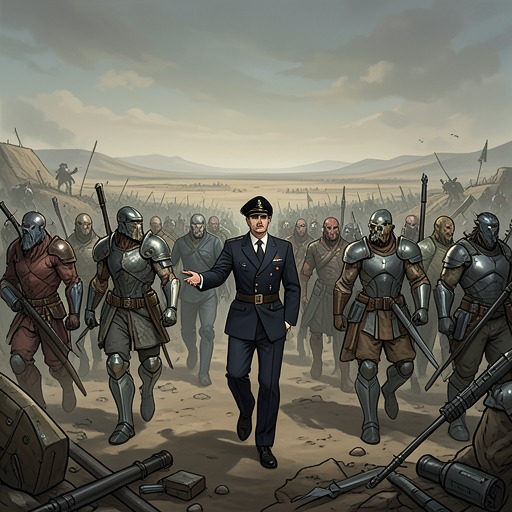
The Forty-World Offensive
Systema Delenda EstThe Forty-World Offensive is Cato’s coordinated assault across more than forty worlds, launched to divert the System’s defenders, isolate the warzone around Gogri, and create the conditions for action against Koh-rel. It marks the point at which his resistance stops resembling a sequence of local incursions and becomes a distributed industrial war: each world supplies its own factories, mines, refineries, machines, warframes, and biological weapons, while independent versions of Cato prosecute separate operations without requiring a single body to cross the System.
Causes and Strategic Design
The offensive grows out of Cato’s exponential expansion. Over years, Lineages have helped him spread to hundreds of worlds, where he has built factories, mines, refineries, solar-panel fields, atmospheric extraction systems, and facilities for processing frozen volatiles. Only a small fraction of this production is devoted directly to weapons and warframes, while a larger portion can be rapidly retooled from industrial construction to military manufacture. That apparently modest military allocation becomes immense when multiplied across hundreds of worlds and years of uninterrupted growth.
The scale is necessary because Cato cannot simply move a conventional army through the portal network. Each world must instead manufacture the forces required for its own defense or attack. This limitation becomes an advantage: every version of Cato operates independently, so an assault on one planet does not divide the attention or physical presence of the versions fighting elsewhere. The same distributed structure also prevents an enemy from stopping the whole campaign by defeating one manifestation. Cato’s network therefore behaves less like a single army than like a planetary swarm of production systems, each capable of receiving direction while continuing to function locally.
The immediate strategic purpose is to draw defenders away from Gogri’s portal and prevent the System from reinforcing the principal warzone. Cato calculates that he must take seventeen worlds to create the required diversion, even though Koh-rel is not directly connected to seventeen separate systems. Once he has decided to sever a small peninsula of the System’s network, however, attacking only a few planets would waste the opportunity. The offensive consequently expands across the worlds linking the selected nodes to Koh-rel, with additional attacks several jumps away to make the threat appear broader and more urgent than the decisive targets alone would suggest.
Participants, Targets, and Risks
The campaign encompasses more than forty worlds: the entirety of the network between the selected nodes and Koh-rel, together with surrounding systems whose invasion can pull System personnel toward false emergencies. Some attacks are intentionally designed to lose. A visible defeat can look like a local victory for the System and still succeed by persuading its people to redeploy toward the apparent danger, leaving the worlds Cato actually needs less protected. The operation is therefore built from unequal objectives: some forces are expendable distractions, while others exist to seize the network’s critical points.
Cato identifies two problems as greater than any ordinary planetary defense: high-rank dungeons and the Azoth stationed at the portal to the newly inducted world. He lacks complete knowledge of how the System-gods will respond, and his simulations cannot produce certainty where he has too few observations. Even the best analysis software cannot infer an answer from absent data. His advantage is not perfect prediction but the ability to prepare many possible solutions and deploy them on a scale unavailable to most inhabitants of the System.
The campaign also exposes a moral and psychological complication in the System’s response. Quests do not merely provide goals; they make those goals easier to follow, through both reward and compulsion. Completing objectives produces pleasure, while the quest itself is embedded in the System’s altered reality as a path of least resistance. The Crusade quest becomes a powerful attractor, drawing Lineages away from their ordinary locations and toward Cato’s expanding war. The people defending the System are thus not simply responding to military necessity. They are being pulled by the same architecture of motivation that Cato despises, even as his actions provoke the System into defending itself.
The Big Bad Bug Bomb
Cato’s most distinctive weapon in the offensive is the Big Bad Bug Bomb, a deliberately indirect answer to the problem of high-rank beasts and dungeons. He does not initially equip the insects or their drop pods with System-jamming technology. Instead, each carries raw materials and a catalyst capable of creating and activating the jamming biology at the right moment. The insects can therefore approach under the System’s notice without immediately presenting the same kind of target as a warframe or an overt technological weapon.
The biology works by exploiting the System’s direct connection to the mind. Since Skills function more like software invoked through a biological interface than like ordinary hardware, neural static can act as a localized denial-of-service attack against the processes that make the System effective. The insects remain vulnerable to some System alteration, and experiments show that they would grow larger while their combat loops became more strongly reinforced if they survived long enough. They are not intended to survive that long. Cato or combat algorithms control them, replacing ordinary instinct with coordinated military purpose.
The weapon is subtle despite its monstrous material scale. Cato drops a million tons of genetically engineered material at a time, but small insects are less likely to trigger the murderous attention of System beasts and monsters than warframes would be. Some are inevitably eaten, yet the swarm is not automatically selected as the principal target of an area-effect Skill. Their distributed intelligence allows them to navigate dungeons, while FungusNet components carried by some insects establish relays and the drop pods root themselves into the ground as control stations.
Cato’s first objective is not the occupied cities but the dungeons. The initial Bug Bombs descend on thirty separate worlds, flooding Bismuth and Peak Platinum dungeons. The insects search for the dungeon cores and, if necessary, swarm boss creatures and detonate small fusion bombs inside them. Cato expects hard-locked floors to be a possible complication, although Yaniss has indicated that such gating becomes less common in higher-rank dungeons. Alum-ranked dungeons may not even possess discrete bosses, instead consisting of entire cities or mountains of monsters, but those are not the immediate targets. The purpose is to remove unoccupied dungeons in advance, clearing the field before the conventional invasion reaches the lower-ranked worlds.
Course of the Offensive
The first Bug Bombs strike thirty worlds. They require time to move through the enormous dungeons, and that delay is part of the plan: while the insects advance underground, Cato uses the interval to attack other targets by more familiar means. Three hours after the Bug Bombs land, warframes descend in blazing drop pods and crash near cities and lower-ranked dungeons. The overt assault follows the concealed one, forcing the System to divide its attention between an invasion visible in the sky and a biological force already spreading through its underground structures.
The warframes are not immediately destroyed, a result Cato finds surprising because he lacks enough information to explain how the System-gods choose their interventions. Their survival becomes strategically useful. The obvious display of force, together with the System quest generated by the invasion, brings defenders into action and activates native Bismuths across several worlds. On Rhurel, a water-wielding Bismuth raises a vortex around an island city. On Koes, an earth-user builds protective domes. On Khem, a defender begins shooting at Cato’s orbital forces with tangles of wire moving at hypersonic velocities. These local defenses are formidable, but one or two Bismuths cannot protect an entire planet, much less coordinate the defense of the whole forty-world theater.
The operation is conducted while one version of Cato fights a steadily losing battle on Koh-rel, holding the attention of the System-gods and making the principal engagement appear to be the center of the crisis. Other versions maneuver forces into position around the target worlds. The result is a layered deception: the Koh-rel battle occupies divine attention, the warframes create visible emergencies, the Bug Bombs penetrate dungeons before defenders understand the threat, and sacrificial attacks create apparent victories that encourage the System to move personnel away from the worlds Cato intends to retain.
Consequences and Significance
The Forty-World Offensive transforms industrial abundance into strategic reach. Cato is not presented as a flawless military genius; his strength lies in leverage. He possesses databases filled with possible solutions, a production base distributed across hundreds of worlds, and enough independent versions of himself to apply those solutions simultaneously. The offensive makes quantity qualitative: once every world contains its own machines and factories, the distance between fronts ceases to matter in the way it would for a centralized army.
The campaign also reveals why Cato’s expansion cannot be separated from reconstruction. Every world severed from the System may face ecological or geological instability, an unviable atmosphere, altered solar radiation, or orbital and axial conditions that the System had imposed without allowing its biosphere millions of years to adapt. Cato may have only days to prevent collapse after liberation. The same industrial infrastructure that supplies the war therefore serves as emergency planetary medicine: factories and machines are weapons before severance, then instruments for keeping the newly severed world alive.
Its scale places the offensive beyond any ordinary military comparison within the narrative. It involves fewer than a tenth of the worlds to which Cato has spread and only a tiny fraction of the System’s total worlds, yet it is larger than any real-world military operation Cato can recall. The number is significant not because it represents total conquest, but because it demonstrates the threshold at which exponential growth becomes political and military power. “Exponential growth was a hell of a thing” is not merely an observation about production; it is the event’s governing principle. Slow accumulation has become simultaneous pressure across an entire network.
The offensive therefore serves as a turning point in the war between Cato and the System. The System’s later defensive mobilization, the Crusade’s expansion, and the movement of Lineages toward the conflict are not isolated reactions but consequences of this coordinated escalation. Cato’s stated quarrel is with the System rather than every individual world within it, yet the means of challenging that structure necessarily expose populations, defenders, dungeons, and deities to the violence of systemic collapse. The Forty-World Offensive makes that contradiction visible: liberation is being prepared through an apparatus capable of industrial-scale destruction, while the same apparatus is expected to preserve the worlds once the System’s protection is gone.