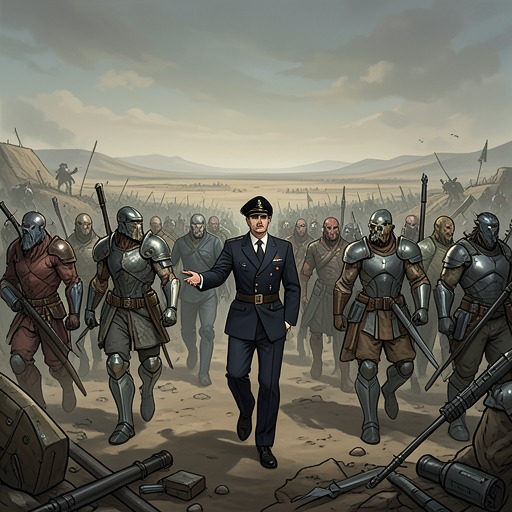
The Gogri Annexation Crisis
Systema Delenda EstThe Gogri Annexation Crisis is the System’s attempt to establish a staging area for annexing Gogri on Koh-rel, and Cato’s immediate effort to deny that foothold. Its decisive importance lies in the way a newly generated portal site exposes the limits of both sides: the System can create a military infrastructure almost instantaneously and protect it with high-rank divine power, while Cato can bring industrial-scale force, orbital weapons, and distributed production to a world that has only just entered the conflict. The confrontation therefore becomes more than a battle over one portal. It is the moment when Cato stops treating the System’s expansion as a sequence of local emergencies and begins answering it with coordinated pressure across many worlds.
Causes and Background
The crisis follows the removal of Haekos from the System. After Cato systematically destroys its dungeons and town Nexuses, the System’s essence cycle fails and Haekos disappears from the network entirely. The event demonstrates to Initik that the System is vulnerable through its infrastructure, but it also creates the conditions for the next annexation. A System notification announces that a new world is appearing: the Gogri staging area has been established on Koh-rel, inhabitants are to be tested, and the portal will open after seventeen hours. The recommended ranks range from Copper to Silver, presenting the operation in the familiar language of a quest even though its consequences are geopolitical and potentially planetary.
The staging area is not a preexisting settlement. An hour before the timer expires, Cato’s spy satellite observes the System clear a space roughly a dozen miles from a town in Koh-rel’s southern hemisphere. Trees and creatures vanish without ceremony, leaving a grassy circle a little over a mile wide. White System buildings, paved open pavilions, and the characteristic pylons then appear in a rough semicircle. The abrupt replacement of living terrain with standardized infrastructure makes the annexation look like an act of administrative manufacture rather than ordinary colonization. It also gives Cato a fixed target and a narrow window in which to act.
The Portal Conflict on Koh-rel
Cato responds before the portal opens. He cannot damage the portal itself, a limitation already established through earlier experience on Earth, so he attacks the staging area around it. Kinetic impactors launched from Sandkicker, one of his kiloton-rated railguns, strike minutes after the site appears. One projectile arrives approximately every thirty seconds, a deliberately conspicuous bombardment intended to deny the area to anyone attempting to gather there. Because the projectiles require four minutes to cross the distance, they can hit only a stationary target, and Cato cannot easily halt the firing once it has begun. Precision is not the objective; continuous destruction is.
The initial impactors eradicate the System buildings, although one pylon survives. Cato estimates that removing it would require a particle beam, but he does not risk committing that weapon before one of his own versions can pass through the portal. The System answers with a higher-rank member of Clan Tornok, who appears directly in the cratered staging area and produces a giant matte-white dome. Its surface behaves according to System-defying physics: incoming projectiles do not shatter it but skid away with most of their velocity canceled. The defense neutralizes not only later shots but also several already in flight, turning Cato’s sustained orbital fire into a demonstration of the System’s ability to impose protective rules over ordinary mechanics.
When the timer completes, Cato recognizes the moment as a point of no return for the world beyond the portal. His forces require another hour to reach effective range, after which he sends them down in large numbers. Drop pods make almost no attempt to slow themselves; inert shock-absorbing gel protects the organisms inside as the containers strike the ground above terminal velocity. Several thousand light scout frames descend around the dome, primarily to obtain accurate targeting data for particle-beam weapons rather than to destroy the shield by direct assault.
The first wave is annihilated by divine power. Cato nevertheless has enough forces for dozens of further waves, including a limited number of heavy warframes designed to launch themselves into orbit through a biological Orion drive. He possesses only a few hundred of these specialized frames, even with the bioforges producing more, but intends to commit all of them. The principle guiding the assault is explicit: there is no such thing as overkill when the objective is to establish a foothold against a protected portal.
The scout frames reveal that the dome has not merely protected the staging area. Beneath it, the System has reconstituted the site, restoring the blasted ground to something approaching its previous condition. The repair may amount to a reversal of entropy, or at least to the System’s ability to rewrite local material conditions. The defending Azoth, however, is not inside the dome. While lower-ranked inhabitants gather there, the Azoth waits on the far side of the portal and annihilates a scout as soon as Cato’s forces attempt to enter.
Strategic Escalation
The Azoth’s position creates the central tactical deadlock. Cato cannot aim a particle beam through the portal at a target standing outside its visible field, and his ground forces lack the power to defeat someone of that rank. The portal is therefore both the objective and the defender’s weapon: Cato must pass through it to reach the planet, while the Azoth can stand aside and kill anything that attempts the crossing. Cato also refuses to break the portal prematurely. Destroying the Koh-rel System might leave the newly annexed world without support, while further high-rank defenders could arrive to contest the site.
The crisis consequently becomes a question of scale. Leese points out that the portal chokepoint cannot be freed by a narrow assault alone; the wargaming simulations indicate that the System must be forced to worry about other regions. Cato decides that his forces are sufficiently distributed and that the Sydean Lineage lies well outside the immediate target area. He orders a message to his other selves and prepares to reveal what advanced technology can accomplish against the System’s assumptions. Rather than fight only at Koh-rel, he intends to create simultaneous emergencies across fifty planets.
This choice is enabled by years of exponential industrial growth. Cato’s Lineages have spread to hundreds of worlds, and each world has developed factories, mines, refineries, solar-panel fields, gas-giant atmospheric extraction, and frozen-asteroid volatile processing. Since portal travel cannot move forces meaningfully between worlds, each world has built its own armies and production base. A small fraction of that infrastructure makes weapons and warframes, while a larger fraction can be rapidly retooled for military production. The Koh-rel crisis thus reveals the military value of distributed industry: Cato does not need to transport one gigantic army through the portal when he can activate many local arsenals at once.
Technological and Systemic Stakes
The conflict also exposes the unusual compromise at the heart of Cato’s war. The System’s imposed physics disables most technology more complex than gears, and its interface can occupy a blank brain implanted in the crown of a warframe’s cranium. Cato would prefer conventional electronics, armor, and guns, but bypassing the ban requires biological construction. Titan’s geneticists exploit the ambiguity of the word organic: Cato’s chromosomes and acids use compounds associated with high-energy chemistry, his industrial womb grows bodies in space, and his cells fuse deuterium while his organs function more like machinery than natural anatomy. The warframes attacking Koh-rel are therefore not primitive substitutes for machines; they are machines redesigned as living systems so that the System cannot classify them as prohibited technology.
The same tension appears in Cato’s communications and mapping infrastructure. A System map is a thin flexible sheet between metal and glass that disintegrates without System support, yet an information pylon can flash it with a detailed download of terrain, cities, dungeons, conflict zones, faction control, mines, quarries, and farms. Cato regards the map as thorough but incomplete, covering perhaps a tenth of a planet’s landmass and lacking the satellite view he would prefer. His response is not to abandon System artifacts but to appropriate them while building independent orbital and biological tools around their limitations.
After months of silence, he reestablishes contact with Raine and Leese through the communications lizards they wear on their heads. The connection is imperfect and lacks worldwide range, but it restores coordination across separated fronts. Cato’s distributed selves, spy satellites, warframes, orbital weapons, and industrial worlds form a communications-and-production network that contrasts sharply with the System’s quest boards, pylons, Nexuses, and rank permissions. The Koh-rel conflict is therefore also a contest between two kinds of infrastructure: a centralized reality-management apparatus and a decentralized technological organism capable of multiplying without waiting for permission.
Consequences and Significance
The immediate result at Koh-rel is not a clean victory. The dome survives the bombardment, the first assault waves die, and the Azoth remains positioned where Cato cannot reach him. Yet the attempted annexation produces a strategic reversal. The System’s apparently game-like staging area becomes a vulnerable fixed point, while Cato’s inability to break the portal directly forces him to abandon the scale the System has chosen and impose a larger one of his own.
The crisis also clarifies the cost of future System collapses. When a planetary Nexus is destroyed, essence-supported lights, stores, towns, mountains, lakes, alien forests, and transplanted ecologies can fail or transform. Later remediation on Heyk shows that a collapse can leave a world nearly uninhabitable: massive flora die-offs reduce oxygen, while native bacteria cannot decompose alien biological matter. Cato’s campaign must therefore include not only bombardment and invasion but also biological factories, industrial restoration, and the reconstruction of atmospheric and ecological processes. The Koh-rel decision to escalate is made with that burden in mind, even as Cato accepts that delaying the conflict may allow the System to spread further.
At the political level, the crisis helps turn Cato from an isolated attacker into a system-wide threat. Misse Eln later finds evidence that Cato’s forces have reached every Inner World and the frontier, describing the spread as a disease rather than a series of opportunistic raids. She regards the frontier as expendable but cannot simply purge the Inner Worlds without revealing how deeply compromised the System has become. The secrecy surrounding that discovery is one of the crisis’s delayed consequences: Koh-rel proves that Cato’s artifice is not confined to the visible battlefield, and that the System’s own territorial categories no longer contain the war.
The Gogri Annexation Crisis therefore marks a tipping point in the conflict. A portal scheduled as a routine quest objective becomes the site of orbital bombardment, divine defense, biological mass deployment, and a decision to threaten fifty planets simultaneously. Its lasting significance is not that Koh-rel immediately falls, but that the System’s method of opening new worlds ceases to be strategically safe. Each new staging area can become a target, each chokepoint can trigger escalation elsewhere, and each local annexation adds pressure to a distributed industrial network that grows slowly until it can act everywhere at once.