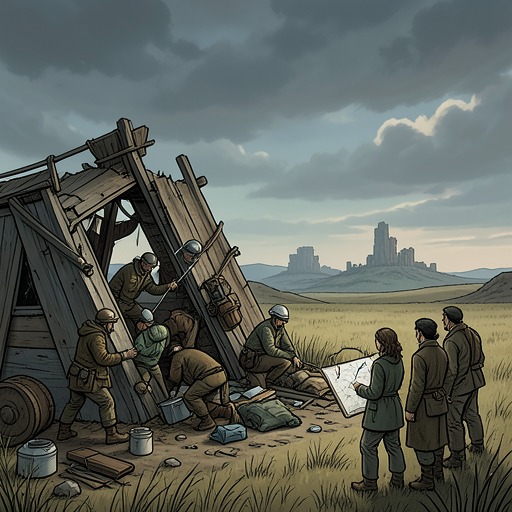
The Gogri Reconstruction Operation
Systema Delenda EstThe Gogri Reconstruction Operation is the large-scale relief and restoration campaign undertaken by Cato after the System collapses on Gogri. The operation begins amid worldwide ecological, technological, and social breakdown, then expands into a deliberately biomechanical attempt to restore food production and preserve the planet’s surviving civilizations. Its decisive significance lies in the burden it places on liberation: once the System disappears, Cato must replace the hidden biological and environmental services that had made System reality function, while persuading frightened inhabitants to accept help from machines they regard as alien and potentially catastrophic.
Causes and Conditions
The crisis follows a short-lived System incursion that reaches Gogri but is severed before the planet becomes fully integrated. Gogri’s inhabitants had been living in the middle of their age of sail when the System arrived. The planet contained hundreds of distinct cultural and genetic groups distributed across four major continents and several large archipelagos, yet the System apocalypse damaged every one of them. Fertile farmland was replaced by alien terrain, sailing ships were destroyed by sea monsters, foundries crumbled, mines collapsed, and hostile monsters appeared across settled and wild regions alike.
The consequences were uneven but universally severe. Hunter-gatherer communities lacked the population and organization needed to resist the sudden spread of dangerous beasts. The seafaring civilizations of the southern continent lost their supply chains, while their cities became death traps. The southernmost societies also faced the immediate pressure of winter: many had only a few weeks of stored food, and in some places nothing remained to forage or hunt because native plants and animals had been replaced by System life.
Gogri’s one advantage was that the System’s presence lasted only days. The connection was cut before the planet could be thoroughly established within the wider System, leaving Cato unopposed when the collapse occurred. That advantage did not mean the disaster was minor. The collapse removed an entire planetary support structure, and the populations left behind had not been prepared to live without it.
Biomechanical Response
Cato responds by using the full meaning of his postbiological technology. For the first time, he deploys his biological engineering as a planetary production system, spreading a massive biomechanical facility across the damaged region in a process likened to an uncontrolled gray-goo expansion. The version of Cato in orbit works in parallel on the local moon, allowing the reconstruction effort to proceed through distributed bodies and facilities rather than relying on a single headquarters.
Aircraft begin crossing the atmosphere and dropping biomass seeds over selected areas. The purpose is not merely to produce raw material, but to accelerate the exponential growth needed to manufacture enough food before the remaining stores disappear. Cato’s models indicate that the effort can barely prevent the worst starvation, but only if the inhabitants cooperate. The operation therefore joins industrial scale to a social problem that machines cannot solve automatically: food can be fabricated, but people must be convinced to accept it, cultivate it, and reorganize their lives around the new conditions.
Cato’s forces approach the surviving societies openly. Raine and Leese accompany him in their original bodies, heavily augmented but not disguised, because Cato does not want to deceive the natives about the nature of the visitors. Their frames are powerful enough to resemble main battle tanks, while the aircraft that carry them are quiet vertical-takeoff craft originally designed for movement inside O’Neill cylinder habitats. Cato lands near the battered palace of the largest remaining civilization, where guards form up beside the walls despite their unease. The scene turns technological intervention into a diplomatic encounter: the reconstruction cannot succeed through production alone, and Cato must negotiate with communities that have every reason to distrust machines arriving from nowhere.
The smaller civilizations nearest the incursion portal have often responded with outright hostility. Cato still intends to send them supplies, but their refusal makes distribution more difficult and exposes a central limitation of the operation. The same technology that can seed biomass across a continent cannot compel a population to regard its provider as a rescuer rather than another invader.
Ecological Remediation
Gogri’s emergency differs from a simple famine because the System has altered the planet’s biological foundations. Cato must restore food while managing dead and dying organisms introduced during the incursion. Alien life has replaced native flora and fauna, and the collapse leaves large amounts of biomass without the ecological relationships needed to process it. The operation consequently treats the planet as an interdependent system of atmosphere, organisms, terrain, and human settlement rather than as a collection of isolated supply problems.
The larger System collapse elsewhere demonstrates the dangers Cato is trying to prevent. On Sydea, the removal of System anchors causes lights and stores to lose power, while mountains crumble, lakes become muddy plains, storms appear and vanish, grasslands revert toward native life, and alien forests wither. On Heyk, massive plant die-offs threaten oxygen levels, while the absence of native bacteria capable of decomposing alien matter leaves weathered husks in place. These precedents make clear that the disappearance of System support can become an ecological chain reaction, and they explain why Cato’s reconstruction work includes biological manufacturing rather than food delivery alone.
The same concern shapes Cato’s wider planning for worlds such as Haekos. He expects ecosystem collapse to include the microorganisms responsible for oxygen production, while altered oceans and coastlines may produce consequences that cannot be predicted from the surface appearance of a planet. Gogri is therefore an early practical test of a recurring post-System problem: removing an oppressive artificial order may restore access to ordinary physics, but ordinary ecology must then be rebuilt deliberately when the System has replaced or destroyed the organisms that sustained it.
Political and Narrative Significance
The operation exposes the difference between ending domination and repairing its aftermath. The System had imposed game-like physics on Earth, produced monsters, and killed billions; Cato’s campaign against it is consequently framed as resistance to an intolerable order. Yet Gogri shows that the System’s departure can leave living populations facing starvation, ruined infrastructure, hostile creatures, and unfamiliar machines. Cato becomes both liberator and unwelcome authority, since the survivors may experience his intervention as another outside power even when it is intended to preserve them.
Raine and Leese’s presence gives the operation a human and relational counterpoint to its planetary scale. They observe the diversity of Gogri’s cultures and languages with amazement, recognizing that a single non-System planet can contain more imaginative variation than the entire System. Their perspective prevents the reconstruction from becoming only an engineering report: the world being saved is not an empty ecological substrate but a multitude of societies with distinct histories, bodies, and expectations.
The operation also establishes a recurring pattern in Cato’s war. His technological advantage permits rapid expansion, but success depends on time, communication, and local consent. On other worlds, he works through communication devices designed to avoid alerting the System; on Gogri, the immediate problem is not concealment but credibility. The reconstruction thus turns the campaign against the System into a test of whether Cato can create a livable alternative without reproducing the coercive relationship he opposes.
Gogri’s recovery remains precarious rather than triumphantly complete. The models promise only a narrow margin against mass starvation, hostile groups remain resistant, and the planet’s damaged ecological networks require sustained intervention. The operation’s lasting importance is therefore methodological: it demonstrates that the post-System future must be built through emergency production, ecological repair, and political negotiation at the same time. Cato can destroy the structure that made the catastrophe possible, but the Gogri Reconstruction Operation shows that freedom becomes meaningful only when the survivors can once again eat, breathe, inhabit their world, and decide what happens within it.