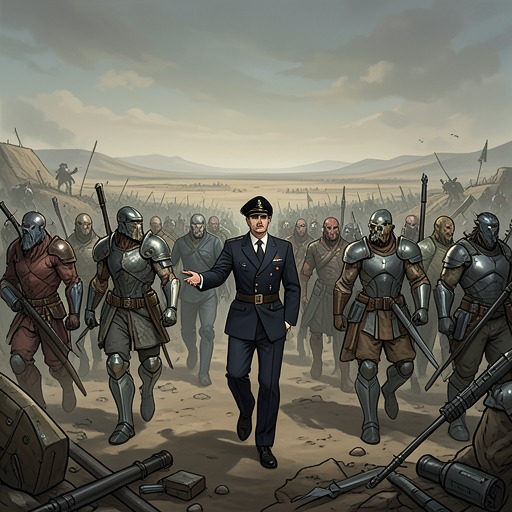
The Haekos Invasion
Systema Delenda EstThe Haekos Invasion is Cato’s emergency campaign to sever Haekos from the System before a newly announced portal can bring the System’s apparatus to another world. It is a decisive escalation in Cato’s war: rather than merely expanding his infrastructure or intervening selectively against local abuses, he attempts to destroy the System on a fixed deadline of three days. The operation combines industrial mobilization, orbital assault, non-lethal suppression, and planetary remediation, while forcing Cato to confront the possibility that saving a world may require inflicting enormous material damage on it first.
Causes and Strategic Context
The invasion begins when Leese Haekos reports that a new world will open through the Gogri Portal Staging Area in three days. Cato immediately recognizes the implication. A newly exposed world has little time to adapt to the System, and therefore offers something that older System worlds do not: the possibility of preventing an entire planetary apocalypse before it becomes entrenched. He orders the System on Haekos brought down rather than allowing another population to experience the fate of Earth or Sydea.
This decision extends the principle Cato declared earlier: the System is the distinct enemy, not the ordinary people trapped inside it. He insists that the System assigns the quests, imposes the essence economy, and turns survival into a losing game. His stated purpose is to remove the structure rather than punish its victims, but the Haekos operation tests whether that distinction can survive a real military campaign. When Raine asks what he will do if other humans stand between him and the System, Cato admits that he may have to fight them. He would prefer persuasion and non-lethal pressure, yet he refuses to let armed resistance preserve an entity that destroys entire planets.
The campaign also reveals Cato’s developing political responsibility. Destroying the System will not simply create freedom; it will remove the hierarchy that currently governs worlds and leave someone responsible for the replacement. Cato does not want to decide who controls planets or receives access to railguns, retroviral engineering, and digitization, but he concludes that abandoning those decisions would be worse. His intervention therefore carries the burden of state formation as well as military liberation.
Forces and Preparation
Cato has only three days to transform a long-term expansion program into a blitzkrieg. His infrastructure is still growing exponentially: mines feed factories, factories build machines, mass drivers throw multi-ton projectiles, solar fields spread across immense areas, and specialized facilities crowd the orbital space beyond Haekos’s moon. Worlds nearer the center of his expansion already possess fleets, supertankers of raw material, railgun platforms, particle-beam weapons, and hundreds of thousands of warframes. The frontier, by contrast, has comparatively little beyond its initial infrastructure, making the operation a race against logistics as much as against the System.
Raine and Leese provide the groundwork for the assault. Their reconnaissance gives Cato the exact locations of Haekos’s dungeons and towns, while the world’s roughly twenty Platinum-rank defenders, including its Planetary Administrator, are assigned special attention. Cato does not initially intend to destroy those high-rankers. Instead, he searches for ways to prevent them from interfering by exploiting the same kind of biological vulnerability that his warframes exploit against System protections.
Project Cringe embodies that preference for incapacitation rather than direct killing. The warframes carry overwhelming smells, unbearable sounds, and flashing light designed to destroy concentration, produce nausea, and force Haekosians away from an area. Cato tests the effects by inhabiting a Haekosian frame himself, confirming that the weapons are harrowing without causing lasting physical damage. Their purpose is temporary removal, not execution, although Cato recognizes that surprise and psychological shock will be weapons in their own right.
The invasion is coordinated across multiple versions of Cato. Messages pass rapidly as forces converge around Haekos, while one instance of Cato monitors the campaign inside a dedicated virtual environment and another manages the wider orbital effort. Raine takes increasing responsibility for commanding the thousands of small bio-drones, allowing Cato to handle strategic command, orbital weapons, and warframes requiring delicate control. Leese is more interested in repairing the biological damage left by the System than in the fighting itself, a division of labor that becomes essential once the offensive turns into an ecological emergency.
Course of the Offensive
Cato gives the order and the campaign begins, but the System responds with a weapon he had previously witnessed on Uriva. A full ten percent of his forces vaporizes in a single instant. Cato had known that System-jamming biotechnology might provoke such a reaction, but the earlier incidents had been too limited to establish how severe the response could become. He cancels the deployment of the remaining bioweaponry still in distant orbit, yet cannot recall the forces already committed to ballistic trajectories. Another ten percent will be lost simply because those units are already falling toward the atmosphere.
The losses force a change in doctrine. The original simulations had anticipated losses of more than ninety percent, and the revised projections appear even worse. Cato therefore shifts toward overwhelming mass, planning to make the System spend its defensive energy on expendable material. Extraction operations throughout the star system supply several thousand tons of raw material each day to bioforges beyond the moon, but fewer than sixty hours remain. The supply chain is growing, yet it cannot mature before the deadline, so Cato must attack with whatever mass has already been produced.
This reversal makes the invasion more heavy-handed than Cato wanted. The System’s gods have left many defenses to local individuals and have not fully hardened the true targets, whether from ignorance or inability. Cato sees that weakness as an opportunity, but he also maintains a distinction between the gods and the people below. The gods are responsible for the machinery of oppression and therefore deserve the brunt of his campaign; the inhabitants are victims whose survival he tries to preserve. That principle makes every objective harder, because a lethal solution would often be simpler.
Cato personally pilots a backup warframe aimed at the capital. The five-ton model is compact enough to enter System buildings, and its spun-graphene drogue chute slows the descent before specialized enzymes sever the chute from the frame’s bones. The scene reflects the operation’s hybrid character: an orbital invasion conducted through biological bodies, industrial materials, and weapons that must function inside the System’s imposed physics.
Ecological Stakes and Aftermath
The military assault cannot be separated from the consequences of System collapse. Cato expects the destruction of the System to produce total ecosystem failure, potentially including the loss of single-celled organisms responsible for oxygen production. The System has regulated atmospheres and concealed differences in pressure and composition across portals, but the physical universe does not guarantee that those conditions will survive its removal. Leese is especially concerned about Haekos’s oceans, whose coasts show extensive alteration and whose fate cannot be predicted from the earlier changes on Sydea.
The later collapse of the System on Heyk demonstrates the danger Cato is trying to anticipate on Haekos. Massive flora die-offs reduce oxygen levels, while native bacteria cannot break down the alien biomatter left behind. Without intervention, the world would become nearly uninhabitable within months. Cato’s forces therefore have to perform remediation on a planetary scale rather than treating victory as the moment when the last System structure falls. The invasion’s real endpoint is not conquest but the preservation of a functioning biosphere.
The earlier collapse on Sydea provides the campaign’s grim precedent. When its planetary Nexus is removed, towns lose essence and power, ordinary physics and native biology spread into regions once maintained by the System, mountains crumble or vanish, lakes become muddy plains, and alien forests wither. Storms erupt and disappear as the planet undergoes a kind of accelerated terraforming. Some transplanted life simply dies, leaving scars expected to last for years or decades even with biological factories prepared for reconstruction. Haekos appears more extensively altered than Sydea, making the cleanup more dangerous and less predictable.
Significance
The Haekos Invasion marks the transition from Cato’s personal resistance to a system-wide military and administrative project. His original declaration that the System must be destroyed becomes an operational doctrine: identify a threatened world, mobilize an industrial swarm, crash the System before its expansion can take hold, and then repair the reality left behind. The campaign also makes clear that victory cannot be measured only by enemy casualties or captured territory. A successful liberation must preserve inhabitants, prevent atmospheric and biological collapse, and create institutions capable of replacing the System’s authority.
The event further changes how the System’s ruling powers perceive Cato. Muar eventually discovers that Cato’s forces are present throughout every Inner World as well as the frontier, realizing that he is not an opportunistic skirmisher but a force that has spread into the System’s deepest political space. The Haekos operation is therefore both a rescue attempt and a demonstration: Cato can strike a world on a deadline, absorb catastrophic losses, redirect his tactics, and continue expanding while the System struggles to understand the scale of the threat. Its central irony is that the man fighting to free worlds must temporarily become their invader, bringing destruction from outside in order to prevent a more permanent destruction from within.