The Haekos Massacre
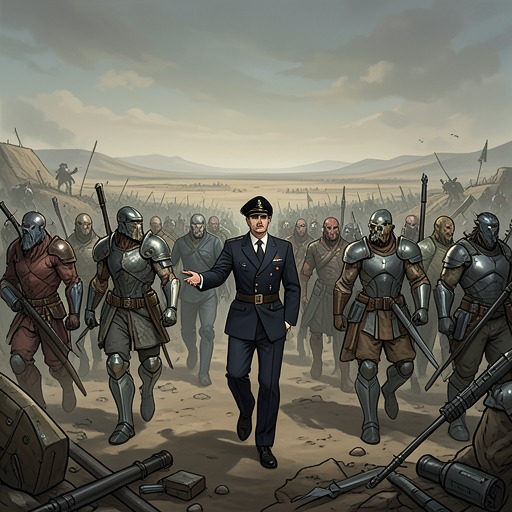
Systema Delenda EstThe Haekos Massacre, also known as Kosch's Shadow Attack or the Shadow Annihilation, is the moment when the Crusade against Cato reveals its most terrifying weapon. Kosch of Clan Renni, an Azoth associated with shadow, converts a thousand-mile circle around Haekos’s central city into absolute darkness and then leaves behind a moonscape of dust, bare rock, and ruined matter. The event is both a massacre of civilians and a demonstration of the System’s political order: ordinary worlds are treated as disposable terrain by powers whose conflict is fought at planetary scale. Cato’s immediate destruction of Kosch prevents the attack from becoming an unchecked victory, but it cannot undo the lives erased in the process.
Causes and Context
The massacre occurs during Cato’s attempt to sever Haekos from the System. Cato acknowledges that the operation itself is an attack, but he also understands the opening of a System portal as an apocalyptic threat to whatever civilization lies beyond it. His justification is therefore starkly consequentialist: allowing the portal to remain open could kill millions or billions, while destroying the System requires violence against people who are themselves victims of that system. The Platinum opposing him voices the obvious accusation that Cato is attacking them; Cato does not deny the charge, because the conflict offers no clean separation between liberator, aggressor, and victim.
The arrival of Kosch changes the scale of that dilemma. Raine identifies him as Kosch of Clan Renni, an Azoth who uses Shadow Affinity. Cato has previously encountered beings no higher than Bismuth, while the ranks above Bismuth are exponentially more powerful; footage from Earth had made the description of an Azoth as a walking nuclear bomb seem plausible. Kosch’s appearance confirms the warning. He is a pale, almost monkey-like figure in black armor that draws in light, with shifting shadows clinging to a body that moves with the unnerving ease of someone framejacked far beyond ordinary time.
Cato tries to prevent a confrontation. He tells Kosch that there is nothing for him in Haekos, that the world will be severed from the System, and that Kosch should leave before that occurs. Kosch rejects the warning as mere words. The gods have called a Crusade to stop Cato, he declares, and regards Cato’s forces as insects fighting insects. His contempt is not merely personal; it expresses the System’s hierarchy, in which an Azoth can look upon an entire frontier operation as insignificant because the world beneath the conflict lacks the power to resist him.
The Shadow Annihilation
Kosch demonstrates his answer by spreading his arms and releasing the shadows gathered around him. The first visible result is the loss of the warframe Cato is using to address him. The magical wave then expands across miles in moments, covering half a continent in less than a minute. From orbit, Cato observes a perfect circle of vantablack emptiness. The attack is not a conventional bombardment whose damage can be measured by ruined structures alone; it removes the visible world from the circle altogether.
The shadow eventually withdraws, leaving nothing behind in the area it covered. Cities, towns, dungeon entrances, and System buildings remain intact, but the living environment around them has been erased. Trees, bushes, grass, monsters, animals, and every person within the radius are annihilated. The surviving landscape resembles a moonscape: bare rock and earth, System structures standing as isolated remnants amid the absence of everything that had made the region inhabited.
The massacre’s selective pattern is as important as its total scale. The System buildings survive while the biological world does not. This contrast turns the attack into an image of System power itself: the institution’s infrastructure is preserved, while the people and ecology existing beneath it are expendable. The result is not simply military damage but a visual separation between the System’s durable apparatus and the fragile lives subjected to it.
The attack also exposes the limits of ordinary resistance. A Platinum convoy escapes by diving beneath the ocean and pulling refugees underwater, because the shadow absorbs light but does not block radio communication. Even those who survive cannot understand the event as it happens; the thousand-mile darkness merely writhes before retreating. Cato, by contrast, possesses digital memory precise enough to know exactly how many men, women, and children have been killed. His technological clarity does not make the loss abstract. It gives the destruction a terrible numerical certainty.
Cato's Retaliation
Leese is left nearly speechless by the devastation, while Raine responds with a grim-faced signal over the communications link. Cato answers not with another argument but by firing an orbital particle beam. Yaniss observes that Azoths do not trouble themselves with frontier worlds because only War Worlds can withstand them. Cato’s reply is that War Worlds—and Cato himself—are exceptions. The statement marks the immediate reversal of the massacre’s power dynamic: Kosch has shown that he can annihilate a continent, but Cato has a weapon designed to reach and kill him from orbit.
The orbital weapon is a monumental installation beneath a vast halo of solar panels, protected by layers of rock, ice, and metal. Its heat radiators spread from the surface like feathery antennae, and its structure bears the engraved phrase To Whom It May Concern. The particle beam requires thousands of square miles of solar arrays supplemented by fusion generators, as well as mechanisms capable of containing and focusing ionized nuclei without being destroyed by the energy they direct.
The beam is nearly a foot thick and crosses the roughly fifty thousand miles from orbit to the planet in a quarter of a second. In Cato’s framejacked perception, the emission itself is almost invisible except where it produces energetic flashes in stray gas. The weapon does not rely primarily on heat, pressure, or radiation. Its particles move with such energy that they collide with atomic structures, and the unending flood tears System matter apart at the atomic level. Even a being able to withstand the heat and pressure of a nuclear explosion cannot simply deflect a weapon that destroys the body through simultaneous atomic disassembly.
Kosch initially absorbs the impact for a moment or two, apparently using defensive skills to resist the point of contact. The atmosphere around him is stripped into ions as the beam passes through it. Cato’s orbital network tracks Kosch and prepares additional beams in case he teleports or moves beyond coverage, but no second strike is needed. Kosch vanishes in a flash consistent with the constituents of carbon-based life, and fire blooms outward where the beam reaches the ground. After a quarter-second, the beam stops, leaving scorched earth, broken rubble, and the capital city’s Nexus building as the only recognizable remnant.
Consequences and Aftermath
Cato experiences grim satisfaction at Kosch’s destruction, but it is immediately undercut by sickness at the scale of the collateral deaths. His embodied warframes register the devastation, while neural systems purge virtualized stress chemistry to prevent the reaction from becoming psychologically destructive. The emotional response matters because Cato is not allowed to treat the massacre as a clean tactical exchange. He knows the exact cost, and the knowledge makes Kosch’s next possible arrival a different proposition: Cato resolves that the next Azoth will not receive the benefit of the doubt.
The event therefore hardens Cato’s policy while preserving its central contradiction. He is fighting to prevent the System from carrying apocalypse into other worlds, yet his method of fighting can destroy populated regions; Kosch’s attack makes that contradiction unavoidable rather than theoretical. The evacuation of nearby towns before Cato’s kinetic strikes shows that he does attempt to limit collateral damage, but the Haekos Massacre demonstrates how little such precautions matter when a higher-ranked System combatant acts without restraint.
Its consequences extend beyond Haekos. Later Crusade notifications report that Sunac and Enksa have been considered lost to Cato and purified, granting essence to the Crusade. Those notifications place the massacre within a wider campaign in which worlds are converted into strategic verdicts and spiritual resources. Haekos is not an isolated atrocity but a preview of a war where planetary destruction, purification, and reward are tied together by the System’s incentive structure.
The massacre also foreshadows the final violence of the System’s inner regions. When Misse later sees the entire Core on fire, every surface turned into white-hot plasma while the True Core reflects the blaze, the imagery recalls Haekos’s transformation from living world to sterilized landscape, but on a still greater scale. Haekos shows what an Azoth can do to a continent; the burning Core shows the same logic reaching the center of the System itself. In both cases, the System’s structures and hierarchies outlast the ordinary lives caught beneath them—until Cato’s war finally begins to attack the structures as well as their inhabitants.