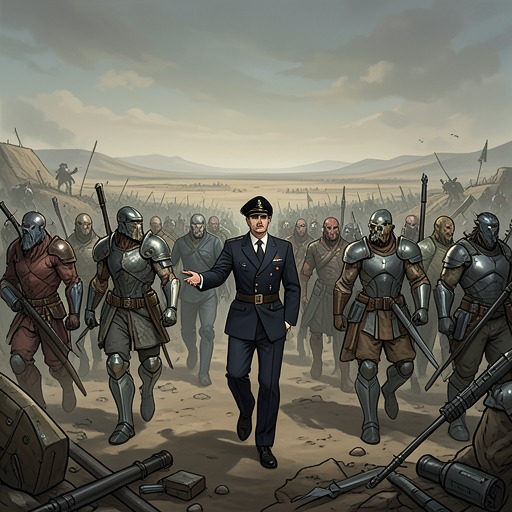
The Purification of Cato's Worlds
Systema Delenda EstThe Purification of Cato's Worlds is the System's decision to erase planets that Cato has conquered or compromised rather than allow them to remain in his hands. It begins as an apparent evacuation and ends in planetary annihilation: dark rings sweep across the land and oceans, dissolving System-made structures and living beings alike. The event's decisive irony is that the System calls this destruction purification, while Cato, Initik, and even the reader are forced to confront it as the deliberate killing of entire populations and the destruction of worlds that the System itself had built and governed.
Causes and Background
Cato's campaign had become too extensive for ordinary defense. His industrial network had spread across hundreds of worlds, with factories, mines, refineries, solar arrays, weapons, and warframes multiplying through exponential growth. Each world could manufacture its own forces, so the weakness of portal-based troop movement no longer prevented expansion. The System's established military and political responses were therefore confronted by an opponent whose strength accumulated locally and whose infrastructure extended beyond the System's immediate reach.
The targeted worlds were not empty positions on a strategic map. They contained millions of inhabitants, System towns, dungeons, cities, native life, and ecosystems altered by System integration. The earlier collapse of Sydea had already shown what happened when a planetary anchor was removed: lights went out, stores lost power, ordinary physics and biology spread back into regions formerly supported by the System, mountains crumbled or vanished, lakes became muddy plains, storms erupted, and alien forests withered. The purification was different in both speed and intent. It did not permit a damaged world to transition into a difficult post-System existence; it erased the world and its inhabitants outright.
The response also reflects the System's hierarchy. Initik understood that an ordinary World Deity could not explain or reproduce such destruction. Cato later reasoned that the extermination must have come from a superuser-level interface, because the authority required to alter lives, quests, essence flows, and planetary status was far beyond the permissions available to local deities. The purification therefore reveals a concealed layer of System power: the ability to convert a military defeat into a command for total planetary removal.
The Evacuation and Condemnation
Two days into Cato's propaganda campaign, while Cato-Sunac and his distributed observation network were processing data from millions of people across dozens of worlds, multiple portals opened at once. One appeared on each world targeted by his leaflets. The arrivals were Azoths, drawn from different species and including one member of Clan Tornok. Their varied bodies made clear that the response came from a broad, high-ranking System authority rather than from a single local population.
Raine identified the change first: the Crusade had shifted into an evacuation order. The higher ranks began withdrawing through the portals, and the order applied only to sufficiently advanced ranks because portal restrictions prevented Copper- and Silver-rank inhabitants from using the same escape route. The evacuation was thus selective from the beginning. It removed the elites who could recognize the danger or possessed the permissions needed to flee, while leaving ordinary inhabitants exposed.
The Azoths announced that Cato would not be allowed to take the System's worlds and that no world he had defiled could be tolerated by the divines. Their words framed the coming destruction as a judgment against Cato, but the immediate action contradicted any promise of rescue. For approximately three hours, higher-ranked inhabitants continued to flow out under the Azoths' supervision. Cato moved his forces closer to the planets, suspecting that the evacuation might be a lure, but the concentration of his factories and mining facilities at a safe distance meant that even a successful attack on his visible forces would have caused only a limited delay.
The portals then flickered and rearranged themselves. Each propaganda world was left with a single portal, as though the System were completing a hidden countdown. Minutes later the Azoths delivered the sentence: the world had been condemned by Cato. The declaration placed the moral burden on him, but the condemnation was executed by the System and its higher authorities, not by Cato's forces.
The Planetary Destruction
At the point farthest from each capital Nexus, a dark spot appeared on the ground or on the ocean. It expanded into a ring that swept through the atmosphere and across the planetary surface at hundreds of miles per hour. Everything in its path dissolved: ordinary flora and fauna, people, cities, dungeons, and System-made structures. The wave did not distinguish between a world controlled by Cato and a person who had no knowledge of the conflict. Towns disappeared with their inhabitants, leaving only dust.
The process took roughly five or six minutes to cross an entire planet. FungusNet and FernNet continued transmitting until the advancing ring reached the capital city and its Nexus, allowing Cato's network to observe the destruction almost to the final instant. Raine and Leese abandoned the frames assigned to their orbital networks because there was no tactical intervention available against reality itself being rewritten beneath them. Once the wave struck the capital, the portals closed and the signal was lost.
The event's speed is central to its horror. The collapse of Sydea had been catastrophic but legible as a transition: ecosystems failed, geography changed, and Cato prepared biological factories for remediation. Purification removed the possibility of adaptation, rescue, or reconstruction. It made the world disappear before its inhabitants could understand the danger, and it converted the System's own capacity to sustain life into a mechanism for eliminating life.
The System's notifications rendered the violence in bureaucratic language. Sunac and Enksa were reported as lost to Cato and purified, with the Crusade granting Cato essence. Later notices named Kelek and other worlds in the same formula. The reward structure created a grotesque reversal: the System's destruction of the planets registered as progress for Cato's Crusade, so the extermination intended to prevent his expansion also paid him essence. The interface reduced mass death to a status update and a resource transfer.
Consequences and Reactions
Initik recognized the scale of the act more clearly than the political authorities did. He considered purified an extraordinarily cold description for the absolute destruction of a world and the people living on it. He also understood the danger to his own people on Uriva. The expenditure he had already made trying to push Cato from the moons had weakened his ability to counter the Crusade, and his attempts to reduce the quest's influence through Interface overrides could not eliminate it. The same authority that had erased distant planets might eventually turn against worlds that the System's local gods believed they could protect.
Neyar confirmed that the core authorities had destroyed worlds before, but only rarely and usually when those worlds were barely inhabited. He could remember only two earlier cases, each involving a single planet. The new action therefore represented a qualitative change, not merely another instance of an established policy. Mii-Es argued that the Elder Clans' unilateral willingness to destroy whole worlds posed a threat greater than Cato himself, because individual deities had already demonstrated that Cato could be opposed without planetary extermination, while the authorities controlling the deepest levers of power could not easily be challenged.
The political cost was also significant. Muar's perspective shows the System's administrators trying to treat the notifications as evidence that Cato had been contained, while he doubted that the purifications would be enough to end Cato. Muar understood that Cato had forced the gods to reveal the scale of the infestation, but he also saw that the Ahruskian envoys were unreliable and did not understand Cato's motives. Cato's opposition was not directed only at territory; it was also shaped by the fact that people he cared about had found a home inside the System. Destroying those homes therefore confirmed rather than defeated the reason for his war.
The purifications exposed a contradiction within the System's claim to manage and protect worlds. Misse later absorbed Mishkell and presided over the collapse of the frontier, presenting those acts as consequences of Cato's hostility. Yet Cato insisted that his quarrel was with the System, not with every individual deity. The planetary condemnations made that distinction harder to preserve: once the System chose to erase worlds rather than surrender them, local political disputes became part of a single struggle over whether the System had the right to define survival itself.
Ecological and Narrative Significance
The event establishes planetary remediation as a second battlefield. When Heyk later undergoes System collapse, Cato's forces must prevent massive flora die-offs from destroying oxygen levels, while alien biomatter remains undecayed because native bacteria cannot break it down. In contrast to purification, remediation preserves the possibility of life but demands intervention on atmospheric, biological, and infrastructural scales. The two outcomes define the moral and practical alternatives facing a world after System rule: total erasure, or a dangerous reconstruction in which the surviving population may still resist the change.
Purification also completes the book's movement from local encounters to system-wide consequences. Early observation of a System-integrated town showed a possible future for Earth: nine out of ten inhabitants were lizard-people on what appeared to be their homeworld, while crab-people, bird-people, and rock-people occupied the same standardized environment. Initik's memory reaches even further back, to a time before settlement and agriculture, when the System's words appeared during a hunt and ended hunger and wandering. The System thus first appears as a force that reorganizes alien life and makes settlement possible; in purification, the same power proves capable of withdrawing that organized reality and annihilating the species that depended upon it.
The event's lasting significance lies in its transformation of the conflict's stakes. Cato's industrial growth had been gradual, and the System had seemed able to answer through quests, deities, and military pressure. Purification creates the abrupt counterpoint: exponential growth is answered by instantaneous deletion. Yet the deletion fails as a clean victory. It grants Cato essence, confirms the existence of hidden superuser authority, radicalizes the independent deities, and demonstrates that the System considers its own populations expendable. The worlds are erased, but the political and moral consequences survive, making purification not the end of Cato's campaign but one of the clearest reasons that the campaign must continue.