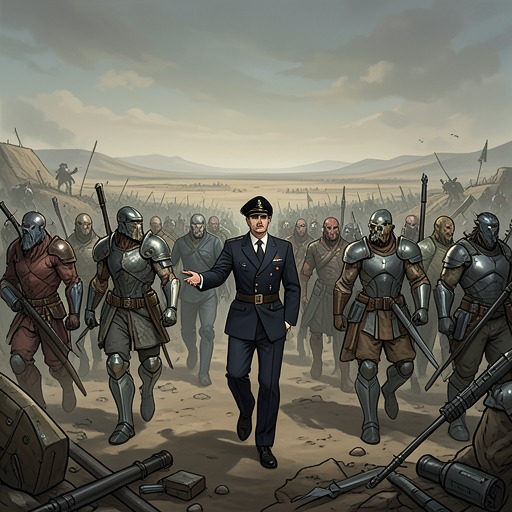
The Purification of the Condemned Worlds
Systema Delenda EstThe Purification of the Condemned Worlds is the System’s most extreme defensive measure against Cato’s spreading influence: the rapid sterilization of worlds judged to have been defiled beyond recovery. Its decisive significance lies in the reversal it exposes. The System claims to protect its worlds, yet its response annihilates cities, ecosystems, System-made life, and ordinary inhabitants alike. For Cato, the spectacle confirms the scale of the enemy he is fighting and forces him to confront the possibility that liberation from the System can itself become an apocalypse for those who have not chosen it.
Causes and Strategic Background
The purifications occur during Cato’s accelerating expansion. Exponential growth has carried his forces and infrastructure across hundreds of worlds, with factories, mines, refineries, solar arrays, weapons production, and Warframe construction distributed across independent industrial bases. The resulting threat is not a series of isolated raids. It is an infestation that can survive the loss of any one army because every world contributes its own forces and manufacturing capacity.
Cato’s campaign also targets the System’s political and psychological structure. He uses propaganda worlds and leaflet campaigns to reach populations that might otherwise know him only as a distant enemy, while his Lineages and industrial systems establish a presence beyond the immediate reach of the System. The System’s response is shaped by the Crusade, a Divine quest whose scope expands as the conflict spreads. For participants such as Muar, the Crusade supplies both purpose and reward: defeating Cato is not merely a military assignment but a System-defined path that draws higher-ranked defenders toward the threatened worlds.
The System’s own behavioral machinery intensifies the conflict. Completing quests and objectives produces pleasure, while the objectives themselves are written into the System’s reality, making compliance feel like the path of least resistance. The Crusade therefore operates simultaneously as command, incentive, and gravitational force. It gathers defenders against Cato even as it reduces their capacity to question whether the worlds they are defending can still be saved without destroying them.
The Purification of Sunac and Enksa
Two days after the leaflet operation begins, Cato-Sunac is monitoring millions of people across dozens of worlds when multiple portals open simultaneously, one on each targeted planet. The arrivals are Azoths: beings of varied species, including one member of Clan Tornok and several morphologies Cato has never previously encountered. Their appearance immediately triggers alarms, because portals opening across many worlds had previously been associated with divine or high-level intervention.
Raine reports that the Crusade has changed into an evacuation order. The change applies to higher-ranked participants, since portal restrictions prevent Copper- and Silver-ranked people from responding in the same way. Neither Raine nor Leese is invested in the quest, but the notification reveals that the System’s priorities have abruptly changed. The defenders are not being instructed to hold the worlds. They are being told to leave them.
The Azoths announce that Cato will not be allowed to take the System’s worlds and that any world he has defiled is intolerable to the divines. As they speak, higher-ranked inhabitants retreat through the portals into the greater System. Cato brings his forces closer to the planets, suspecting that the evacuation may be intended to lure him into a trap, but the greater part of his factories and mining facilities remains at a safe distance. Destroying the forces already near the planets would delay him, not end his campaign.
For roughly three hours, the higher ranks continue to withdraw under the Azoths’ supervision. Then the portals flicker and reorganize until each targeted world has only one portal remaining. After a concealed countdown, the Azoths declare that each world has been condemned by Cato. The accusation turns Cato’s presence into a legal and metaphysical sentence: the worlds are no longer treated as territories to defend, but as contaminated objects to remove.
A dark spot appears at the point farthest from each capital-city Nexus, on land or ocean. It expands into a ring sweeping across the atmosphere and surface at hundreds of miles an hour. The wave leaves dust behind and dissolves everything in its path: living beings, ordinary flora and fauna, System-made creatures, cities, and dungeons. It does not distinguish between Cato’s creations and the populations that had never consented to his intervention. Towns vanish with their inhabitants, while the approaching ring advances toward the capital and its Nexus.
The destruction is completed in five or six minutes. FungusNet and FernNet continue transmitting until the wave reaches the capital cities, including the unsuspecting Coppers and Silvers who have received no meaningful warning. Raine and Leese abandon their orbital-network Warframes because no tactical action can oppose reality itself turning against the worlds. The portals close, and the signals are lost.
Planetary Erasure as System Policy
The Crusade registers the result as a victory. Notifications state that the world of Sunac has been considered lost to Cato and purified, then deliver the same judgment for Enksa while granting essence to the quest participants. The language is clinical and rewarding: annihilation becomes purification, and the destruction of a population becomes progress within the System’s economy.
Muar understands that Cato has forced the gods to act, but he doubts that destroying selected worlds will be enough to end him. The purifications reveal the full seriousness of Cato’s spread without eliminating its source. They also expose a conflict in the System’s notion of defense. World-purging may be useful against an isolated independent god or a politically disposable world, but it becomes untenable when every important world shows signs of Cato’s presence.
This dilemma later becomes explicit in the consideration of the Inner Worlds. Once it is known that both the frontier and the Inner Worlds are compromised, the frontier can be abandoned because its resources are comparatively limited. The Inner Worlds cannot be condemned so easily. They are too valuable, and purging all of them would expose the failure of the campaign’s assurances. The secrecy surrounding the revelation demonstrates that purification is not merely a weapon; it is also a political admission that the System can no longer guarantee the integrity of its own territory.
Contrast with Cato’s System Severance
The purifications gain their horror partly through contrast with the changes that follow the removal of System anchors on Sydea. When a planetary Nexus is destroyed, System power disappears from towns, lights go out, stores shut down, and ordinary physics and biology spread into spaces previously sustained by System essence. Mountains crumble or vanish, lakes become muddy plains, storms appear and disappear, and alien forests wither. Yet this collapse leaves a damaged world rather than an instantly empty one. Cato prepares biological factories and later undertakes remediation, even though the transition kills transplanted life and leaves scars that may persist for decades.
The distinction is ethically unstable but narratively important. Cato’s severance produces catastrophe through uncontrolled ecological transition; the System’s purification produces catastrophe through deliberate erasure. On Heyk, the aftermath of System collapse nearly makes the planet uninhabitable: massive flora die-offs threaten oxygen levels, while native bacteria cannot break down alien biomatter, leaving dead organic material to accumulate. Cato’s forces respond with large-scale intervention because survival requires rebuilding atmospheric, biological, and agricultural systems. The condemned-world operation offers no such interval of recovery. It removes the world before recovery, resistance, or consent can matter.
Cato’s own relationship to destruction is not innocent. Earlier, killing a quest creature causes the System to push essence into his body, and the pleasurable sensation disgusts him because it reveals how the rank structure manufactures murderous behavior. His expansion likewise depends on industrial growth and the conversion of worlds into production bases. The purifications therefore do not place a wholly destructive System opposite a wholly restorative Cato. Instead, they turn competing forms of systemic violence against one another: reward-driven killing and expansion on one side, administrative sterilization and divine condemnation on the other.
Narrative and Thematic Significance
The event marks a change in scale. Earlier conflicts can be understood through individual battles, portals, anchors, or cities; the purification makes the planet itself the unit of action. A dark ring crosses an entire world in minutes, while the characters can only watch through orbital views and failing communications. The scene’s power comes from the mismatch between human-sized perception and planetary-sized consequence: a single change of color on a global display represents every visible landscape being replaced at once.
It also gives literal force to the idea that the System is a lack of choice. The inhabitants of Sunac and Enksa are not offered evacuation, negotiation, or a chance to distinguish themselves from Cato’s infrastructure. Higher ranks are removed, lower ranks remain uninformed, and the condemned worlds are erased according to a decision made elsewhere. The System’s promise of direction and meaning becomes indistinguishable from imposed judgment when the same machinery that grants quests and rewards can declare an entire world guilty.
The purification further destabilizes the language of healing. Terms such as contamination, defilement, and purification suggest a medical or religious operation, but the actual procedure is planetary extermination. The System treats ecosystems, cities, dungeons, and persons as interchangeable signs of infection. Cato’s later remediation, with its attention to oxygen, microorganisms, dead biomass, crops, and altered oceans, exposes what the System’s abstraction suppresses: a world is not merely a node, a Nexus, or an essence reserve, but a layered ecological and social reality whose destruction creates consequences that no notification can contain.