The System Crash
Systema Delenda EstThe System Crash is the decisive end of the System and the culmination of Cato’s war against its reality. What begins as a planetary-scale attack becomes a prolonged drain on the System’s resources, then a desperate contraction of its surviving structure, and finally an astrophysical catastrophe that removes the True Core from ordinary reach. The event destroys the institution that had regulated worlds, deities, environments, and mortal lives, while leaving Cato’s preparations and the liberated worlds to survive the aftermath.
Causes and Strategic Background
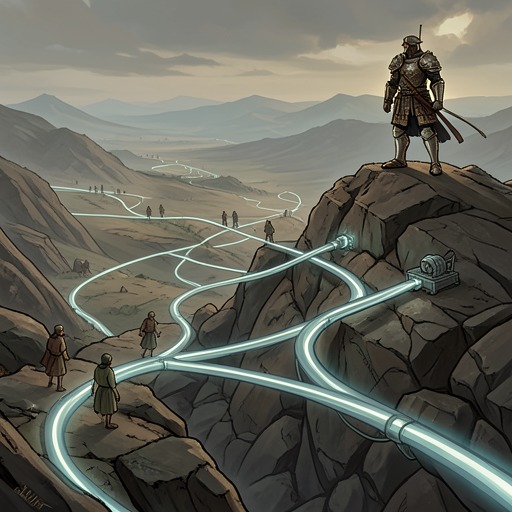
The crash is the result of a conflict that had grown beyond raids or local rebellion. Cato had spread his production base across hundreds of worlds, using factories, mines, refineries, atmospheric extraction, frozen volatiles, and vast solar arrays to turn industrial growth into military capacity. This exponential expansion gave each world its own armies and manufacturing systems, even though portal logistics remained limited. The System’s rulers initially treated Cato as a problem that could be contained or concealed, but Misse Eln eventually learned that his forces had reached every Inner World as well as the frontier. The discovery made ordinary world-purging politically and materially impossible: sacrificing one compromised world might be acceptable, but condemning every valuable Inner World would expose the failure of the campaign and destroy confidence in her rule.
Cato’s stated quarrel was with the System rather than with every deity personally. When he confronted Misse Eln, he rejected her attempt to define the conflict as a private attack on her authority. That distinction mattered because the crash was aimed at the infrastructure and rules that made the System dominant, not merely at one faction within it. The final operation therefore attacked the System’s capacity to sustain itself, turning its own dependence on essence and protected anchors into a vulnerability.
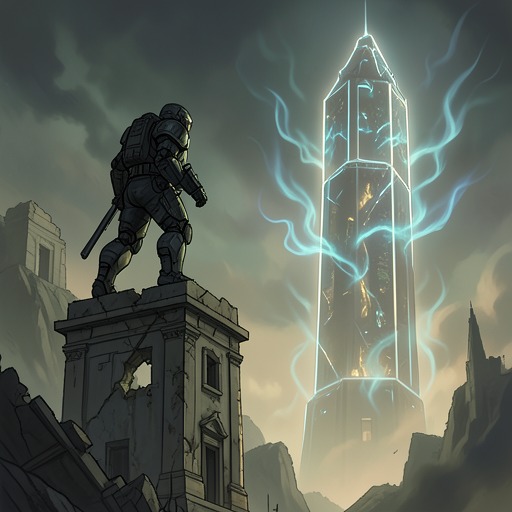
The operation also followed the pattern established on Sydea. There, the first disruption appeared when the thirty-first dungeon closed: System displays began fading in and out for warframes on the eastern hemisphere, with no explanatory error message. Cato then destroyed System Nexus pylons, beginning in the east where the System was already failing. Korek Town experienced the first complete local crash after its pylon was pulverized. Monsters vanished, colors changed, and portions of the landscape dissipated as the esoteric reality imposed by the System gave way.
The destruction of additional anchors caused a wider retreat. Towns lost essence, lights and stores shut down, and ordinary physics, biology, and ecology spread into areas that had been System-supported. Mountains crumbled or disappeared, lakes became muddy plains, invasive forests withered, and storms erupted in a final period of chaos. Cato’s earlier experience made clear that removing the System was not a clean restoration: transplanted organisms could simply die, leaving ecological scars and threatening the atmosphere. On other worlds, the aftermath required emergency remediation, including intervention against massive plant die-offs, collapsing oxygen levels, and alien biomatter that native bacteria could not decompose.
The Final Assault on the Core
The decisive assault began with a blinding attack that Misse Eln witnessed through a scry-view. The entire Core appeared to be on fire, but the phenomenon was far more extreme than ordinary combustion. The air across every surface in the Core became glowing, white-hot plasma, as if each planet had been turned into a sun. Even the True Core reflected the light. Azoth-ranked materials and powerful individuals could resist, but doing so consumed essence, and the System’s total reserves began to fall for the first time since Misse had severed the frontier.
The attack was not an instantaneous strike that could be endured and forgotten. Weeks into the crisis, Misse recognized its method as a long bleed designed to drain the System until it became helpless. Muar understood the immediate military implication: the weapons had to be found and destroyed. Yet searches by Alums carrying portable Nexus crystals could not locate the sources. The attack seemed to have altered reality itself, producing columns of incomprehensible energy throughout the Core. Cato’s distant weapons were therefore effective not only because of their destructive power but because their origins remained inaccessible.
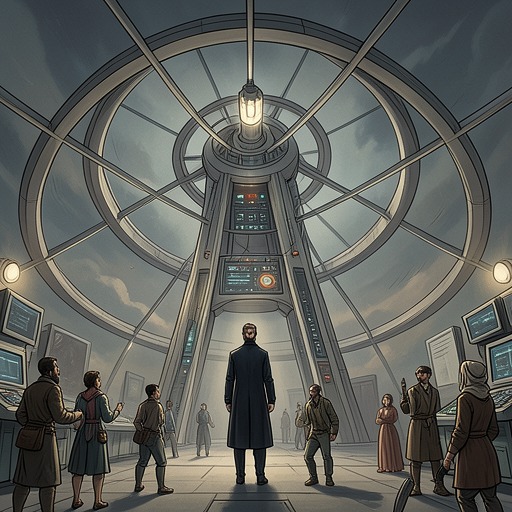
Misse attempted to preserve the Core by moving the Core Worlds into Estate spaces. More than a hundred worlds were removed from their positions above the War Worlds and placed inside private dimensions within Deity space, while the populations of the War Worlds were relocated into mortal-grade areas. Muar then restricted the System’s influence, and the System withdrew to the True Core. The essence drain stopped temporarily, apparently proving Misse’s belief that the weapon had been neutralized.
The apparent success was a trap or, at minimum, an incomplete reading of the assault. Once the War Worlds were separated from their former arrangement, ordinary physics resumed around them. A hundred suns were suddenly placed so close together that gravity took hold. At the same time, the System issued warnings, accelerated Misse and Muar into fast-time, and revealed that essence was still vanishing rapidly. The attack had not ended; the reorganization had merely exposed the System to a deeper stage of the crisis.
Contraction and Extinction
Misse and Muar responded by pruning everything they could. Other Inner Worlds were abandoned, the Estates of less important gods were discarded, and the gods were designated for later resurrection if sufficient resources survived. Misse cut away structures and populations outside the True Core while Muar removed mortal estates, lesser gods, and his own possessions. The logic of preservation became indistinguishable from liquidation: anything not essential to the Font of essence was converted back into fuel.
The contraction reached Misse personally. Her own world had to be sacrificed and returned to essence. The former Core Worlds, the clans, and even her father were discarded. Muar severed the estates that contained mortals and lesser deities. By the final stage, nothing remained of the System except Misse, Muar, the True Core, and the Font of essence. The ruler who had treated worlds as administrative and political units was forced to reduce the entire civilization she commanded to a shrinking reserve of energy.
Misse’s final gesture toward Muar gives the collapse its most intimate human scale. With nothing left to discard, she reached out and took his hand while the Font ran dry. The last essence disappeared, and the System disappeared with it. The event is therefore both a military defeat and a dissolution of the governing relationship that had defined existence for its inhabitants. The System does not merely lose a war; it consumes its own worlds, servants, estates, and history in an attempt to remain alive, only to exhaust the resources that made its survival possible.
Cosmic Aftermath
The System’s disappearance immediately produced a supernova at its heart. The event confirms the physical cost of a structure designed to circumvent ordinary reality, deny death, and resist the universe’s ultimate limits. The System had been extraordinarily powerful, but its architecture could not permanently evade phenomena such as stellar detonation or singularity formation.
A black hole formed almost directly over the True Core. Its gravity seized the System’s anchor and drew it away from the universe, enclosing it behind a gravitational well that ordinary physics could not cross. The surviving works and former Core Worlds exploded outward as high-energy dust, creating the material seed of a nebula that would take thousands of years to form. The destruction thus transforms the System from an active institution into an inaccessible remnant and a future astronomical structure.
The blast front expanded across light-years, but Cato had anticipated the possibility of such a catastrophe. Nearer worlds housed servers in deeply protected facilities behind layers of ablative shielding; more distant worlds were protected by enormous umbrella-like structures that reduced the radiation to auroras and brilliant nights. The shockwave still shredded the fragile mirrors of the Nicoll-Dyson swarms, destroying humanity’s largest weapons, but their purpose had already been fulfilled. Telescopes recorded the destruction for fractions of a second before being obliterated, while the various versions of Cato sheltered from the aftermath.
Consequences and Significance
The crash fulfills the liberation promised on Sydea. When its final dungeon and remaining portals vanished, inhabitants could leave their towns without facing monsters, look into the sky without fear of winged predators, and imagine futures not limited to combat or the whims of godlings. Sydea became subject to ordinary physics and could establish civilizations based on art, architecture, philosophy, science, and eventual expansion among the stars. That earlier planetary collapse functions as a smaller-scale model of the final event: freedom arrives not through gentle reform but through the violent removal of the reality that had enclosed the world.
The broader consequences are more complicated than simple emancipation. The System’s retreat can erase monsters and artificial landscapes, but it can also destroy transplanted life, destabilize geology, collapse ecosystems, and remove the biological processes needed to sustain oxygen and recycle dead matter. Haekos demonstrates the danger sharply: its collapse left the world nearly uninhabitable, with flora die-offs threatening oxygen levels and alien biological remains accumulating because native bacteria could not break them down. Cleanup and remediation therefore become part of the victory, not an afterthought. The end of System control creates the possibility of genuine civilization only if survivors can rebuild the physical and ecological foundations that the System had been silently maintaining.
The event also completes the book’s central reversal. The System had presented its rules, quests, anchors, portals, and essence economy as the stable conditions of life, but its stability depended on continuous extraction and centralized control. Cato’s campaign exposes that dependence by attacking anchors, expanding industrially beyond the System’s assumed limits, and forcing the governing powers into impossible choices. The collapse moves from slow disruption to sudden planetary change, from planetary change to a long strategic bleed, and from that bleed to total cosmic failure. Its final words, “Systema Deletum Est,” mark not merely the end of a regime but the destruction of the artificial order that made its domination appear natural.
The campaign is finished, but the work of living after it has only begun. Cato’s victory removes the System; it does not automatically restore every ecosystem, repair every world, or reconcile every surviving society to the loss of familiar rules. The crash is consequently both an ending and a threshold: the annihilation of a constructed universe’s authority, followed by the difficult emergence of worlds that must govern, heal, and understand themselves without it.