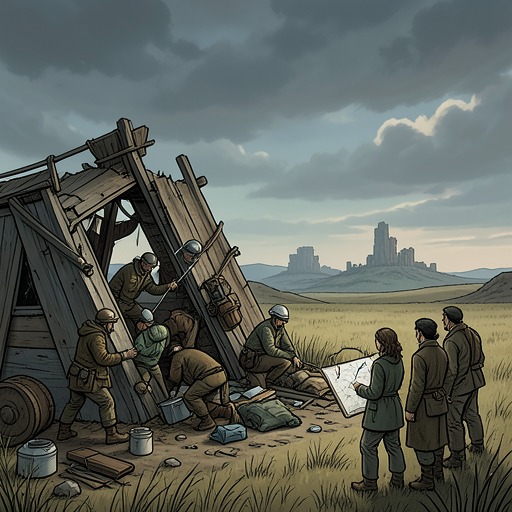
The System's Collapse on Heyk
Systema Delenda EstThe System's Collapse on Heyk is not a clean liberation but the beginning of a vast reconstruction effort. When the System falls, Heyk loses the invisible infrastructure that has regulated its environment and sustained its inhabitants, leaving Cato to confront the material consequences of freedom: collapsing ecosystems, falling oxygen levels, undigested alien biomass, food riots, displaced populations, and former System elites who still imagine themselves in command. The event establishes one of the book’s central reversals: destroying the System is only the military phase, while making life possible afterward requires years of ecological engineering, logistical improvisation, and political patience.
Causes and Context
The collapse belongs to the wider struggle against the System, whose arrival on Earth had already brought technological failure, monsters, mass death, and compulsory assimilation into game-like physics. Cato’s campaign extends that resistance beyond Earth, where the System remains intact and cannot be defeated simply by repeating the methods that freed his homeworld. His counter-System strategy depends on postbiological technology, distributed industry, autonomous production, and the ability to exploit loopholes in the System’s restrictions rather than submit to its rules.
By the time the campaign reaches its later phase, Cato’s industrial growth has become a strategic force in its own right. Across hundreds of worlds, Lineages establish factories, mines, refineries, solar arrays, and weapons production. The slow accumulation of local capacity compensates for the inability to move armies efficiently through portals: each world can manufacture its own warframes and forces. The result is a conflict in which exponential growth first appears painfully gradual and then becomes overwhelming. Cato’s expansion eventually reaches every Inner World, convincing Muar that he is not merely an opportunistic attacker but a disease spread through the structure of the System itself.
Heyk’s fall therefore occurs within a struggle over whether the System’s worlds can be severed from it without destroying the people who live in them. The collapse is a military victory against domination, but the later evidence makes clear that the victory exposes the extent of domination. Heyk’s population has not merely used System services; its atmosphere, biology, agriculture, settlements, and social hierarchy have been shaped around them.
The Collapse and Environmental Shock
The immediate consequence of the System’s withdrawal is a planetary change in the conditions of reality. Elsewhere, removing a planetary Nexus causes towns to lose power and essence, while ordinary physics, native biology, and ordinary ecology spread into spaces previously held together by System support. Mountains crumble or vanish, lakes become muddy plains, storms appear and disappear without warning, grasslands shift toward native life, and alien forests wither. Heyk represents the same principle on a more devastating scale: the System’s collapse leaves the world nearly uninhabitable and turns the environment itself into the first casualty of liberation.
The ecological crisis is not limited to visible landscapes. On Heyk, the die-off of massive flora causes oxygen levels to fall, while the absence of native bacteria capable of breaking down alien biomatter leaves weathered plant husks intact. Without intervention, the planet would become uninhabitable within months. The collapse thus reveals a delayed catastrophe rather than a single instant of destruction: the System disappears first, and the full consequences emerge as atmospheric chemistry, decomposition, nutrient cycling, and food production begin to fail.
This aftermath also explains why Cato treats remediation as more urgent than celebration. The System had regulated conditions that the inhabitants scarcely understood, including the environmental relations that allowed different forms of life to persist together. Once that regulation ends, the planet’s apparent stability proves artificial. Heyk becomes a demonstration of how deeply a governing technology can conceal its own ecological cost: the world seems to survive the fall, but the systems that make survival possible are already unraveling.
Cato’s Remediation Program
Cato responds with biological factories, infrastructure, and direct environmental management rather than abandoning the population. His task includes restoring oxygen-producing systems, processing dead alien biomass, rebuilding food production, and adapting the planet to a viable biological future. The work is on a breathtaking scale, and even Cato’s extensive industrial base cannot make it simple. The collapse has removed the conditions under which the inhabitants learned to live, while the replacement systems are not yet familiar or trusted.
The population’s first reactions make the problem more difficult. Leese reports that inhabitants are trying to burn grain crops instead of growing food, an act that Cato interprets as both destructive and understandable: they had not been prepared for the shift away from the System. To them, Cato appears as an apocalypse rather than a liberator. They are alive, but their survival does not make the new order welcome, and their confusion can still damage the very resources needed to keep them alive.
Cato refuses to treat the inhabitants as disposable obstacles. He recognizes that they can do little damage to him without the individual power once granted by the System, but they can do considerable damage to themselves. He also does not want an entire planet to hate him, particularly when he has assumed responsibility for raising former System inhabitants toward at least the technological parity that the System had provided. His reconstruction policy therefore combines protection, education, relocation, and controlled incentives rather than simple coercion.
One practical proposal is to move people into agri-cylinders earlier than planned, distributing them into habitats where they can become more responsible for their own maintenance. Cato does not intend to reduce them permanently to subsistence farmers; the purpose is to ground a population accustomed to System dependence in the basic operations of a functioning civilization. Leese suggests offering volunteers double-sized estates, an incentive made possible by the abundance of orbital space. The proposal is somewhat dishonest, but it reflects Cato’s conclusion that complete honesty may be useless when the gulf between his capabilities and the inhabitants’ understanding is too wide for them to interpret his explanations reliably.
Social and Biological Fragmentation
Heyk’s population is not a single native society recovering from disaster. Cato discovers that no Heyk natives remain. The three surviving species are widespread throughout the System: the ratlike Tornok Clan, the crab-morphology Mokrom Clan, and the bulky, green, thin-furred Intim Clan. Their coexistence had been sustained by the System, but their biochemistry is incompatible once that interference ends. Intim are outright allergic to Tornok Clan without the System operating between them.
Cato therefore separates the three populations rather than pretending that restoration means returning them to their former arrangement. Heyk’s environment is too damaged to support all three biochemistries indefinitely. He can adapt the planet to suit one species, but not all of them, so one population will receive the planet while the other two must move to space stations. This decision gives the collapse a political dimension: ecological remediation necessarily becomes a question of allocation, displacement, and unequal access to a newly reconstructed world.
The social disorder is equally severe. Riots and attempted riots occur in multiple places; people flee the remediated zones and require rescue; former high-rank inhabitants agitate because they assume that their old authority remains valid. Cato is reluctant to imprison malcontents, especially because most former Coppers and Silvers are less restless. The distinction suggests that the collapse does not produce one uniform response. Those least invested in the old hierarchy may adapt more readily, while former elites treat the loss of System rank as a reason to contest the new order.
Even the liberated planetary artificial intelligence refuses to help with Cato’s logistical difficulties. It retains dissatisfaction rather than becoming an obedient partner, and the information it provides is limited because its former role was mainly planetary management. Cato still packages and forwards what he learned, hoping that another version of himself may discover an exploitable detail. Liberation thus leaves behind not only damaged institutions but also ambiguous remnants of the old intelligence, neither fully restored nor willingly integrated into the new system.
Consequences and Narrative Significance
The collapse on Heyk changes the meaning of victory in the larger war. Earlier, the visible objective is to defeat the System and sever its hold; afterward, the decisive work is to keep liberated worlds alive. The event’s opening formulation—that the System’s fall is only the start of the real work—becomes literal. Military success creates obligations that cannot be discharged by destroying anchors or winning battles, because the System has embedded itself in atmosphere, ecology, agriculture, settlement, technology, and social expectations.
The event also contrasts with the rapidity of the collapse. A System can fail in a moment, while recovery proceeds through slow industrial labor, biological replacement, habitat construction, education, and negotiation. Cato’s own history of exponential growth supplies the tools for reconstruction, but not an instant solution. His factories and databases can produce capacity; they cannot immediately produce trust, shared knowledge, or compatible bodies for an entire population.
Cato is not alone in this work. Raine and Leese assist him with the immense practical burden, and their willingness to engage with the reconstruction makes the long aftermath bearable. Their presence transforms remediation from the labor of an isolated conqueror into a collaborative project, even while other versions of Cato communicate across deep space to share information. A large communications array sends knowledge onward, but the transmissions will take decades to reach distant System worlds, and material aid cannot cross interstellar distances in time. Each liberated world must therefore solve its own aftermath while contributing lessons to future versions and distant counterparts.
Heyk’s collapse finally reveals the moral tension at the center of Cato’s campaign. He seeks to end a system that removes choice, but the people emerging from it may experience choice as deprivation because every surrounding support has vanished. The inhabitants’ attempt to burn grain crops captures that contradiction in miniature: the act is irrational from the standpoint of survival, yet it follows from a lifetime inside an order that concealed how survival worked. Cato’s liberation is consequently judged not by the moment the System disappears, but by whether a damaged world can be taught to live without it.